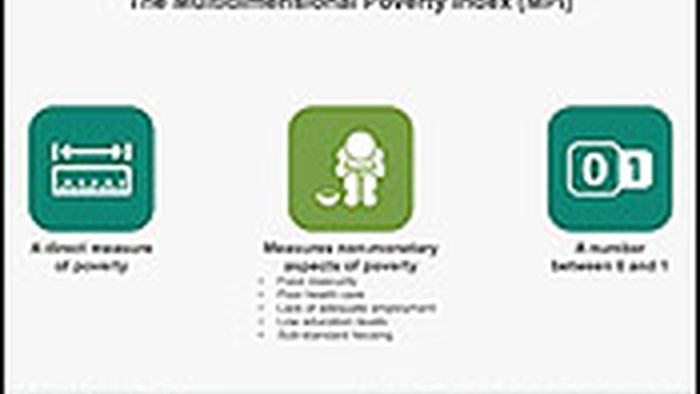
It's well known and oft-lamented that over half the country falls below the poverty line, but while a lot of those households are monetarily poor, only 35% of them are not able to meet their basic needs.
These numbers were presented today by the Statistical Institute of Belize and are a result of their Multidimensional Poverty Index. It's a new analysis of poverty in the country, which looks at more than just the amount of money a household is earning. This now allows statisticians and policy makers to have a more clearer view of what poverty actually looks like on the ground.
But how exactly did the study work? Courtney Menzies has a breakdown of SIB's method and findings.
For decades, poverty has always been measured in terms of money - how much a household earns and whether it's enough to meet their basic needs.
But in 2021, the Statistical Institute of Belize embarked on a new kind of study and today presented results for the Multidimensional Poverty Index.
MPI is a different way to measure poverty - rather than looking at cash, it considers poverty in a more broader sense, particularly whether a household is being deprived of specific basic needs.
Diana Castillo-Trejo, Director General, SIB
"What we did was we collected data to assess whether or not households were meeting 17 basically needs represented by 17 indicators and using those we were able to divide our households into those which were multi dimensionally poor, meaning that they have a certain number of accumulated deprivations, one on top of the other that qualify them according to our classification as being multi dimensionally poor."
"We covered four dimensions which we considered to be important to wellbeing. These dimensions are health, education, employment and living standards. Under health, you have your things like your quality of the drinking water, access to health services, under education you have whether or not children of school age are attending school, whether or not children of school age are lagging behind the grade they're supposed to be in. For living standards, we look at the quality of housing materials, the type of assets that they have, and under employment, we look at persons being unemployed, persons being informally employed, persons being under employed in the household."
So, while in the last 2018 study of monetary poverty, it was discovered that 52% of Belizeans fall below that line, only 35.7% are actually multi dimensionally poor.
That translates to over 31,000 households, or over 133,000 persons whose basic needs are not being met in terms of health, education, employment and living standards are not being met.
Trejo explained the difference between the two:
Diana Castillo-Trejo, Director General, SIB
"One tells you about the household's access and command over money resources and the other one tells you about the household's ability to actually meet and whether or not these basic needs are actually being met on the ground in practice."
For example - a farmer in the south may not have a large income, but he is able to feed his family and send his children to school.
And according to the index, the largest number of multidimensionally poor persons - over 30,000 - live in Cayo, while Toledo - the district often considered the "poorest" - has the least number at over 18,000.
However, the study also found that in terms of ethnicities, Mayas had the largest intensity of poverty, meaning multiple needs were not being met.
And that's why the prime minister said that the MPI has been a long time coming since it gives the whole picture of what poverty really looks like in the country.
John Briceno, Prime Minister
"This has been a concern even when we were in government back in 1998 and 2008, we felt that whenever you're doing a study on poverty, you're just looking on the issue of monetary terms and I think one of you brought it up that in many instances, people have, they have a chicken in their backyard, they have access to food and they work for their own, they're not necessarily part of the formal economy so by doing this, I think we could have a more in depth look, not just an in-depth look as to the poverty in our country but it would also allow us to look at the actual indicators, there are 17 indicators and from that we can see where we need to address, what we need to work on to improve the lives of our people so it's not only about getting a job, access to the internet for instance, access to healthcare, water, all of these combined together can give you a better picture on the actual poverty in our country."
Trejo added that there will be another study in September of this year, which should see significant improvement, since the first MPI was done during the height of the pandemic.
This information can be used to help guide policy makers, as well as to help track multidimensional poverty and to study trends with the implementation of Plan Belize's Medium Term Plan.