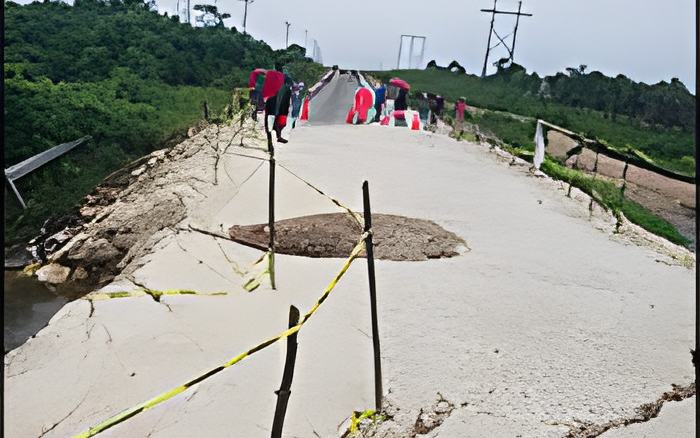

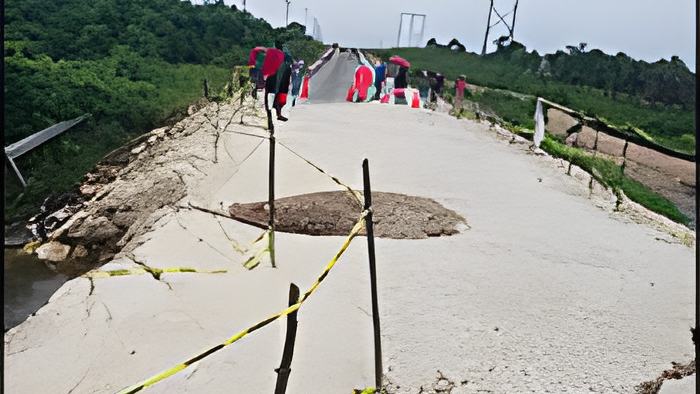
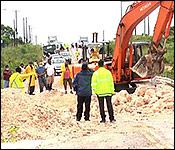
But the most major highway that failed today was the George Price Highway - and again it happened at mile 38.5 - a replay of the heavy rains in June.
We took you there back in June to show you how a road undermined by a weekend of rain, had turned all of Western Belize into an island.
We'd wondered how the temporary project would hold up in ETA's floodwaters but on Wednesday when I spoke to Senior Engineer Irving Thimbrel he assured me that ministry's patch job would hold. It didn't - and we start tonight's story with that assurance - which could not stand up to this very heavy flood:

FILE: November 4, 2020
Irving Thimbrel, Senior Executive Engineer
"We dont anticipate that we are going to have any problems."
It was Deja Vu all over again at mile 381/2 as last night cracks started to form in the Ministry of work's temporary bypass.
Irving Thimbrel, Senior Executive Engineer
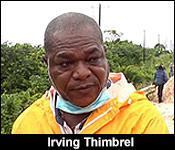
"We started to see some cracks around 6' o'clock yesterday evening just some small cracks and then during the course of the night as the water was passing through it started to open up. So when I came back out here around 11 o' clock we started to see that the cracks were actually opening up and you could put a stick inside of them and then about 3 o' clock or so we stared to see a difference in level and about 4 o' clock this morning that's when the hole appeared."
It's a repeat, albeit short-lived, of an event that back in March split the country in two. It also split the village of St. Matthews and this morning when we got on the scene we found a frustrated chairwoman who was done believing in the Ministry's timelines.
Esperanza Ariaza, Chairperson, St. Matthews
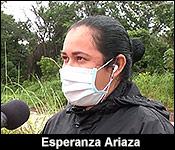
"The way that I see the Ministry of works moving at this moment, I believe that by midday this will not be open. This will be sometime later within the night time, I believe."
"This had happened from June and then we had Nana coming in September and they did something rushing pretending that it was gonna be fixed and that was it now everything is just patch, patch patch and nothing has been put in place. They are trying to divert a street now, but basically its just hours they put on a day. This needs to be work on like day and night. The contracts are there so why not put the work."
And while safety hasn't been compromised, schedules certainly have. This morning we heard from three commuters tapping their feet and gazing with crossed arms at the obstacle separating them from urgent business on the other side.

Jerry Crawford, Freight Driver
"I've been up from this morning from 2:00 o'clock and I'm stuck here and I can't get across to go and sell the furniture that I've brought to sell and it just got me discouraged because it was supposed to get fixed and they only half patched it and left it so at the end of the day it's us that's having to pay all of this because it's our taxpayers money that's going on it to repair it and they aren't doing it the proper way how it's supposed to be so we can't be happy with this."
Wilhem Braun, Machinist
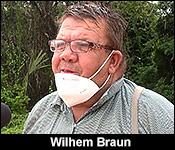
"They could have gotten that fix from a long time, but you know how the government go, they never at time, they do it way too late. They don't let the people know anything, until the people reach this spot. That's the problem."
David Botes, Driver, Triple A imports
"We are waiting from 5'oclock this morning. We're supposed to be delivering dried goods. We have three trucks going one to PG, one to Belmopan and one to Cayo, but due to the weather we can't continue doing our work. We got four trucks going together and none of them can't move."

"They think that we'll never have bad weather and you know usually these times it's lots of bad weather. So I think the government slipped up or it didn't put interest in the situation."
Not so, says the Senior Engineer. Irving Thimbrel has been on site for days even checking in multiple times throughout the night. This morning he told us that the delay came down to the quarries.
Irving Thimbrel, Senior Executive Engineer
"The problem right now is that the quarry's are opened at 8 o'clock in the morning and so that is what is taking us so long but the material being here it's gonna be a very, very, quick thing to remedy."
Cherisse Halsall:
"Now, Sir when you and I spoke three days ago you assured me that this thing would hold because the volume of water would not be as much as it was in June, did something change?"
Irving Thimbrel, Senior Executive Engineer
"Nothing changed, the stones are still there, it's just the finer material that continuously filters through that we are losing and that's what we're tapping up now."
And while that top up is well underway, it doesn't solve the problem.
Cherisse Halsall:
"So when can we expect something more permanent?"
Irving Thimbrel, Senior Executive Engineer
"Everything takes time. If we are building a bridge out here it would have taken more than the time. People are saying 6 monts. What we are building are some 12x12 precast culverts. We will stay with the forms, we would be able to continue to do projects of a similar nature because we have the forms. It takes a while to build those forms. It took about a month and a half or two months to build these forms and now it's going to take another month and a half to build the culverts. Right now we are about 9 away from completing those culverts. That is going to be a permanent solution. Maximum a month and a half if the weather holds."
And Indeed by midday, just as he'd promised Thimbrel had one lane open at Mile 38 1/2. Vehicles are being allowed to cross in batches and the work and maintenance continues.