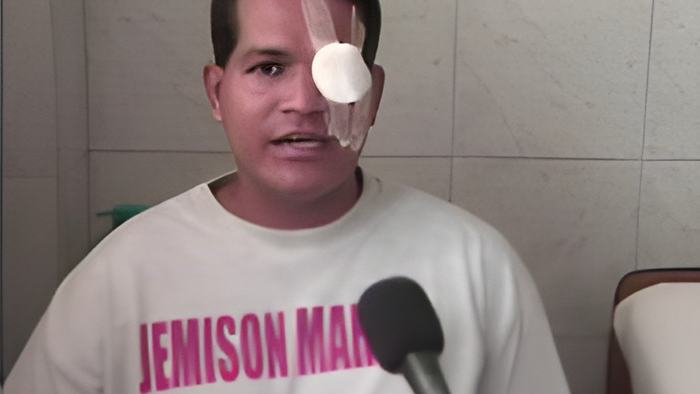
On Friday we told you about the case of 29-year-old Javier Herron, the Toledo resident who had his eye surgically removed after a shard of metal punctured his eyeball while he was repairing a motorcycle. Well, Herron is in the hospital recovering from an post surgical infection but the controversy over whether he should have lost his eye at all rages on.
On Friday night his sister Mona Lisa Mangar told us that she felt that it was the fault of the KHMH, specifically its eye doctor, David Hoy who did not come in to see Javier when he went to the emergency room on Sunday. Hoy spoke to the general practitioner over the phone and gave his instruction from there.
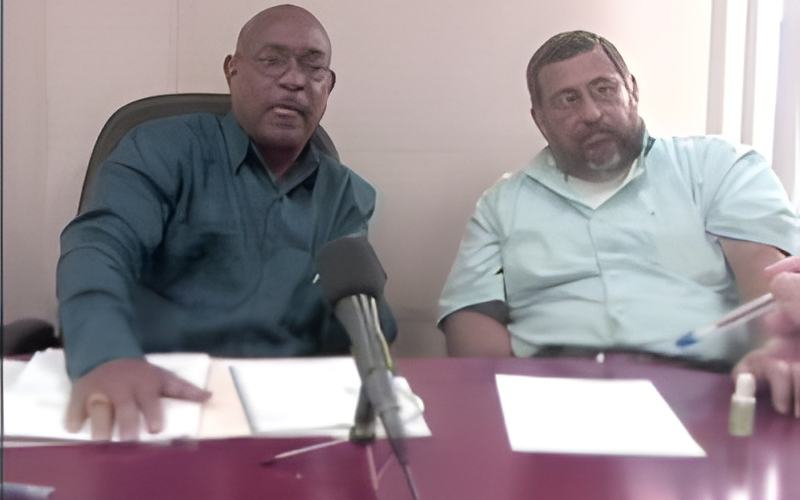
The family insists that Dr. Hoy should have come in and if he had, their brother would not have lost his eye. Bolstering the strength of that emotional argument is the professional opinion of Dr. Amin Hegar. He told the family that if there had been a decisive specialized intervention, Javier Herron may have lost his vision, but not his eye. Today, all those arguments came flaming aground in a press conference, held at the KHMH with the participation of all the hospital's heads of departments. Here's the story.
Javier Herron, Lost An Eye
"I am feeling sad and stressed about what has happened to me. I am almost destroyed. I feel severe, I feel hurtful and I feel that my last days have come by for me."
Jules Vasquez,
Why do you feel so hopeless?
Javier Herron,
"Because what I thought what happened to me shouldn't have happened. They shouldn't have taken out my eye with my even knowing."
Jules Vasquez,
Javier do you blame Dr. Hoy for the loss of your eye?
Javier Herron,
"Yes I do blame him because he is on emergency call and he should have come and deal with my eye right away."
That's Javier Herron's complaint as he comes to grips with the difficulties of life after losing an eye. But despite the direct compliant against him Dr Hoy says no matter what he did on that day he could not have saved the eye.
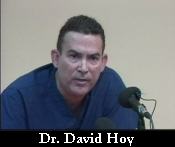
Dr. David Hoy, Ophthalmology - KHMH
"When you have a patient that gets to your clinic 22 hours after an injury that Javier had in Toledo, it is not the fact that you think you have infection or you think you don't have an infection, you have an infection. That is simple ophthalmology. When you are dealing with and eye that is open with a piece of metal through it, the possibility even in the first three or four hours, your success rate is extremely low."
But Dr. Amin Hegar who saw Javier Herron just before he referred him to the KHMH says the eye could have been saved.
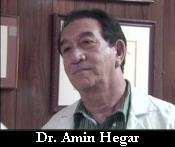
Dr. Amin Hegar,
"When the patient came here the patient was seen. His eye was open, the pupil could have been seen, I could have seen the iris, the infection was beginning but if the foreign body had been removed, which was the cause of the infection, like you have a splinter in your hand, what you do is remove that foreign body. You could treat it with antibiotics but if you don't remove the splinter from your hand or the eye, that infection continues. So the logical thing to do is to remove the foreign body, especially when the eye was not too infected, when it was beginning."
Dr. David Hoy,
"He was going to save this person's eye. I was shocked. That is 22 hours after something went into a man's eye in Toledo. If I was in Dr. Hegar's shoe at that time, I would have told that patient that you are going to lose your eye and I am going to send you over to KHMH and I am going to send you there so they put you on antibiotics so you don't lose your life. That is what I would tell that patient.
I would never, if I was in Dr. Hegar's shoes, and I hope I'm never in his shoes, think that I would go into an eye that has 22 hours or almost 22 hours of an injury to the eye. So for Dr. Hegar to be giving false hope to these people who are already sad, who are already having all kind of things happening to
Javier from December, I feel saddened that somebody, a colleague of mine, could tell another patient that he is going to save the eye when he fully knows, if he has read his ophthalmology, or maybe he has forgotten it, that he is going to save the eye. That is impossible."
Jules Vasquez,
Is that an ophthalmological situation at that point, it is a medical situation, and that he treated it in a medical way by stabilizing the infection, getting the person an intravenous antibiotic?
Dr. Amin Hegar,
"To be frank I see patients sometimes with many more days, just this afternoon I saw a patient from San Pedro with a foreign body in the eye, of course that this was superficial. He had about two days and I took it out, patch on the eye, and started antibiotic. This patient, although he had 20 hours, 22 hours, it was not at the point for me, at that point, I did not see him, the following day like Dr. Hoy, I saw him 18 hours and bacteria multiplies quickly. Hundreds become a thousand, a thousand become ten thousand and it goes very quickly so you have to act quickly. At least to the point where he was, he would have lost vision but not the eye.
I believe I would have saved the eye. I have experience, I would have done that. I am a member of the American Academy of Ophthalmology which I have respect, and when you have that kind of training you know what to do."
Dr. David Hoy,
"When he got to KHMH it is a medical emergency and I treated it that way. If I had physically come to KHMH, I would have done the exact same thing and if they begged me to go into that, to do anything different, I would say I can't.
We have a patient, I think I explained to Jackie, that has a foreign body inside the eye for 24 hours before patient gets to KHMH. That eye is a lost eye. There is no way, unless its God going to operate it, that that person is going to save the eye. That somebody is going to tell the patient that, nobody wants to do that, that is the last thing I want to tell anybody. I feel like running through the door when I see a situation like that.
But at that point, I don't go into an eye that is already 24 hours infected and think I am going to become God and try and do magic because what I am going to do is I am going to spread the infection and what I am going to have is the following day an abscess in the brain and I am going to run the risk of this man losing his life."
Dr. Amin Hegar,
"If the family had told me that they can't find the ophthalmologist or be doesn't want to come or the hospital wants to be paid or whatever, they could have called me and I would have done their surgery, the removal of the foreign body for free."
Dr. David Hoy,
"If I knew Dr. Hegar had seen that patient before, I would tell you what I would have done. I would have called Dr. Hegar and told him that you sent me a hot potato with a dagger my friend and you don't do that to a colleague because you know fully well you can't save that person's eye.
And what made it worse is he told the family that if they go back to him, KHMH did not take care of them to go back to him and he would have done it free of charge. I was amazed at something like hat. That's what frightens me, the man was going to operate on somebody's eye 22 hours after a foreign body is in the eye. I can't understand that."
And while he can't understand that, what Hegar can't understand is how Dr. Hoy did not come in to see the patient.
Dr. Amin Hegar,
"One cannot rely on general practitioners for good eye evaluations. General practitioners are not trained. We study almost five years for eyes so
you need a lot of experience in treating eyes. I will tell you when I was at the old Belize City Hospital they used to call me anytime of the night and I would go to attend. One cannot prescribe over the phone, not for yes. You have to see it and you have to see it with an apparatus like this, with a microscope. That is why we use microscopes, to see what's the general situation of the eye."
Dr. Hoy did see it the next morning after Herron was hospitalized overnight with antibiotic treatment. While trying to clean out the puss, he says he had to make a snap decision.
Dr. David Hoy,
"While I am cleaning out the pus, more pus starts to come from behind the eye and I think showed Dr. Arriaga that on my tape this morning. I told Sister Henry I am taking this patient to KHMH and I am taking out the eye now because it was no more about the eye, I am going to lose this patient.
I am in a dilemma because the hot potato has been sent to me and I have to deal with it. I took that patent, I put it in my technician's card and I said get that patient to the emergency room now and I am coming behind. I got my clothes and my instruments and I was in that operating room. I explained to Javier that I cannot do anything else but he told me that yesterday Dr. Hegar told him that if he I had done it, I would have been able to save the eye. At that point in time it is not about Dr. Hegar or about anybody else, it is about saving the life of that patient and that's what I did."
But while Dr. Hoy is relieved that he managed to save a life, Mona Lisa Mangar - Javier's sister, who attended today's press conference, says he is not satisfied.
Mona Lisa Mangar, Sister
"I am not still satisfied and I am going to pursue this case."
Jules Vasquez,
Why are you not satisfied?
Mona Lisa Mangar,
"Because when the media asked him the questions, he did not specify and he did not bring up the answers to the questions. He elaborated on other things."
Jules Vasquez,
He is saying that in that situation, whether you are by phone, by fax, by email whatever, when you have a foreign body in your eye for 22 hours, there is no saving that eye.
Mona Lisa Mangar,
"I still believe the eye could have been saved. Like I said the eye ball would be out, the eye ball would not have to be out but he could have had the eye, he would not have to put in a false eye."
Jules Vasquez,
So all that explaining has no effect on you?
Mona Lisa Mangar,
"No I am still not satisfied, no matter the case I am still not satisfied."
Jules Vasquez,
Would you accept that if somebody says you are not a doctor.
Mona Lisa Mangar,
"Yes if he had come in and told me Sunday evening, at least give me five minutes and told me this is what is going to happen and eventually this is what will come about then yes I would understand, I would be more convinced and satisfied."
Jules Vasquez,
He says he is glad that didn't happen because if he did you have had ended up in the hands of the person who referred you here.
Mona Lisa Mangar,
"Then I still would have been more satisfied because if I go back there maybe he would explained the situation to me better than Dr. Hoy did, which he never did.
Jules Vasquez,
But I am saying couldn't it be argued that you are blaming the hospital when it couldn't have done anything. Will you ever accept that?
Mona Lisa Mangar,
"How can I ever accept that when I told you if he had come five minutes and told me yes, this would be the problem or this would be the situation then I would understand but I cannot understand. I still cannot understand."
But looking back Dr. Hoy says if he had to do it again, he would do it the same way.
Dr. David Hoy,
"I am glad it went the way it went because you what the Mangar family would have done, they would have gone back to Dr. Hegar and now I really believe that he would have tried to take out the foreign body and then I would have been in this hospital taking out an eye and maybe having something more serious here today."
And while both doctors stand their ground, one grateful for the patient's life and the other second guessing the loss of an eye, Dr. David Hoy says it's not about their professional opinion - it's about saving lives and that's what he says he did for Javier Herron, who must now live with a permanent disability.
Dr. David Hoy,
"Again it is not about myself and Dr. Hegar. It is about Javier. And you know where that patient is right now, he is in the surgical ward. And you what I am worried about, that he doesn't have a fever because what happens to me or this discussion here and these cameras mean very little to me anymore. What I find happening is all we do around here, and I am talking about cameras, is we kick around political footballs to get gains. What I see is a KHMH, which is a reflection of the poor of this country, these nurses, these doctors, are working more than anybody else and all I see happen to them is that they are being banged and now it is my turn, my turn to be banged. And I am just a little pawn and so are you Mona Lisa.
We are pawns in a bigger game and we are playing around with people's lives and as a country, 25 years old, we have to change. This is time that we talk and cooperate with each other about how we are going to fix this country. This man over here is taking heat. This other doctor over here is taking heat. This nurse is taking heat and now I am taking heat. But the heat I am taking doesn't bother me. You know why? 'Cause I am fully aware that what I did was correct but the person who is the saddest is Javier. Javier is the saddest because he doesn't have an eye but Javier is the luckiest because he has his life.
I want the public to know that enough, enough of trying to bring down this hospital. Enough of trying to bring down our nurses and our doctors. Enough of trying to bring down the system. The system that we have here at KHMH is for the poor and it is the same poor bringing down the poor. We are self-destructing as a country and where are we going. Come on Jules what are we doing."
We must note that Javier Herron has been the victim of two major and successive misfortunes. He was knocked down off his motorbike by a government vehicle six months ago and suffered major head trauma and post traumatic stress. Since then, he had to give up his job, and make a living by doing odd mechanic jobs. Adding to that is the fact that, as the family explains it, the case was thrown out of court and he is now pursuing a civil case to get something out of it.
In this accident, he is also suffering from posttraumatic stress and the family is asking that anyone with counseling experience who'd like to help can come forward. Javier Herron is a husband and the father of one.