
The Belize Defense Force this morning launched its HIV and AIDS initiative. Important because HIV status and military service have long been at odds for the BDF, which was famously accused of AIDS discrimination by HIV Ambassador Dolores Balderamos Garcia when it wanted to test and get rid of HIV positive soldiers. Now, the BDF is being more tactical in its approach to this delicate issue. At a ceremony today, the force introduced awareness posters and promoted testing. We today found out that the Force Command simply can't afford to have an army with a high incidence of HIV infection.
Lt. Col. Stephen Heusner, Deputy Commander - BDF
"So far the infection rate in the BDF is low. At the moment those with HIV are allowed to stay and contribute to the force. If the infection rate continues to rise however, changes to our policies will have to be made."
That's the declaration that Deputy Commander of the BDF Col. Stephen Heusner made today as the army launched its AIDS initiative. The effort is about making sure that the BDF's infection rate is kept low.
Lt. Col. Stephen Heusner,
"The people in the BDF who are infected with HIV is a very small number. Most of those people are volunteers, as opposed to regular force members and so the concern right now is not that great. However we are concerned that with the continued increase in the figures in our population, that it could affect members of the BDF eventually. If they comes a time in the future where we have to look at an increasing rate in the BDF then of course we will need to look at policy very closely to ensure that we maintain a healthy force so that we can continue to do our job effectively."
And in a physically demanding job such as the BDF, Heusner says that they may have to make unpopular policy adjustments and decisions.
Lt. Col. Stephen Heusner,
"When I say that without the need to change our policies, that means that those people who are HIV positive, considering if it is an alarming number, then we will need to effectively come up with some policy that will affect those."
Alfonso Noble,
It is dazzling to me that an institution like the BDF may be contemplating discrimination.
Lt. Col. Stephen Heusner,
"The type of work that we do in the armed forces... I mean, right now the United States and other countries who we send people on courses to have a strict policy that for our people to go on those courses they have to be HIV negative. Now for us to continue train our people effectively abroad we will need to meet those requirements. If our numbers increase here in the BDF, we will need to start looking at whether or not we will have to become and try to... we are trying as much as possible, not to get people out of the BDF if they become HIV positive. However as we all know this disease increases and
develops later on into AIDS and that could have an impact on our effectiveness where we have a large percentage of our forces with this diseases and we will need to try as much as possible...and whatever policy... I don't know what our policy will be if that happens, what I'm saying is we will have to look at it and need to make some policy changes to ensure that we maintain a ready and healthy, effective force."
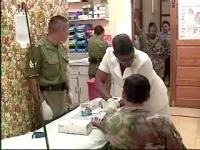
But before the BDF's policy on HIV and AIDS is revisited, they are first attempting to ensure that the general soldier population has the necessary information. These posters are an addition to the BDF's ongoing education programme. They focus on abstinence, being faithful, use of condoms and knowing your status. And to back up that awareness effort, today after the launch soldiers were offered testing. Earl Bol simply wanted to know and Captain Thomas Cal led by example.
Earl Bol, Soldier
"My girl just took the HIV test because she is pregnant and actually I was supposed to take it a long time ago but I didn't have the time."
Alfonso Noble,
Are you at all nervous?
Earl Bol,
"No. I wanted to know this from a long time, I wanted to do it a long time ago and I got the time now so I am glad."
Captain Thomas Cal,
"I believe it is to show example first that in the BDF that as leaders we need to lead by example and also I think it is something very important and something serious for us to consider and so I took it as one individual doing this test myself, knowing that I have the confidence that I will be negative."
Alfonso Noble,
Are you at all nervous?
Captain Thomas Cal,
"No, not at all."
And maybe he isn't nervous because he's sure of his safe sex practices, or because he has as a fall-back, existing practices by the BDF on soldiers who test positive for HIV.
Lt. Col. Stephen Heusner,
"The policy right now is very clear: we do not get rid of any soldier who has been identified with HIV. We keep them in the force depending on their physical condition and then we will put them in a place whereby they could contribute to the BDF. We do not send people home right now if they are HIV positive. That is the last thing we want to do right now for anybody."
What they do want to do is know an exact prevalence number within the ranks to be able to self evaluate and put response mechanisms in place. Lt. Colonel Ervin Gabourel is the force medical officer.
Lt. Colonel Ervin Gabourel,
"The strategic plan that we are now launching will promote voluntary

counseling and testing. So we are trying to encourage people to come in and get tested. If you encourage people and you make them believe or assure them that it is in their best interest to get tested, then that will help us to get the true picture of the prevalence of HIV/AIDS in the force. Having the true numbers will determine the priority given to this problem. Having a true number, then we will be able to see what we can expect in the future, how much money should be allocated to this particular problem; how many people will we be having down because we won't be able to treat them. So it is very important. Remember this disease has the potential to kill anybody, especially if you don't get the proper treatment.
One of our priority areas that we have underlined in our strategic plan is to have a sustainability to this response and the only way you sustain this response is to keep people aware of the need, the urgency, to know your status. So once we make emphasis on that, people will realize this is something serious and it needs to have all the importance that they do with any thing important in their daily life. Sustainability will be done through a very active group of people that we have who believe that this is a problem that needs utmost attention and to be given all the priority and attention. It comes all the way from the Commander to he last soldier that we have in the force."
And that began today as they queue of soldiers was constant the army hopes this drive and the ABC and K Campaign will be effective, if not it will have to squarely confront the question of whether fighting fit soldiers can carry the HIV virus.
Balderamos Garcia today said she understands the BDF position on having fit personnel, HIV and AIDS should not be the sole standard. She stressed that there is much need for discussion between AIDS advocates and the military.