
For patients with kidney problems, dialysis is the difference between life and death. Some need it as many four times a week while others can get by with only one visit per week. Most patients travel thousands of miles to reach hospitals in Guatemala and Mexico to receive treatment but today while at the Health Care Partners Hospital our team met John Jackson. He is a 25 year old kidney patient from Dangriga who travels to the city three times a week to receive his treatment. Here’s his story.
Keith Swift Reporting,
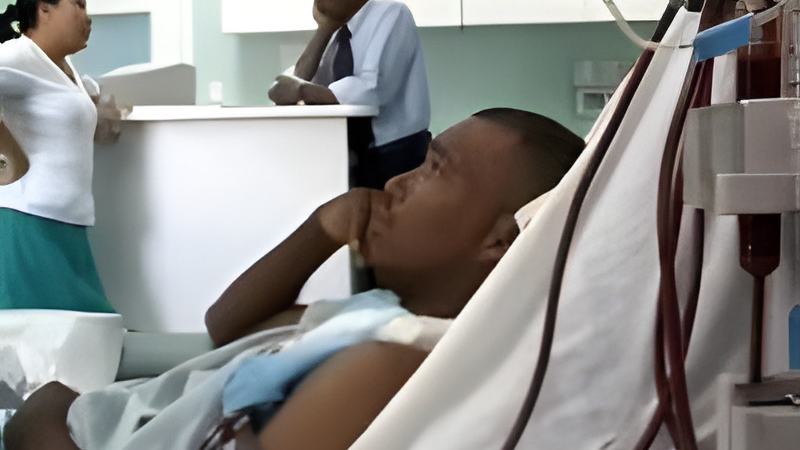
This machine is what keeps John Jackson alive. Both of the 25 year old’s kidneys have collapsed - and so three times per week he comes to the dialysis unit at the Health Care Partners Hospital and sit in this chair for three hours.
John Jackson, Kidney Patient
“I got sick and by the time I went to the doctor and found out what happened it was too late. I found out my kidney was already gone. So since March 4th I’ve been living on dialysis until now.”
Keith Swift,
So now you are telling me you come here three times a week.
John Jackson,
“Yes sir, every week from Dangriga.”
Nurse Maria Ack is the head of the Dialysis Unit which is where you’ll find three of the country’s only dialysis units. She says these units do what a patient’s kidneys can’t do.
Nurse Maria Ack,
“What we do is we basically clean their blood and remove excess toxins and water from the body. One removes the blood and it runs it through a pump that controls the amount of blood that can be cleaned per minute and then it
goes to an artificial kidney which is this one. And when it runs through there, these two pumping systems, one is an acid and the other is a bicarbonate, run in the opposite direction to the blood and it is in that process that the toxins and excess fluid from the body is removed and when it returns back, it exits, the artificial kidney is already cleaned and it returns back to the body.”
The process takes three to four hours. It is time consuming and also expensive, John Jackson has to pay $500 for every visit.
Keith Swift,
Is it a struggle to sit here three times a week for three hours basically doing nothing?
John Jackson,
“I get used to it.”
Nurse Maria Ack,
“It is very important for them to survive because when the kidneys are not functioning anymore we are doing the function of the kidney, the basic functions of the kidney and if they don’t get that, what happens is that the toxins will build up in their bodies, and the excess liquids will build up in their bodies and then they get toxified and the excess fluids start to accumulate in they have shortness of breath and they could die. So they need this dialysis at least two to three times per week.”
Keith Swift,
Before were you going elsewhere for treatment?
John Jackson,
“Yes, it was cheaper in Chetumal but after a while I found out I couldn’t handle the distance so my father decided for me to come back here.”
John Jackson doesn’t plan to keep this up much longer. He hopes to get a kidney transplant.
John Jackson,
“Right now at the moment my younger brother planned, well he said he wants to give me a kidney but at the moment he smokes and drinks and I have a hospital in the UD that offered to do the transplant for free but my brother has to stop drink and smoke for at least six months so I guess I have to wait on that.”
And he’ll be waiting on that – while hooked up to this machine.
The cost per treatment at Health Care Partners is $500. A treatment at a hospital in Mexico or Guatemala costs between $200 and $300.