
U.S. Charge d' Affaires Keith Gilges is set to depart Belize. He leaves after 3 years in the post - 3 years in which he says his visibility has been his greatest asset.
And at the end of an ambitious farewell tour, Gilges sat down with Cherisse Halsall to talk about narco jets, visa categories, and Belizean hospitality. Here's more.
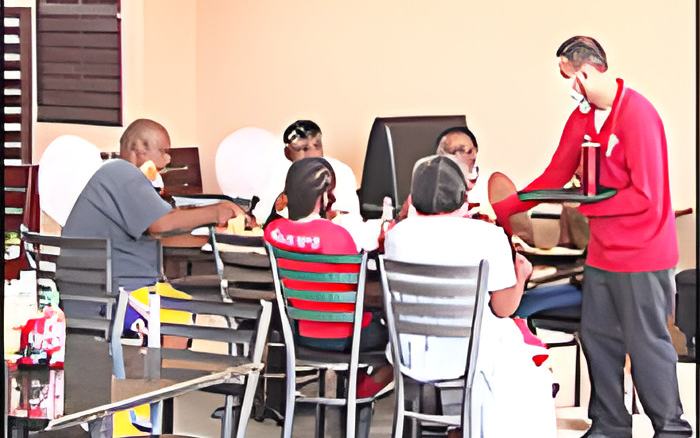
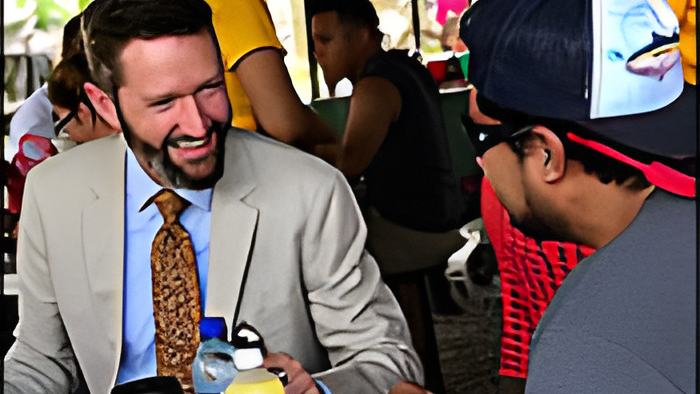
This is the image of a newly arrived Charge D'Affairs joyful, exuberant, and diving right into his new posting. But that was 3 years ago before COVID, before a new administration and before many of the lessons he'd learn as Belize's US Charge. And yesterday in his exit interview, Gilges reflected on another first, the moment when he showed Belize the kind of diplomat he would prove to be.

Keith Gilges - Charge'd Affaires
"I was grateful to my public affairs officer at the time Natella. I said hey listen I want to go out and eat in the market and I was like sure so I ended up having stewed chicken and rice and beans for the first time here and she captured this photograph of me sitting with a guy, his name was Jose, we had a great lunch, had a great chat, and headed back to work. About six months ago I was out on one of the islands and he actually worked on that island and he walked up to me and he said I'm not sure you remember me and I was like, we had lunch together. It sort of encapsulated a few things about Belize which is how warm and welcoming the people are, so my ability as Charge' to wander into the Belize market to get some rice and beans sit down and just start chatting with people, that's not possible everywhere in some insane for a person in my position to be able to do, but you can do that in Belize."
And while Gilges enjoyed how personable he got to be here, he says he was also impressed by Belize's strong democratic values. Something he says was made evident during our recent pandemic time elections.
Keith Gilges
"My prime takeaway as an observer for the election was how great Belize does democracy, in a tough setting, in a time of Covid, Belize went forward, there was a high voter turnout, it was successfully and well run, so as a staunch proponent of democracy, I look at the process and say a lot of countries have a lot they can learn from how Belize does it because Belize actually does it very very well."
But while democracy may reign here, so too does transnational crime.
Cherisse Halsall
"Belizean police to respond to these well-organized crime organizations, Belizean people tend to be very pessimistic about what we can and cannot do concerning narco jets, do you think we're getting a leg up on that type of crime, and how optimistic are you about us moving forward in that direction?"
Keith Gilges
"Sure, so the criminals are smart, the transnational criminal organizations are smart. They are going to go where they have the greatest chance to land their product and get it frankly, to the United States because we are the Primary market for these illegal narcotics. Now, before I came and nothing to do with me, there hadn't been a significant drug bust in quite a while, we saw that ramp up and I think both the cooperation from the drug enforcement administration with the ANU here, with the government here, you saw the Belizean security forces being more successful in interdicting narcotics. So, helping to improve the capacity of the Belize security forces to track the planes as their coming in, have some idea of where they may land, get the forces out to that spot, have the air assets in place to try and manage and maintain to interdict those drugs is so vital, and we've seen greater success in that, we are committing resources to that, both in terms of equipment and in terms of the training because the equipment is only as good as the person who's using it. And their willingness to use it to try and stop the drugs from getting through."
And with northward bound narcotraficantes, gang-related crime, a high murder per capita rate, and the shadow of human trafficking, Belize remains on the trafficking in persons tier 2 list:
Keith Gilges
"Back in 2018 Belize was on tier three which is really the bad list, in 2019 Belize moved off that to tier two watch list, they had done a lot more in terms of prosecuting in terms of prevention, and in terms of protection of victims, and I think and I'll speak candidly here, there was a bit of a sigh of relief that you made it off of tier 3 onto their two and the challenge is that if you just keep doing more of the same that doesn't show continued progress and so over the past couple years."
And until we reach that level of success many of our citizens will be barred from seasonal farm work that used to form a major supplement to their income.
Cherisse Halsall
"Belizeans are still being denied H2A and H2B U.S. workers visas and I believe these are the visas to go and pick crops in the fields. It's an important sector that a lot of Belizeans used to participate in but now they find themselves barred."
Keith Gilges
"I think that affected about 300 people. I think that was the number we were talking about that normally would come to Belizeans to go up there. But listen there is also a labour shortage in the US right now, and those issues certainly are paramount as we see economies opening back up again as we see travel and trade trying to move forward, that I don't believe was a decision made by the state department, it was made by the department of homeland security as a result of Belize's tiered ranking."
Cherisse Halsall
"Now, this next question I imagine your instinct will be to dodge and to give the standard answer but I'll ask you to speak from a place of humanity for a second because I'd like to talk about Ashley Enriquez who is the Belizean child that migrated to the US on foot to go and meet her father there."
Keith Gilges
"So let me speak from the heart, we all want to see families reunited, you want to see families reunited, you want to see children with their parents, there are individual circumstances that drive people to make decisions and whether that's to send your child up unaccompanied through Mexico, I mean I can't imagine, and I'm not a parent but I, to imagine a parent in such a circumstance that they're willing to have their child travel alone through any country for a long period of time, there's a real driver there. To anybody that's saying you know, I'm going to send my child alone, I mean what's driving you to do that is scary and so we do say that's such a risk, the flip side of it and here is where I'm leaving in a week and a half so maybe I can be a little more candid is listen we also need to work on the immigration system in the U.S., there are problems with it. It's just not the most efficient system and that's a policy debate that's going back and forth in the U.S."
Cherisse Halsall
"So, what's one of the best things that you've been able to do in this position and then one of the things that you may have wanted to do but didn't quite work?"
Keith Gilges
"I invested that time to get the word out, people sometimes give me credit well gosh during your tenure here the government has one so much more and that's actually not true, we have done a lot but we've been doing a lot for a long time, I think people just didn't know it so maybe my great success is getting out, because it's my face in the camera but I'm just highlighting the work of people at the embassy partnering with Belizean government, Belizean civil society organizations to do all these things."
And so, Gilges has cut his last ribbon on Belizean soil, but his mission isn't over he heads back know as an employee of the state department, yes, but also an unlikely ambassador for Belize, forever after able to articulate what he found special, complex, and irreplaceable about this place that he once called home.
Gilges' successor is expected in two weeks.
Also on the horizon is the appointment of a new U.S., Ambassador but a timeline for that arrival has yet to be confirmed.