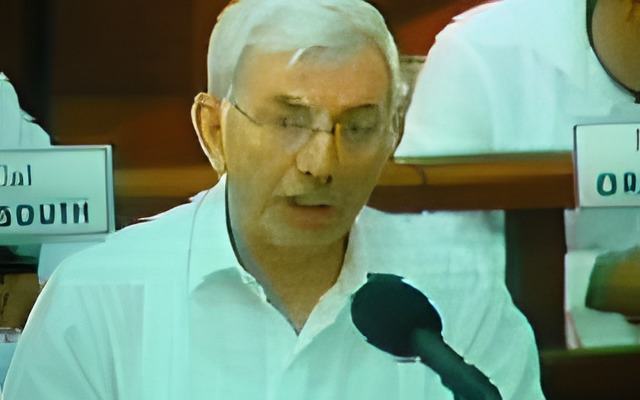
The Supreme Court of Belize had its ceremonial opening today. The tradition is a fixture of the month of January but as we found out, it's more than just a lot of scenery and traffic blocking on Regent Street this year, change is a big topic in the judiciary Alfonso Noble found out more.
Alfonso Noble Reporting,
Members of the judiciary including the bench and bar as well as other staffers left the annual church service at St. John's Anglican Cathedral. For a procession down Regent Street to the Supreme Court where the ceremonial opening took place beginning first with an inspection of the guard of honor. Immediately following that, the crowd gathered in the Chief Justice's courtroom to hear his address. Paramount in his address were the country's financial worried.
Abdulai Conteh, Chief Justice
"While acknowledging the fact that we live in times of financial constraints and the need for the much talked about severe tightening that's been decreed on the public sector, it must be remembered that the due and proper administration of justice cannot be gotten cheap. But financial constraints should not be allowed to infringe upon or impede the due administration of justice for this would be really a policy of penny-wise, pound-foolish. When the due administration of justice becomes hobbled by financial constraints, the judiciary is set on the slippery road to losing its independence and integrity and hence its impartiality. This cannot be healthy for any polity or economy. To skimp on the judiciary is a shortsighted policy that will endanger not only the independence, integrity, and impartiality of the system of administration of justice but ultimately the rule of law and thereby impoverishing all of us. Even for its comparable population, Belize has the least number of judges and magistrates in relation to other sister jurisdictions in the region. The ever-increasing list of both the criminal and civil cases make manifest everyday that more judges are needed. The fact that judges have to move immediately from one civil case to another leaves preciously too little time to write clear and reasoned judgments. For quite some time now these courts, both Magistrate's Court, at least in Belize City, and the Family Court have had to operate in an environment that's less celeritous if not hazardous. I therefore takes this opportunity Mr. Attorney again to commend the commitment, the fortitude, displayed by the presiding officers in these courts as well as their staff as they preserve in the discharge of their duties. I can only again express the hope Mr. Attorney before too long that these courts will be housed in more proper and fitting environment and buildings."
But while Conteh expressed the judiciary's concern on the upcoming times of austerity he acknowledged the present push for the always topical issues of reform that this time around will see the implementation of new civil procedure rules that are expected to streamline access to justice.
Abdulai Conteh, Chief Justice
"The new rules will change the landscape of civil litigation. They will have the principle aim of demystifying litigation and simplifying the process of going to court so that the process itself will be less cumbersome, less expensive, and certainly more speedy in terms of resolution of cases that do go to court. The new rules will bring into play a more proactive case management by the court itself. Pre-trial conferences will ensure that only live issues do go to actual trial, and more constructive between the parties themselves and their attorneys, and where feasible mediation as an alternative dispute resolution mechanism instead of a full blown trial in the court. All these will help ensure a more just, less expensive, and speedy resolution of cases."
Francis Fonseca, Attorney General
"We must therefore move with dispatch to sign off on these rules. Put the proper structures in place at the registry, ensure that personnel are properly trained on the rules, and then move to implementation. I understand from the Solicitor General that the final text of the rules should be completed and circulated to both the judiciary and members of the bar by the February 1st 2005. The overriding objective of the rules is to enable courts, as the Chief Justice has said, to deal with cases justly by ensuring that the parties are on an equal footing saving expense, dealing with cases in ways that are proportionate to the amount of money involved, importance of the case, the complexity of the issue, and financial position of each party ensuring that each case is disposed of exopediotusoy and proportionate allocation of court resources for each case. Case management will be the engine that will drive the rules. The purpose of case management is for the courts to actively manage cases by identifying the issues at an early stage, deciding promptly which cases need investigation and trial, and encouraging parties to settle cases or use alternative dispute resolutions, encouraging parties to cooperate during trial, deciding the order in which issues are to be decided at trial, fixing time table to control the progress of trial, dealing with several aspects of cases on the same occasion, and making appropriate use of technology, giving directions to ensure that trials proceed quickly and efficiently, and ensuring that parties disclose evidence to the other side in advance."
But while Fonseca spoke on the new civil procedure rules he along with Conteh took time out to address the alarmingly high incidence of child abuses cases.
Abdulai Conteh, Chief Justice
"More alarmingly, I am sure you will all share in this alarm, is the increasing incidents of carnal knowledge against minors. Exactly 26 of the serious sexual offenses against females, out of a total of 33, 26 were against minors. This is a very disturbing state of affairs that must be addressed and remedied for welfare of our children in whom the future of this nation depends."
Francis Fonseca, Attorney General
"The recent spate of domestic violence and child abuse cases that have dominated the airwaves in recent weeks underscore the importance to ensure that the system favors the children and other vulnerable groups."
And it is with this and other examples of increased lawlessness in mind that Fonseca outlined further reforms to legal procedures which should increase the effectiveness of the justice system.
Francis Fonseca, Attorney General
"The recent killing of 3 police officers should leave no doubt in the mind of any anyone that reforms must be made to the criminal justice system and they must be done now. We will be looking at abolishing preliminary inquiries to reduce the time it takes for a case to come to trial in Supreme Court, reviewing the Evidence Act so maximum use can be made of witness statements, and so that criminals cannot get off on the technical rules governing admissibility of evidence. Critically we will have to examine ways of protecting witnesses who are afraid to come to court and give evidence. These measures will not stop crime; it might not even reduce it. What is hope is achieved is that some loopholes will be closed and imbalances in the system addressed so that the chances of convicting an offender is substantially improved."
Francis Fonseca becomes the fourth Attorney General to address the court in the last 6 years.