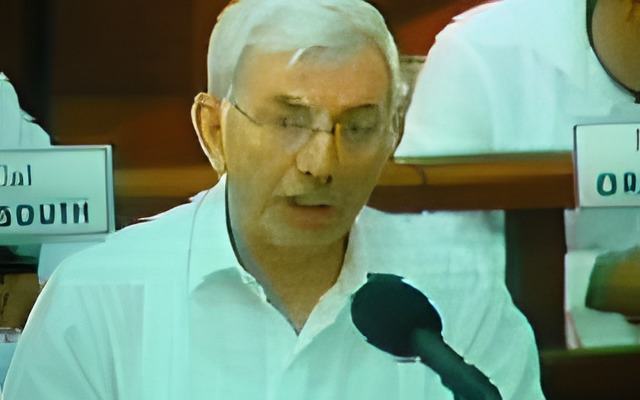
On Friday we told you about the new budget and the tax measures it proposes. After the budget is debated on Friday and passed by the House, it should be signed into law by next week and the new measures will come into effect in February. And while its passage is a certainty, tonight we take a close look at the proposed tax measures which hope to increase tax revenue by 22%, and ask if government can actually increase its revenue by nearly a quarter in one fiscal year.
The central feature of the budget is that it projects that $90 million in new taxes will be collected. Last year, $410 million in taxes were collected and this year government hopes to collect $501 million. No matter how you do the math, that's $90 million, but not according to the Prime Minister. He insists it is only $55 million dollars in new taxes.
Jules Vasquez,
Mr. Prime Minister do you think the $90 million in new taxes is realistic?
Said Musa,
"There is no $90 million in new taxes."
Jules Vasquez,
There is $90 million more projected over last year sir.
Said Musa,
"But not $90 million in new taxes. Check it out."
But the numbers don't lie and those same numbers show that the major part, almost half, of the new revenue comes from an increase in business tax, collection of which is increasing by almost 50% from $66.9 million to $97 million dollars.
This comes straight off the top of the gross earnings of Belize's businesses and the conventional wisdom is that it will be passed on to consumers in higher prices. But in what seemed more wishful thinking and social platitude than economic policy, the Prime Minister frowned on the practice.
Said Musa,
"These are taxes that should be absorbed by the business people and not passed on to the consumer and the relevant government agencies and concerned activists will, I am sure, be vigilant to ensure that this is the case and that they will expose any attempt by businesses to pass these taxes on to the unsuspecting consumer."
Arturo Vasquez,
"The increase in business tax that is...I would believe most businesses pass it on."
The other big chunk of the new revenue will come from a 2% increase in the environment tax which will raise $15.5 million more for the government. It's a 224% increase in collection which, the Chamber president says, will come straight out of your pocket, like a covert sales tax.
Arturo Vasquez,
"To me that is the same as if adding 2% to a sales tax. The Prime Minister was very clear in his speech, 'cause I heard it when he made the first announcement, that there is no increase in sales tax. I think the general public looks at sales tax as saying there's no sales tax increase and so maybe we've gotten away a bit. But to increase environmental tax from 1% to 3%, that's like 300% that is also like sales tax. 1% is currently being added to all imports coming into the country. That now goes to 3% so automatically all products on the shelves will be increased by 2%."
And as for sales tax, while the percentage on that was not increased - revenue in that area is also going up, from $114.3 million to $122 million, meaning you will pay $8 million in taxes. And while that is part of the revised revenue picture, another big part comes from excise duty which increases from $9.8 million to $20.5 million gathered from charges on alcohol, local beer, and soft drinks. Local beer alone should yield $4.1 million dollars. And while the excise tax bite increases by over 100%, from $1.80 a gallon to $3.60 per gallon on beer, still, it can hardly be considered a large increase. After all in 1998, the excise rate was fixed at $12.00 per imperial gallon. And to read into the Prime Minister's thinking, accepting a 100% increase, after 6 years of enjoying the windfall of getting the equivalent of a massive decrease is considered "paying it back."
Said Musa,
"Those who have benefited from the impressive economic growth of the past six years will agree with our policy that the burden of any new taxes should not fall disproportionately on the shoulders of the working poor."
And so while it's left to be seen if businesses will pass on the tax increases, that will make the political situation that much more difficult for the government. But it's the terror of the bottom line not political after shocks that is the concern right now. And the terror must be great because all indications are that the prime minister will have a harder time achieving his revenue target. In last year's budget, 15 of the 22 revenue centers performed below what was projected - that means government collected less than it had hoped to in 2/3 of its collection areas accounting for a $42 million shortfall in recurrent revenue. Now with $90 million in increased tax revenue budgeted for this year, can the government really expect to collect it? Recent history would indicate not, but the Prime Minister seemed sure.
Jules Vasquez,
Is it realistic sir?
Said Musa,
"We believe so."
Of course, if the government does not meet those targets - things can go downhill quickly. An estimation of how bad it is comes if you add up the figure for salaries to public servants which is $225 million with debt servicing which is $215 million more. That's $440 million - $30 million more than was collected this year and that's just to pay debts and salaries, forget how much it costs to actually keep government operations running. And that perhaps is the most compelling demonstration of the money mess the government finds itself in where it absolutely must find sufficient tax revenue from a shrinking economy.
And as an aside on the budget, and one that does not augur well for the free flow of information, we note that this year marked the first time in our 11 years of covering the budget speech that the speech was withheld from the media. The practice has been that during the last quarter of the presentation the speech is given to members of the press corp. But this year, the Government Press Office cited cost cutting measures and said that they could not afford to print a copy for everyone. So the media couldn't get a copy of the speech until it was posted on the government website three hours after the Prime Minister had finished reading it. Also, it is the first year that the budget document provided to us did not have any statistical tables appended to it. And also, as we've reported, it's the first year in those 11 years of budget speeches that we've covered where the Minister of Finance has not availed himself for interviews after the budget presentation.