
Last night, we told you about the report that was recently completed which examines the systemic problems at the Magistrate Court. Consultants Godfrey Smith and Dennis Morrison have taken a long and honest look at why court users have long been frustrated with the glacial pace at which the wheels of justice turn in the Magistracy
That study is known as the Situational Analysis of the Magistrates' Courts of Belize, and it is part of the Canadian Government-funded Improved Access to Justice in the Caribbean Project.
Tonight, we examine the report's findings more closely and talk with key stakeholders; Daniel Ortiz has that story:
From our review of the Impact Justice Report, there seem to be several important thematic areas that have been identified.
The executive summary of the report says, quote, "Magistrates and their staff work in less than salubrious conditions; use outdated technology with a patchwork of equipment and judicial tools; have no legal research facilities; basic bathroom facilities; lack of personnel for their personal safety and security; and suffer a persistent shortage of staff and severe delay in filling vacancies created by magistrates who have retired or resigned.
In sum, the weak edifice, deficient "engine room" and persistent neglect of the magistracy through successive governments substantially impact the quality and delivery of justice received by court users, manifested in many adjournments, long delays, and frustrated litigants and users."
Yhony Rosado - Frustrated Court User

"Listen, one of the reasons the fuel price is so high is because of the payment - they have to pay the politicians, pay Chester Williams, pay the police, pay the prosecutors, pay the magistrates, pay, pay, pay, pay for nothing because you cannot get justice in our system."
"And yet the magistracy does not grind to a halt. It continues to dispense justice and maintain the rule of law. What saves it from collapse is, plainly, the dedication of the magistrates and the commitment of the clerks of the court (some of whom are simply outstanding), and the small staff they supervise performing multiple tasks and working in cramped quarters with outmoded equipment and technology." End quote.

Sharon Frazer - Chief Magistrate
"I want to thank the staff. I want to thank the magistrates. I want to thank everybody who is involved in holding this up, because despite what you're seeing in that situation report. Because you look at it, it doesn't look good, but we're surviving."
And on that point of dedication and hard work, the investigators point out that the support staff must be commended for their multi-tasking, and the multiple roles they play to cover the shortage of human resources.
The investigators found that the clerk of court is typically assisted by two or three other staff members, but it is clear that all clerks of court are overworked and serve as convenient jacks of all trades.
Magali Marin-Young - Attorney General
"There are some public officers who yes, the report does identify have to be a jack of all trades. So, they have to be the clerk for the magistrate court. They have to be a mediator in some instances, for the family court, where the court doubles as a family court and magistrate court. Then, they have to scan the files. So they have to provide scanning; IT."
The next big challenge that must be addressed is the constant adjournments of cases before the court that causes them to languish in the justice system. It is a major point of frustration for defendants who must set aside all personal and work commitments to show up to court, only to hear that their case has been adjourned yet again.
Magali Marin-Young
"The police take very long to give the DPP the files. Then, there is also a delay with the DPP reviewing the files to see what charges. And then, it's relayed to the prosecution branch for the police because the police prosecutor is the one that prosecutes criminal matters at the magistracy level. Then, when it gets before the court system, there are delays and adjournments. If an attorney is before another court of higher jurisdiction, there is a constant request for adjournment. So that delays the process and also to be quite honest, there is a shortage of magistrates. We do need to increase the number of magistrates."
The investigators recount one instance saying quote, "We were told of the case of a woman resident in Belize City, who had a claim against the father of her child in the Punta Gorda magistrate's court. She spent $96 for her return bus ticket to Punta Gorda and a further sum for a babysitter for the day only to find out upon arrival there that the magistrate was not in office for some reason. On the second occasion, the magistrate was there but the father's attorney was not there so the matter was automatically adjourned. On the third occasion the woman could not afford the cost of another set of bus tickets and a babysitter, but this time the father and his attorney were there. The child's father won the case." End quote.
Sharon Frazer
"Daniel, that's a tough question. I must admit. We're trying to put in monitoring and evaluation mechanisms. So, it would be that a lot would rest on the office of the Chief Magistrate, and that of the seniors to ensure that we are accountable, that in fact we're giving the hours that we're supposed to, and for the adjournment policy to work for the system that we want to put in place it means that Magistrates have to be accountable. So, coming to work at ten and in fact leaving at 12, coming back at three, and leaving at four is really not at all acceptable. But these magistrates that we have know they're committed, they're committed and I am trusting that that kind of observation you'll want to see."

Magali Marin -Young
"Judiciaries that have invested in computerization they've found [it]to be far more efficient. So, their recommendation is that a larger share of the justice budget be devoted to computerization, the active management of the progress of cases by courts, and this is systematic production of statistics at the court level is associated with shorter trial length. So, this software allows for judges to monitor and to better supervise. So, a chief justice or a chief magistrate would be able to say, okay, why is Judge X able to complete that trial within six months, and Judge Y is taking two years."
And the next, big area of complaint is the neglect of the magistracy's buildings and courtrooms by successive government administrations.
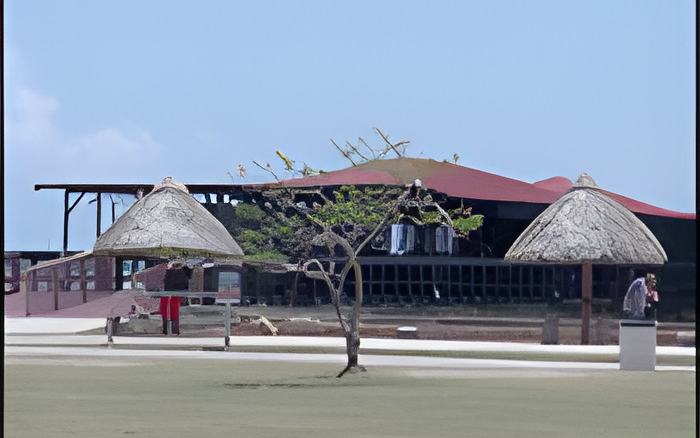
Many of the Courtrooms and office spaces have suffered water and flood damage that have left to fester to the point that the buildings are falling apart. Also, they are too small to accommodate the support staff and the general public. Some of the district courts have long since outgrown their facilities.
Sharon Frazer
"The truth of the matter is we have never been in a building that was actually designed to offer the kind of services that we expected to offer. We had to go where it is that we were put at least. At least, I can tell you that this now AG is paying attention. And in fact, so far as even getting the situational report done, it was to her office and like I said, we're looking at fixing addressing the building issues. Dangriga is a start. So, I hope that people can't say that the South is being ignored because Dangriga was the start."
Both the Chief Magistrate and the Attorney General have made the point that major renovation and refurbishing of the Magistrates Court's most damaged builds have either commenced or are in the process of being completed. They say that this study as well as other research projects on administration and case backlog will shape the reforms that will be implemented at the Magistrate Court.