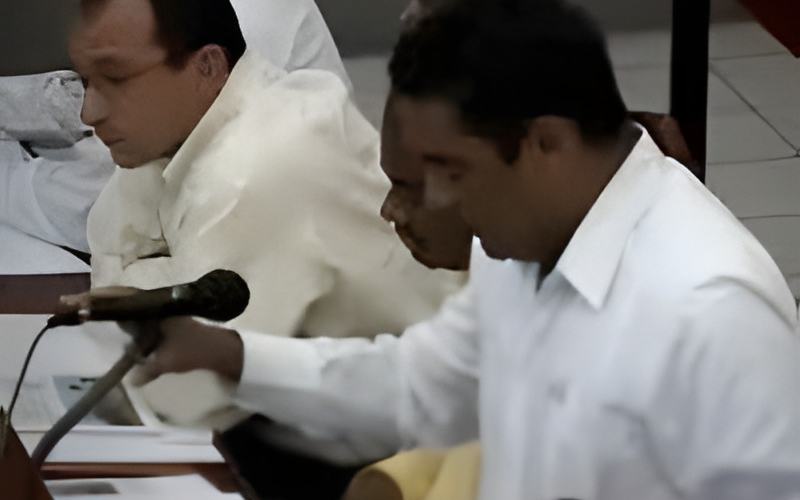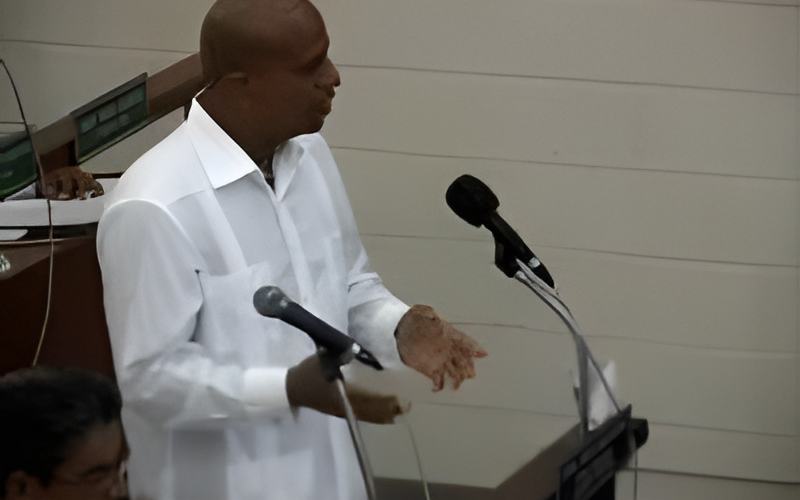

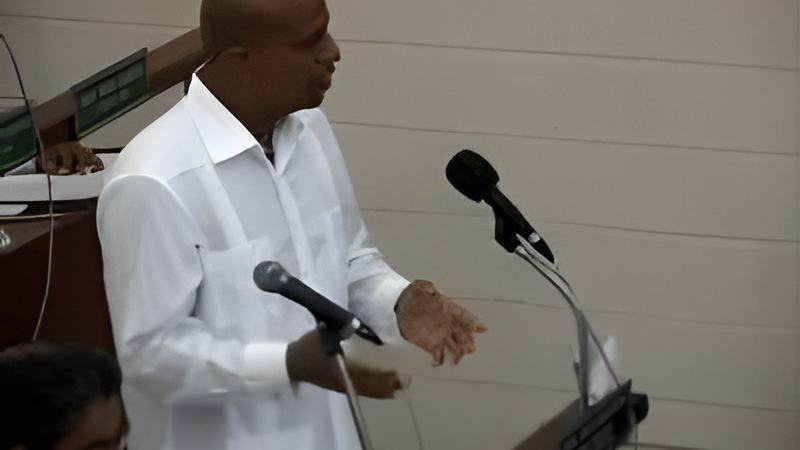
And while Coye was in court, his PUP colleagues were in Belmopan. It was the first working session of the new House of Representatives at the National Assembly building this morning. 7NEWS was there and here’s what was on the agenda.
Jules Vasquez Reporting,
New macebearer, new Speaker, and a new configuration in a very full House on one the right side of the Chamber complete with new pin striped suit, new faces and old ones back after a long break.
And on the left side, a slender Opposition bench excluding former Prime Minister Said Musa and Fort George representative, who left the country yesterday – missing his first House meeting in more than a decade. And with the newness of appearances came a new agenda.
Reform in the areas of term limits, recall of representatives, creating a referendum mechanism that can be triggered by citizens, enlarging the Senate to shift the balance of power away from the government and amending the Freedom of Information Act.
Hon. Dean Barrow, Prime Minister of Belize
“This administration campaigned to the Belizean people, especially over the last few years, on a platform of reform, on a platform of transparency, and on a platform of good governance.”
And an empowered Senate will be the center of that.
Hon. Dean Barrow,
“Part of the enlarged power of the Senate will see the Senate being able to summon members of the executive to give an account of their stewardship. CEOs, Heads of Departments will all be accountable to the Senate, will all have to report, if sent so, by the Senate on the way their department is being run and that extends as well the power to summon members of the executive on the part of the Senate. It extends as well to the power to summon Ministers of government including of course the Prime Minister.
So you can see Mr. Speaker that this is a fundamental change, this is a see change, this is a wonderful move on the part of this new administration to introduce and enshrine a clear system of accountability by the executive to the Senate of this country controlled not by the ruling party.”
And citizens are also empowered with a Referendum Act.
Hon. Dean Barrow,
“And we are saying in this regard Mr. Speaker is that if 10% of the electorate on any national issue by way of signatures on a petition ask for the holding of a referendum on a particular issue, that referendum must automatically, must asthmatically be held. Obtaining ten percent support by way of signatures on a petition will oblige the Governor General to issue a writ of referendum on the particular issue. Of course the signatures on the petition will have to be verified by the Elections and Boundaries Commission.
We’re saying for this referendum to be carried you have to have at least 60% of the electorate either countrywide or in the particular area turn out to vote. But once 60% votes then a simple majority of those voting will decide the issue. So if 51% of those that voted, providing you reach the threshold of 60%, 51% say yes it is yes. 51% says no it is no. That is what this particular bill is all about.”
And the media and citizens will be empowered by an amended Freedom of Information Act.
Hon. Dean Barrow,
“But the greatest stumbling block to the current Act is that it contains a long list of exempt documents, the access to which may be refused under the law and these provisions were always invoked by relevant authorities to refuse public access to documents. Now added to this is the fact that over the past ten years, the last government signed numerous contracts containing a secrecy clause. That was used to hide from the public some nefarious contracts that the last government signed, to hide from the public and indeed to hide from members of the last government’s own Cabinet.
I spoke earlier about this accommodation agreement between BTL and the government of Belize. None of us knew of this agreement and when I wrote to the CEO of BTL and say well you’re telling me about an agreement, a copy of which does not exist in the Ministry of Finance. I need to see that before we can even continue to talk. He wrote me back to say, ‘I am sending you the agreement but I point out to you that the agreement commits you to secrecy and if you dare tell the Belizean people about it, I will take legal action.’ That is what the last government did.
Well in this Freedom of Information Amendment Act, we are putting in a clause two which adds a new section 21a to the Act, prohibiting secrecy provisions in public contracts and other documents. It further provides that every secrecy provision in a public contract which prohibits or restricts its disclosure to the public shall be wholly void and of no effect. The days of doing things in the dark behind the backs of the Belizean people and in order to screw the Belizean people are over.”
And while that’s for accountability, the constitutional amendment to enable preventative detention is highly controversial.
Hon. Dean Barrow,
“But the controversial, the sole in my view controversial feature of this Bill has to do with the detention that we are proposing as an enabling measure in the Constitution that the police and the courts would be able to order in the case of persons suspected of being involved in gang activity, suspected of being involved in the commission of murder, but where there is no proof so that you can’t actually charge these persons.
I want to make clear Mr. Speaker that where that is concerned, all we are proposing is an enabling provision that if it is passed, would then entitle us to bring forward legislation that would set out the terms and conditions under which this form of detention would be able to operate.
The police who wish to detain somebody would have to apply to a three person committee comprised possibly of the Commissioner of Police and two others being the President of the Crimes Control Council and a Senator, one of the non-government Senators or their designees. Another thought is that possibly the Commissioner of Police will have nothing to do with it. He will have to make the application to a three person civilian committee.
But in any event it will not be that the police on their own, because we understand that people feel that there have been abuses in the past, not people feel – there have been abuses on the part of the police. I say this without prejudice to the wonderful job that they by and large do but there have been egregious abuses on the part of the police and the fear is that this power would be abused by the police. Well we would make absolutely sure that the power cannot be exercised except either a civilian majority body orders or an entirely civilian body orders it.”
And Barrow says they are prepared to withdraw it.
Hon. Dean Barrow,
“We need to understand that we will err on the side of caution. So if even a minority is against it but it is a vocal minority and there is a majority, we think in favour it but it is a silent majority, it is the vocal minority that will carry the day. We prefer to err on the side of caution.”
And while there was all the talk of renewal and reform inside, outside it was business as usual for media personnel. The oppressive, police-enforced security measures that were implemented in the last three troubled years of the Musa administration remained in full effect. Police searched media personnel and their equipment, restricted their movement and generally made things difficult for the media. The kind of thing one expects from an administration in public trouble – as was the last Musa government, but a very troubling start for a government elected with a huge mandate. When we brought it up to the Prime Minister, he made it clear that he knew nothing about it and instructed both the clerk of the National Assembly and the Minister of National Security, who also pleaded ignorance, that it should cease. We’ll tell you how it goes at the next meeting.