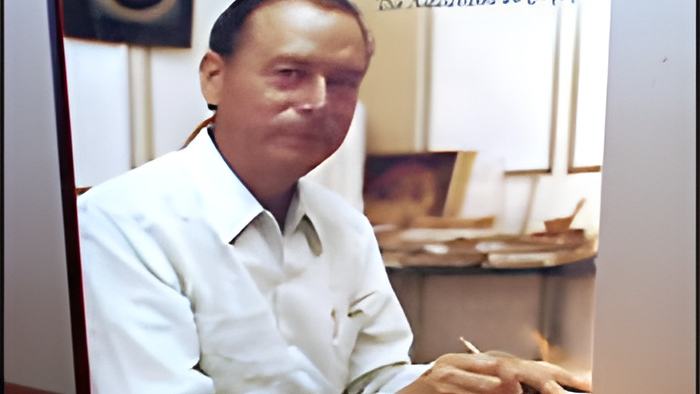
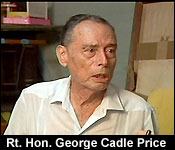
The first tell-all authorized biography of George Price will be launched on Friday and yesterday - the man Price permitted to tell the story of his life, sat down with us and discussed some of the finer details of this most fascinating book.
Smith already told us how the 90 year old Price completely let down his guard and agreed to discuss everything in his remarkable life.
For many, the most fascinating period is the birth of the nationalist movement and the PUP in the 1940's and 50's.
Price was attending the seminary on his way to becoming a priest when the Second World War made it impossible for him to continue his studies in Rome.
That's when he was forced to return to Belize - and ended up in the company of the historical giants: Robert Thurton, Phillip Goldson and Leigh Richardson.
We discussed his complex relationships with these men - first of all Thurton, the richest man in British Honduras at the time and his employer when he decided to get into politics:
Jules Vasquez
"After he comes out of the priesthood, he's jobless, and Mr. Thurton, to whom his father owes debts, hires him as a translator. Obviously, Mr. Thurton was the critical figure in his life in terms of his patronage, we believe, enabled Mr. Price. Is it one of the ironies that the greatest nationalist leader was born out of the cradle of capitalism, this ruthless capitalist, Mr. Thurton?"
Godfrey Smith - Price Biographer
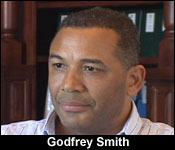
"Absolutely, I would have to agree that if you were to ask me, 'What figure, whether literary or real, what person - what thing - most influenced Price?' I would say that the single greatest influence on him was Robert Syndey Thurton. Even in terms of mannerisms, scribbling on the back, saving paper by scribbling on the back of envelopes, recycling envelopes, being very careful with the use of money, his embrace of the US as opposed to the British, his vision of Belize's place as being more Central American, I think all came out of his exposure to Mr. Thurton."
Jules Vasquez
"Now, if I read it right, or the interpretation I get is that Mr. Thurton's interest in Mr. Price as a politician - the young Mr. Price - was that Mr. Thurton felt he could use Mr. Price to ply him against the British with who Mr. Thurton was always fighting over the payment of taxes."
Godfrey Smith
Yes, That's certainly the impression I got from speaking to Price and researching around the issues. What I'm not saying that Price allowed himself to be used a tool of Thurton. I think whether because of Price's militancy against the British, Thurton benefitted, that may well be and was, but I think my own sense is that Price, in and of himself because of his perception of the backwardness that British Honduras was in, he himself built up resentment for the colonial establishment. But I'm in no doubt that that was urged along and encouraged by Thurton."
Jules Vasquez
"And then, that is the other mystery in the book, or in the life of Mr. Price. Where does he become politicized?"
Godfrey Smith
"It is true that when I asked Price what was his political influences in his adolescent years, he was not a political person. There was nothing that he pointed to that suggested to me that there were any great political influences in his life. In my view, one of the things that perhaps caused, or triggered that political conscientization in Price, was as he put it going to Guatemala where - in his words - 'My mind opened.' And he saw -"
Jules Vasquez
"When he was a seminarian."
Godfrey Smith
"Yes, he was a seminarian, and he was just totally impressed by the development he saw in Guatemala, by the universities, by the health facilities, and everything else. And he wondered, 'Why is it that British Honduras, where the British Hondurans are inclined to look down on their Central American neighbors, why was British Honduras so backward?' And the answer could only be - at that time - because of the oppressiveness of the colonial government."
Jules Vasquez
"Now, when Goldson and Richardson were tried and convicted of sedition, and they went to jail, it was one of the most amazing occurrences in Belize's history. I think it was Manuel Esquivel who framed it in the context that they were Belize's first political prisoners. What do you think was his role in that, and what do you make of the fact that when Richardson was released and a spontaneous rally was held, he didn't attend? It was held at the mouth of Majestic Alley, I believe."
Godfrey Smith
"Yes, not only did he not attend some of those rallies, but I also found that in instances, where, for instance, the Jamaica lawyer, Noel Nethersole, came to Belize, all the leadership of the PUP would be there to greet him, and to brief them on the political developments in preparation for the trial of Goldson and Richardson, and Price was always absent. His response when prodded, as I did ask him what this meant, he reminded me that he had a full-time job with Mr. Thurton, and was often travelling with Thurton abroad, and that those instances co-incided."
Jules Vasquez
"The sharp inquiry of 1956, the contact or no-contact, now Price, almost counter-intuitively immerged from that a people's hero."
Godfrey Smith
"Well, I don't agree that it was counter- intuitive that he immerged as people's hero. By then, Price had engineered, crafted, the art of house-to-house campaigning, and making himself personally known on an individual basis to people throughout the length and breadth of Belize. By the time of that inquiry, Price, I would say, was a well-established politician, and had a firm grip and handle on Belizean politics, and on the mind and psyche of the Belizean people. His triumph, if you will, remember now that the inquiry found that there was contact. It just didn't go on to say where the actual money was coming from. It didn't say that it was coming from the Guatemalan Government; it said that it possibly could have come from the newspaper association etc. So, but nonetheless, it was a triumph, out of which came the slogan, 'Contact or No Contact, PUP all the way'. In other words, the people didn't care, whether Price or the PUP had contacted Guatemala. It was PUP all the way."
Jules Vasquez
"Now, on 103, you wrote that Mr. Price, at the Battlefield Park Meeting, 'Any accusation that the party is receiving aid from Guatemala to work against our own, is therefore absurd, ridiculous, unfounded, and possibly malicious.' Putting it as he did, it could be fairly interpreted that the party was receiving aid from Guatemala to fight the British, who Price did not consider to be 'our own'. This, you wrote, 'This was actually the case, as Price had been receiving monthly cash contributions from the Guatemalans for some time.'"
Godfrey Smith
"Yes."
Jules Vasquez
"This is the first time that I know, that this assertion has been made in any serious work of research."
Godfrey Smith
"And it has caused, as I understand it, a bit of a stir in some political quarters for the reason that Price always denied, as he had to, that he was receiving money from the Guatemalans. He had to because we were a colony governed by the British, and obviously, actions could be taken against him by the colonial government if he freely admitted. And we know that no politician would. The fact is that he was receiving the money not use, as he put it, against his own, but it was used to fight the British Government. I personally see no difficulty with it. I think it was a master stroke. I think was a bold and 'ballsy' move on is part. He had to find money where he could to keep the propaganda going, and to engage in political warfare. It might have required less funds then, but a political campaign in any period in history, to be able to campaign successfully, to be able to put out your propaganda, to be able to mobilize, have flags etc., requires money, and he was getting it from the Guatemalans."
Tomorrow, we'll continue our discussion with Smith and talk about Price's transition from enemy of the Colonial Government to the establishment figure who led Belize to self-government and Independence.