

Today's Climate Outlook Forum also provided a detailed post-mortem of last year's hyperactive hurricane season. 2020 was particularly challenging for the countries in the hurricane belt and Belize, like other neighbouring countries, had to be on high alert. Viewers will remember that Hurricanes Eta and Iota caused the most destruction in Central America. But the experts say that there were 3 main climatic variables that lined up perfectly to cause an abnormally high number of tropical cyclones during last year's season.
Here are a few excerpts of a presentation on the topic, which was made by Dr. Cedric Van Meerbeeck, a climatologist at the Caribbean Institute for Meteorology and Hydrology.
Dr. Cedric Van Meerbeeck - Climatologist, Caribbean Institute for Meteorology and Hydrology
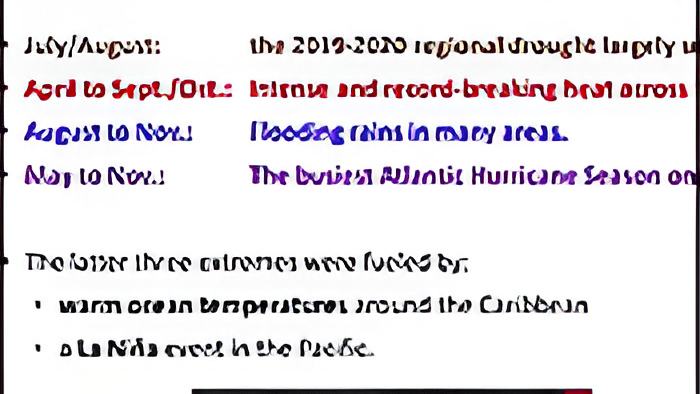
"The year 2020 started with a drought, which continued on from 2019, and that drought kind of largely subsided region-wide between July and August. Now, we all remember that in 2019, the drought in the northern parts of the country was really, really dire. So, that was part of the same regional drought event. So, we started out with drought, then from April to October, we had intense and record-breaking heat across the region, which was partly also caused by the drought, including in Belize. Then, from August to November, there were flooding rains in many areas, and all of that supplanted by the business Atlantic Hurricane Season on record. The latter 3 extremes were fuelled by the warm ocean temperatures around the Caribbean, and also by a La Nina event in the Pacific. Those two factors are, to an extent, predictable, up to several months in advanced, and that means that the major hazards that depend on those conditions can also be forecasted to a certain extent up to several months in advance. Briefly again, the 2020 Hurricane Season, we've already looked back at that, there were 30 named storms, and overall activity was about 1.8 times more energy given by the storms that than on a regular year, and you could see that several of those agencies that were mentioned by Mr. Gordon, including also CIMH had also forecasted a much higher than usual activity of tropical cyclones for 2020. And CIMH also, in addition to season-wide forecast, we also look at parts of the season. In 2020, you could see that all those agencies, including CIMH, had forecasted with high confidence that there would be many more storms than usual. The last impact for the hazard was heat. The heat was so prevalent last year, that at the end of October, CIMH issued a press [release] stating a record-breaking heat in 2020 across the region and is that really a new norm. You could see that, in terms of maximum temperatures, in terms of the number of heatwaves, etc. It was really a remarkable year."
According to Dr. Meerbeeck, Belize was one of several countries in the region that experienced at least 30 heatwave days between July to September of last year.