Former DFC general manager Roberto Bautista continued to testify before the Commission of Inquiry today. On Tuesday he detailed the circumstances that led up to the DFC issuing the Novelo's group with a $30 million loan in one day. That was against every DFC rule, and even the terms of the agreement. So why was it done? That's what today's questioning centered on.
David Price, Chairman
"The long and short of the matter is that there were gross irregularities in the disbursement of the Novelo's loan. What the commission needs to establish is whether those irregularities go beyond mere irregularities, whether they constituted some kind of wrongdoing, perhaps of a criminal nature."
And in that search, they continued to ask questions about the $30 million Novelo loan, especially the $2 million in legal fees that were paid to process it.
Herbert Lord,
"Which company handled the Novelo Company loan?
Roberto Bautista,
"The Novelo company, from information in the files, it shows that it was the Glen Godfrey Company."
Merlene Bailey-Martinez,
"So the Glenn Godfrey Company was handling the legal arrangements and it was Glen Godfrey who authorized the disbursement, unilaterally?"
Roberto Bautista,
"Yeah."
Merlene Bailey-Martinez,
"When Glen Godfrey authorized the full final disbursement, how did that affect Glen Godfrey's law firm in terms of its receipts of legal fees?"
Roberto Bautista,
"The legal fees, I don't recall at what point it was disbursed, whether it was disbursed before this or after. I believe it is was done after because if you notice we retained $2 million for legal fees."
And while Godfrey authorized the transaction and his firm collected on it, Bautista said that if the rules had been followed this would not have happened.
Herbert Lord,
"So had we used the DFC's schedule, follow it up payment for payment as you go along, we would not be here today?"
Roberto Bautista,
"I agree with that. That is what should have been done."
Herbert Lord,
"It seems that each and every guideline there was never met and yet in the end, our biggest institution passed out in one day, one morning and in the afternoon, $30 million. So in one day $30 million was passed out and there was nothing we had left to control those monies and therefore today with that, still additional amounts were paid out again to keep the interest going and we are still at $32 million after having sold many of the properties. And of course many of them were never transferred to the DFC as was agreed."
Roberto Bautista,
"Well the only thing I can say is that the auditor should have had control."
Herbert Lord,
"Bearing in mind of course that you were one of the major players, it was your signature which authorized it, subsequent to the other officers saying it was okay."
Roberto Bautista,
"I am saying that if management was given the control, we would have had control in the implementation of this project, then that would not have happened."
But the Chairman was in charge and Commissioner Lord asked Bautista how far he'd go to obey Godfrey.
Herbert Lord,
"But not every decision made by the Chairman has to be carried out by the General Manager. There is the case of Adolph Eichman who says I followed orders. Are you telling me that every order that you are given you will follow?" "
Roberto Bautista,
"I am not saying that."
Herbert Lord,
"That is what you are saying."
Roberto Bautista,
"In this particular case what I am saying is that the Chairman is the one who instructed me to do so in writing and verbally."
Merlene Bailey-Martinez,
"I am just saying that when you look at the agreement, what his instructions were, were contrary to the very agreement that the Novelo's signed."
Roberto Bautista,
"As I said I followed instructions. He is my boss, if I didn't so, I would be charged for insubordination."
Merlene Bailey-Martinez,
"And the country would have been grateful to you."
And management also followed orders when it came to a $1.5 million fully disbursed loan for Papi Pena to assemble buildings in the Corozal Free Zone.
David Price,
"Was that project ever built?"
Roberto Bautista,
"From what I noted in the reports, that project was not completed. It was not done. The material and everything was in the country, he had them at his warehouse, but despite several follow-ups he never did set it up."
David Price,
"You have any idea why that was so?"
Roberto Bautista,
"I don't know if he changed his mind because he stopped building and they started stealing some of the materials."
It is a loan that's not recoverable based on the collaterals.
Roberto Bautista,
"I don't think we will be able to recover the $1.5 million because if it was completed, perhaps yes. But as it is, it is just the land that is available."
David Price,
"There was little action on it for at least two to three years. Could that
be because this was one of those sensitive loans?"
Roberto Bautista,
"Yes sir."
David Price,
"Sensitive in what sense, economic or political."
Roberto Bautista,
"I don't know how to answer that question. All I can say is that management did not have control in moving against this loan much earlier. We have reminders, we even demanded the loan, but when we reached to the critical stage of publication, it was put 'on hold.'"
David Price,
"Who instructed that you hold on?"
Roberto Bautista,
"A lot of this "hold on" came from the credit committee."
David Price,
"Which is chaired by the deputy chairman of the board."
Roberto Bautista,
"Yes sir."
Another loan that got some degree of protection was Bill Lindo's Western Development Limited which got two loans totaling $1.3 million approved for the purpose of purchasing a dredge for land reclamation at mile 2 - and where is the loan now?
Roberto Bautista,
"The loan is non performing. We have assigned it to our attorneys and that is the status at the moment."
David Price,
"What has happened to the dredging equipment?"
Roberto Bautista,
"The dredging equipment was, I think it was floated somewhere around, I don't know the exact site in Belize, but it is not good. It is not workable. We have tried to sell it. We had it at one time in the papers but when they looked at it, I don't think it was in a good condition so the offer was negligible, almost nil. $10,000 was being offered and we couldn't sell it for that. So it stayed right there and it is not working, it is not good."
David Price,
"To whom does it belong?"
Roberto Bautista,
"It belongs to the DFC because we held a bill of sale but I don't think anybody wants to buy it because as I said, it is more scrap than anything at the moment from what I gather."
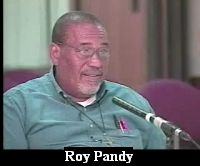
And from bad loans to questionable accounting practices, former financial controller Roy Pandy testified in the afternoon session. As the financial controller he's the one who booked the $50 million transaction that took place in March of 2004, where DFC was asked to put a roundtrip transaction on its books for money never received.
David Price,
"Ms. Longsworth refused to book that transaction. Were you aware of that?"
Roy Pandy,
"I don't know what position she took on it but…"
David Price,
"You subsequently booked that transaction."
Roy Pandy,
"Yes."
David Price,
"On the basis of what?"
Roy Pandy,
"The transaction was booked and a CD was issued in favor of the government of Belize."
But did he see the $50 million CD? That become a bitterly contested point.
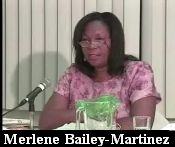
Merlene Bailey-Martinez,
"Mr. Pandy, was that $50 million ever deposited in any account of the DFC?"
Roy Pandy,
"The $50, the $50 million was put in form of a CD in favor of the government of Belize."
Merlene Bailey-Martinez,
"Was the $50 million every deposited in any account of the DFC?"
Roy Pandy,
"Not that I know of…a CD was issued."
Merlene Bailey-Martinez,
"No, that is not what I am asking…did it ever go into the accounts of the DFC? Yes or no?"
Roy Pandy,
"I don't really remember the transaction as such."
Merlene Bailey-Martinez,
"You don't remember?"
Roy Pandy,
"No."
Merlene Bailey-Martinez,
"I know you understand what I am asking Mr. Pandy and you're not answering."
Roy Pandy,
"No, no, I am telling you how the transaction was handled."
Merlene Bailey-Martinez,
"How did the Belize Bank put it into the account of DFC?"
Roy Pandy,
"At the Belize Bank, what was done, is this is the $50 million to DFC and the agreements spells it out. It says that this will be a CD in favor of GOB. That is the transaction that would happen."
Merlene Bailey-Martinez,
"That is what you based your thing on? Did you see that certificate of deposit?"
Roy Pandy,
"I don't remember seeing it."
Merlene Bailey-Martinez,
"If you are saying that it was not on the basis of a deposit into the account of the DFC, it is not on the basis of you seeing or having in your possession a certificate of deposit, what is the basis on which you booked that transaction?"
Roy Pandy,
"I don't remember if I had a copy of the deposit but I am telling you government recognized that it got the $50 million."
Merlene Bailey-Martinez,
"You are saying that the proof of that transaction is a certificate of deposit that issued to GOB and you are also saying that you never saw that certificate of deposit so what is the basis? You did not see a credit to your account at the Belize Bank or anywhere else, you did not see a certificate of deposit, what is the legitimacy of this transaction in terms of funds transferred from Belize Bank to the DFC or if you want to extend it out to the GOB?"
Roy Pandy,
"There was no movement of funds. The funds were in the form of a certificate to the government of Belize."
David Price,
"Your claim is as much as it can be, a claim, that this was a legitimate transaction, but the commission of inquiry is not of the view that it was a legitimate transaction."
As we reported in 2004, the IMF visited Belize in August of 2004 and roughly criticized the $50 million paper transaction, calling it round tripping, where the money would go, or appear to go, and then return to its source, in this case the Belize Bank.