

A month ago, we told you about the latest upgrades that the sugar industry is making to increase operational efficiency. The stakeholders have set up a digital portal to allow the cane farming associations to connect directly to the ASR/BSI, and all of the domestic creditors so that loans and all matters related to financing can be streamlined.
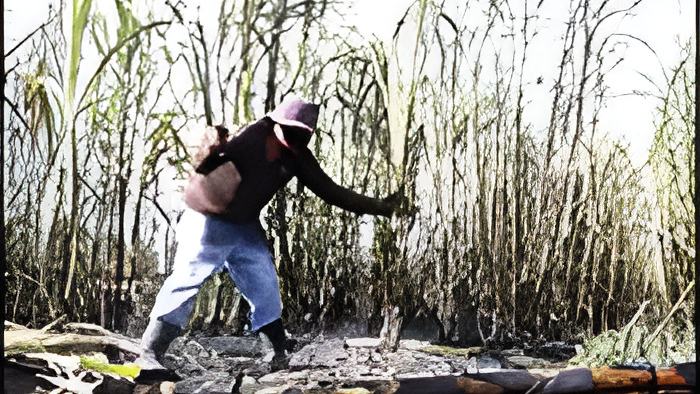
And now, the cane farmers are making a big step to regularize their industrial relations with the more than 1,800 cane cutters who work their fields. As viewers may be aware, manual harvesting is difficult, manual labor, and insiders in the industry have hinted that the working conditions for the cane cutters are usually bare bones.
As with other forms of agriculture, the cane cutters often come from the immigrant community, and so, paperwork such as employment contracts aren't a feature. The cane farmers have decided to change that, and with the help of the regional organizations they do business with, they've come up with a Booklet for Good Hiring Practices in the Cane Farming Sector.
That document was officially launched today in a virtual ceremony, and 7News tuned in. Daniel Ortiz reports:
The working relationship between cane farmers and cane cutters, the seasonal employees of the sugar industry, is about to improve significantly with the roll-out of the Booklet for Good Hiring Practices in the Cane Farming Sector.

Basically, it is a rule book and a guide which outlines how farmers ought to treat cane cutters, so that they will easily comply with both Belize's domestic labor laws and the ethical requirements they must meet to keep their certification with Fairtrade.
Sarah Singer - Senior Supply Chain Manager, Fairtrade Foundation UK
"Fairtrade recognizes that for some highly labor-intensive products like sugar, some farmers need to hire workers, for example, to support the harvest, like the cane cutters in Belize. These workers, without access to land, have very few options for sustainable livelihood. Many are seasonal migrant workers, who are often transient and face particularly precarious employment situations. They often lack formal contracts, basic health and safety assurances, adequate wages - among many other challenges. So, what does Fairtrade do to enforce good working conditions and to protect these workers? Fairtrade International starts with the core ILO conventions and recommendations and the main reference for good working conditions. The Fairtrade standards clearly state there must be freedom discrimination, no tolerance of violence or abuse of any kind, no forced labor. If forced labor is found remediation must be taken. No child labor, again if child labor is found, remediation must take place."
"Workers must also have fair conditions of employment, and there are also occupational health and safety requirements. Many of these requirements in the Fairtrade standards are core requirements that certified organizations must meet to become Fairtrade-certified."

The stakeholders in the sugar cane industry took a long and honest look at their employment practices for cane cutters, and agreed that the conditions for this group of workers were getting dangerously close to forced labor. So, with the help of Fairtrade and its regional partners CLAC and COOP, the farmers, the cane cutters and the ASR/BSI conducted an extensive consultation process to try and agree on fair working conditions for sugar cane harvesting. They even had input and advice from the Social Security Board, and the Labour Department.
Olivia Avilez - Cane Farmer Relations Manager, ASR/BSI
"One of the key important aspects is the price of the tasks, what are the responsibilities of the cane cutters, in term of what they come to do to the field. What are the responsibilities of the harvesting group leader? And number 1, as in any job, it's how much they will get paid. I think that's one of the first that needs to be clear between them."
"The other things are working conditions in the field, things like personal protective equipment. That's one of the things that really came out from all the training. We don't have enough money for PPEs. We know it is important, and how can we get them? That's where we try to close the gap, address those barriers. Shin guards are one of the most important pieces of PPE when we talk about cane cutting, shin guards, and goggles. And that is stipulated in the contract. Also, simple things like water, ensuring that there is water in the field, for productivity, and also for ensuring health conditions. Some other things are working hours. Working time during the week. We have to ensure that we have a 45-hour during the week, and we don't surpass that without ensuring that there is a proper accounting of overtime. 1 day's rest was a key contention point between the whole process. One of the things that we had to look at, for example, is yes, the cane cutters do need a continuous 24-hour rest time."

And while most of these are victories in favor of the cane cutters, the farmers employing them also get benefits.
Oscar Alonzo - CEO, Belize Sugar Cane Farmers Association
"The Associations to which the reaping group leader belongs will be able to show compliance with the Fairtrade standard that now requires the existence of written contracts of employment. Major sugar, especially the Co-operative Group of England will now be assured that sugar cane production is being undertaken under the appropriate labor conditions required by international labor conventions and the Fairtrade standard. Both international household and industrial consumers will be more eager to purchase Fairtrade sugar, as they will be aware and be content that the impact of the Fairtrade premium, which they pay, will be impacting cane cutters among others."

Anselmo Marin - Zone 3 Manager, PSCPA
"As a cane farmer, I think this will help in a positive way. This will help the cane farmer, and at the same time, the Group Leader, because in having signed a contract, the cane farmers will depend that this person will arrive at work to do his job, which is to cut cane. Similarly, the group leader will not have to be thinking, 'I wonder if my people will reach work today or not.' So, I believe that this is an agreement that has always been done verbally, but it has not been done in writing."

And now that all these worker/farmer concerns will be properly penned out in writing, Belizean sugar stakeholders are getting a thumbs up.
Malcolm (Mac) McLachlan - V.P. International Relations, ASR Group
"Belizean farmers can be rightly proud of their 12-year, Fairtrade journey, the elimination of harmful chemicals, action to counter child labor, action to ensure the health and safety of the workforce, and the creation of a fair and ethical employment climate for so many people in Belize are all examples. These are all continuing, positive contributions to the sustainability of our industry, for which the farmers deserve great credit."

Julia Clarke - Director, Ethics, Tate & Lyle Sugars
"The contracts book is now ready to distribute, and ready to use in the forthcoming crop. It's a brilliant achievement. This is a fantastic moment. I am delighted to celebrate it all with you. I congratulate you all on your achievement, and I wish you all the best for the forthcoming crop."
Emily Pearce - Fairtrade Officer at Co-op

"Congratulations on the launch of the Booklet for Good Hiring Practices in the Cane Farming Sector, and your work to pioneer a better future for the sugar cane industry."
These employment best practices are supposed to be implemented in this upcoming sugar cane season, which should begin in a few weeks' time.