Last week Friday, we gave you a preview of our tour of the National Gas Company's brand new Stann Creek LPG facility. That's where the public-private company has established Belize's first marine terminal to receive cooking gas, which Belizeans know better as butane.
National Gas has replaced the big Central American companies, Southern Choice Butane, formerly known as Zeta Gas, Gas Tomza, and Belize Western Energy Limited, as Belize's only importer of LPG.
As viewers will remember, the former importers have been on a campaign to discredit National Gas even before they officially introduced themselves to the general public. On Friday, after months of finalizing their operations, the National Gas Company invited 7News in to see how they do business as a 60-million investment. Our news team took a tour of their Independence Village facility, and Daniel Ortiz has that story:
This unassuming building is the office of National Gas Company's operations center and oversight facility in Independence Village, Stann Creek District.
(NGC Over-head Drone footage of the office and the 19 LPG tanks and 00032.MTS)
The entire compound is situated basically right next door to the Port of Big Creek, and it was strategically placed there.
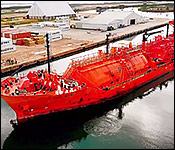
(The Best pieces of the drone footage of ship being guided to dock at Marine terminal and picture - with motion - of company employees overseeing a shipment)
This location allows for Belize to have its first marine LPG terminal.
The country's international LPG suppliers can ship monthly quantities of the cooking gas to provide stable and uninterrupted access for consumers.
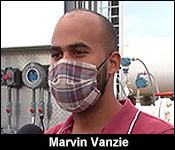
Marvin Vanzie - Operations Manager, National Gas Company
"It all really starts by the dock-side in the Port of Big Creek. There, a ship comes every 4 weeks - every 4 to 5 weeks - depending on the consumption for that month, and it brings about 1.2 million gallons of LPG. And when I say LPG, I mean it brings 2 separate products. It brings Butane, and it brings propane. It docks there, we will then connect to that ship with our hoses."
The terminal is directly connected to the facility's 19 mega tanks through a series of underground pipes that were constructed with safety and durability in mind. This facility has to be insulated as best as possible from the risks of an industrial fire since over a million gallons of highly flammable fuel are stored here.
Marvin Vanzie
"From there to our main facility, where our tanks are, is about 1,500 feet of pipeline. We have 8-inch lines, 6-inch lines. They go underground, and then, they come to our facility."
"Belize doesn't necessarily have building codes for an LPG facility. We had to look to the US codes. There's one in particular called the NFPA-58 - National Fire Protection Association. Code 58 is specific for LPG."
"At our facility, the propane goes into its own batch of tanks, and the butane goes into its own batch of tanks. We have 6 tanks dedicated for butane, and we have 12 tanks dedicated for propane. After that, those products are blended, and then, they are put into what we call the blend tank."
The blend that the operations manager is referring to the legally-regulated mix of 70 % propane and 30% butane that you should be getting. If a company is pumping a higher percentage of propane into your tank, you aren't getting far value. If your mix doesn't have 30% butane, your gas will run out faster.
Another important detail is that the National Gas Company doesn't sell directly to you, the consumer. As the importer, they sell to the butane companies, which retails to you, whenever you call one of them to refill your tank.
Marvin Vanzie
"We have a specific system that's for blending, and that does it according to what the Belize Bureau of Standards dictates. In our case, we're allowed to blend 70:30, or 70% propane, and 30% butane. Now if a customer requires a different blend, they'd have to go through the Belize Bureau of Standards to get that."
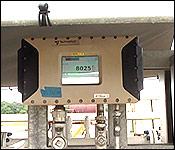
"When a customer makes an order, then we'll know how much product to blending starts at the blend skid, which is on our leftover there, and the device basically has some of the most accurate meters that are available. They're called micromotion Coriolis meters and those detect the exact amount of product and also compensates for temperature and pressure."
"Those meters are there to make sure that we get the right accuracy, rather than some false figure, that might be misleading."
Those micro motion Coriolis meters are the most expensive pieces of equipment on this compound, but National Gas invested heavily in them as a key oversight and consumer protection feature.
Marvin Vanzie
"They do a real-time calculation on the exact amount of liquid that's passing through there, if it is liquid, or it's in a gas phase. And then, it also looks at the temperature and pressure and says this is exactly what went into the customer's truck, not less, not more, and that's standard to 60 degrees Fahrenheit."
"There is not one other device that's more expensive than that on the compound."
NGC also has a delivery service that is used for customers who meet a certain threshold.
Marvin Vanzie
"[For] larger customers who order 10,000 gallons or more, it's our trucks which actually go and do that delivery. Smaller trucks that are about 2,200 gallons and up are the ones that actually come to our facilities to do purchasing."
All of the facility's main functions and features, including its real-time vehicle fleet tracking system, is done from its control room.
Marvin Vanzie
"The control room is our main hub of information. Basically, all activities are approved here."
"Some of our main functions here, apart from making sure we keep things safe, is also to keep things on track and on schedule. A big part of our relationship is not only receiving product, but it's getting it to our customers."
"We have a schedule that people expecting be on a specific day at a specific time. Our control room operator here basically monitors our trucks. We have our fleet tracking system, which is this screen over here. And on that screen, you'll be able to see that it tells you the location of your trucks. It tells you what time was the last time they passed a specific point, if they stopped, how long did they stop. And then, it allows for the control room operator to call that person up, and say, 'Hey, what's up? What's going on? I noticed that you stopped for more than 5 minutes, is everything okay?"

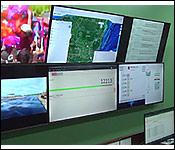
Sergio Caliz - Control Room Operator, NGC
"We know exactly where the truckers will start. We go based on the schedule. That basically schedules off where exactly we're going to send the product."
"If there are any changes, they would notify me based on an email. And from there, I would update the schedule, call the drivers."
Marvin Vanzie
"For all 3 facilities, before a truck could even receive the product, the control room has to be the one to actually press that final button. The operators will call and say, 'Hey, we're ready to load.' He'll be able to see here if the truck is connected."
"He'll verify verbally with the guys over the radio, or over the phone, and then, he'll give that final press of a button."
"From here, he's able to see the amount of product that is in each tank, in each facility. So, if they are consuming the product, even before they call and say they need more product, he'll be able to send a truck to a facility because they needed it. He can see that they need it."
The National Gas Company has 2 other branch facilities as part of its supply chain for the retail companies: one in Orange Walk, and the other in Belmopan, where the company's corporate headquarters are located.