

Two weeks ago, we showed you what Prime Minister Briceno had to say about his government's plans for minimum wage when the press asked him about it. He declared that the minimum wage was set for implementation at the start of the year. That means that Belizean laborers who were making three dollars and thirty cents an hour will go up to five dollars an hour.
Tonight, the Belize Chamber of Commerce and Industry is raising concerns that the government is not carefully considering the potential negative impact that it could have on the same employees who would most benefit from the increase in salary. They make the point that they and their membership, who are employers, are completely in support of the proposed increase. But, they are asking the government to go back to its March 2022 position of a phased-in approach, similar to the increase in Social Security contributions.
We fast forward nine months later, and the PM is now insisting that it should happen in one fell swoop.
That leads to the BCCI's second issue on this issue. They also point out that the minimum wage has been used as a political football by the two mass parties for political expediency, which is partly why the minimum wage hasn't been addressed in 10 years. So they are recommending a calculation formula that would look for key indicators and automatically trigger smaller incremental increases annually, using an evidence-based approach. That way, employers wouldn't have to take such a major financial hit all in one go, the employee gets their salary increase, and the political directorate won't be able to dominate and control this conversation that should transcend party politics.
The Chamber held a 2-hour information session with the press, and here are a few takeaways from that discussion:
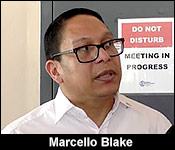
Marcello Blake - President, BCCI
"First, there are two overarching points: 1 that it must be done in a phased manner. It has to be done gradually, and also for there to be triggers. So, there is a formula that we're recommending which should be looked at. [It] doesn't have to be used, but at least it is a guidance note for the government to be able to then put triggers in place so that we're in this position where ten years have passed since the last increase. The Chambers supports the increase. We're just saying it has to be gradual so that our members can adjust to the economic strains that they will definitely be faced with."
"The politicians, as usual, continue to do what Dyon refers to as speech framing. That is, they get out there and say what they want to say, and then the public takes it as a fact when - in fact - there is a process. Why go out and make certain pronouncements when you have a task force that was assigned? Let the process go through to the end before the politicians get out there and speak. I think that's what they need to take a look at. Obviously, for political reasons, it works for them, but at the end of the day, it deters those who may want to participate in the process from saying hey, if you're saying it's so, then it's so, and so, there is no way we can change your mind."
Daniel Ortiz
"Explain to us how maybe the Prime Minister's pronouncements recently that five dollars an hour will be implemented by the end of the year - how that impacted the participation of employers."
Marcello Blake
"As I said before, members felt that okay, the government has spoken. This is the way things will go, and so, why would I - I don't want to use the term waste my time, but why would I invest additional time and resources to be at the consultation when in fact, the government is saying, '[It] doesn't matter what you say, five dollars come January 1."
We also got a chance to speak with the Chamber's Chief Policy Analyst, who has been researching minimum wage changes in other countries, and he told us that international trends have shown patterns that significantly increasing the minimum wage overnight can have severe adverse effects on the section of the population it should actually be benefitting and protecting. They could suddenly find themselves disemployed by their companies. Here is an excerpt of that discussion:
Dyon Elliott - Chief Policy Analyst, BCCI

"[The] President made reference - or alluded to the balanced and evidence-based approach. So, the Chamber of Commerce is the employer's representative for the International Labour Organization."
"To make the point again, we are in agreement with increasing the minimum wage, but if you consult the ILO's balance and evidence-based approach, it says to you that, among other things, there is a gap between what workers need and what the economy can afford. The ILO goes on to tell you in their minimum wage policy guide that if you are going to make these changes, it needs to be successive and gradual because if you do it too fast if you try to do it in one fell swoop, you can trigger adverse economic effects. So, what are those adverse economic effects? There are potential disemployment effects. Low-skilled workers we could see a situation where there is less demand for low-skilled workers. You can see some low-skilled workers losing jobs. It is possible that you can see that non-wage benefits are cut because employers are struggling with very thin margins. Some of them are still in the red, actually. You will find that they may - okay, we'll just cut back on non-wage benefits: bonuses, extra holiday time - whatever the case - may be to try to make ends meet. You may also see - which is my biggest concern, and [which] I think should be everybody's biggest concern - when you look at the change in the employment structure, the composition of the workforce. There has evidence in other jurisdictions where a too-sharp change in the minimum wage overnight has led companies to say, 'Well, instead of hiring ten low-skilled workers, let's get four semi-skilled or high-skilled workers, and reduce the hiring of low-skilled workers, basically going contrary to the redistributive effect that the minimum wage was supposed to be protecting against anyway. So, employers and businesses are going to find ways to offset these costs. Another thing that you may have is on you, the consumers. Some companies - I won't say which industries - have already started to prepare themselves to pass on that price to absorb the increased cost. There are at least 11 different things the empirical works and research in this area have shown can happen. Now, what you should ask the Government is which one of those is most likely to happen in Belize. Has that study been done?"
We also asked Elliot about the preliminary estimates of the overall increase in the wage bill if and when the government implements it on January 1st. He told us that the estimates suggest a sudden increase in the private sector's wage bill of 200 million dollars overnight:
Dyon Elliott - Chief Policy Analyst, BCCI
"We're talking about 2020, almost 14 to 16 percent recession. We're still getting back on our feet. A lot of companies are still struggling, even getting back to normal."
Daniel Ortiz
"Getting their employees back to 100% [salary]."
Dyon Elliott
"Exactly that is still happening. So, you're already competing with record inflation. Belize hasn't had inflation at this level for at least 13 years, and we know why: the international effects and all that type of stuff. Fuel prices are high. Food prices have been fluctuating significantly. You had a backlog with shipping that had been increasing container costs. All of these trickle-down. Fertilizer prices have gone up, and then, in this already struggling environment, among other variables that I have not mentioned, you have a 52% from $3.30 to $5 overnight."
"Using general data from the SIB - and again, this needs to be drilled down [on] further. This data should be coming from the Ministry of Labour - whatever government agency is responsible for this. But, from our estimates, we're seeing close to 200 million dollars being added in payroll costs just overnight if that happens like that."
We'll have more from that interview in our subsequent newscasts when you'll hear why the Chamber thinks that companies should be incentivized to provide better living wages to their employees.