
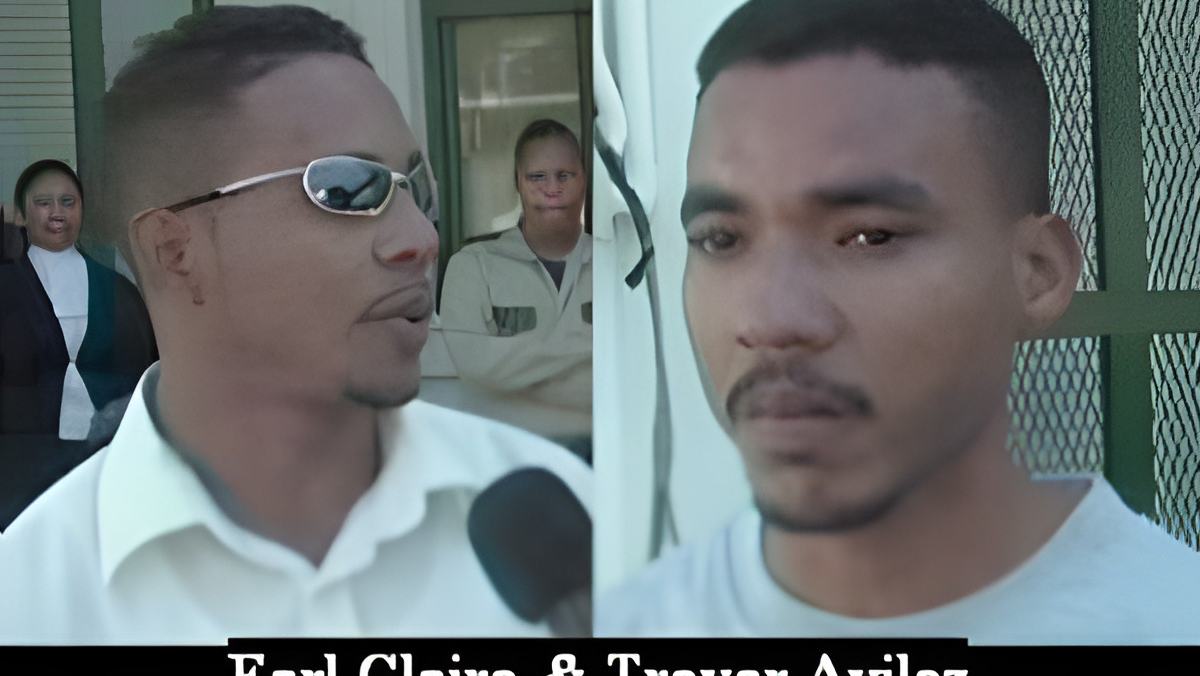
But first, two men accused of killing a man in two years ago walked out of Supreme Court free men today. Earl Claire and Trevor Avilez who were accused of killing Celestino Zetina on July 9th of 2005 today had their day in court. The case hinged on caution statements given at the time of the arrest. Their attorney Michael Peyrefitte prompted a trial within a trial to see if it was admissible. And that's where the case broke down. Alfonso Noble found out what really made the case go down.
Alfonso Noble Reporting,
This morning Earl Claire and Trevor Avilez who had been accused of the 9th of July 2005 killing of Celestino Zetina walked out of court free men. And as they did, Doroteo Zetina, the father of the man they were accused of killing, expressed his disappointment.
Doroteo Zetina, Father of Deceased
"I feel very bad about it. I feel very depressed. First they let go four and now the next two walked away freely. That is real bad, this place doesn't have justice at all, no kind of justice. But I will leave it to God, I know God will deal with them. I will always this in my mind because the way I saw my son that day, his picture is always in my mind, the way he was - all opened up, all eaten up by worms. It was not a pretty sight."
And while Zetina will be haunted by the images of his decaying son, Claire and Avilez are now trying to move on. Now free, both men believe justice was served.
Trevor Avilez, Acquitted
"The judge made up his mind and the public knows and the judge knows that we are innocent of this crime. We will just continue to move on, find something positive to do and not follow the wrong person."
Earl Claire, Acquitted
"Justice was served. It is a new page in my life, I need to carry on as the productive individual that I am. Due to the negligence of the police officers, I spent nineteen months in prison, innocently. My life was ruined because of this, my reputation was ruined because of this, just because of their negligence in investigating matters properly."
And that's the lynchpin in this case. Prosecutor Audrey Matura explains that caution statements by the accused were all that the prosecution had to go on.
Audrey Matura, Crown Counsel
"There was conflicting evidence coming from the police officers who dealt with the confessions, that is who dealt with the two accused from the moment they picked them up from their house that morning to the time that they gave the statement. The biggest conflict came with the evidence of then Inspector Puga, who is now no longer with the department. While when he gave evidence that first he said he didn't offer any inducements, he didn't use force, he didn't use any threat - surprisingly when he was cross-examined by the defense his story change and he basically said he promised Trevor Avilez that if he gave me information where to find the body and assist the police, he would assist him. While he didn't say affirmatively that he would not charge him, the accused is saying that Mr. Puga told him that he would not charge him. In law that couldn't be voluntary, that's called an inducement.
For Earl Claire, he's saying that he was held for over twenty four hours, his constitutional rights were denied, meaning he wasn't given a phone call, there is still dispute as to whether he got food. But at some point we know he got food but the police there messed up again. Police seem to fail or seem to forget that when you have a person detained, you have to log down everything you do with that person. The minute that person is detained for murder, you have to detain him, tell him of his constitutional rights, you have to caution him that he doesn't have to say anything. And it is not only to tell him of his constitutional rights but to ensure that he can exercise those rights. In the case of Earl Claire he is saying he didn't get a phone call and he didn't get to communicate with anyone and by the time he was asked to give that statement, his free will was not there and he could not give it voluntarily. So there is something definitely flawed with how the police conducted their investigation. If they had documented everything they did; when he got food, when he got visitors, if he had any, that they offered him a phone call, and all that - he would have been able to come and make these claims. So although these guys are saying we participated in the killing of Zetina, the law is saying that they only said that, they only confessed to that because at that moment they didn't freely or voluntarily offer that information. What the prosecution could have done is to offer a deal to one of them to be a witness but then this case and the decisions as to this file occurred before the present DPP and that decision, the present DPP, would not have disturbed. I wouldn't be at liberty to tell you all the details that transpired before because I was not involved in it, I only know that when I got the file it was to come to court and to do what is best that we can do with the little we had on the file."
And that little that was in the file worked to the defense's benefit. Attorney for Claire Michael Peyrefitte explains.
Michael Peyrefitte, Defense Attorney
"Basic fundamental procedures were not followed which the police should know. It is not some magical formula they have to figure out. There are certain set things that they have to do upon detention of an individual and in this case they did not do that so I would say their actions did not help in this case. You cannot have to two people go on trial with certain evidence that was gotten against them by virtue of force and pressure and threat; it is just not allowed. So in that event then, the court had, in my view, no choice but to dismiss the caution statement."
And with the judge dismissing the caution statements the prosecution had nothing to go on, and the accused were set free. Matura says it illustrates that teamwork is essential.
Audrey Matura,
"The prosecution could have said that we will not prosecute this case right now, let the guys go free, and tell the police to go and do further investigation. That would have been another option but then those are the options we seldom take because by the time the police bring the file to us, they are basically saying this is all we can find and people don't seem to realize that prosecutors only win or lose cases based on what the police produce and the police maybe need to work closer with the prosecutors so that they know what is lacking on the files and I am sure that will be happening in due course."
But experiences like these only point to the necessity for that due course to be accelerated.
Matura says that all is not lost in the killing of Zetina as there were other men who were involved who have not been brought before the court. She urges those who might have any information on this case to contact the Police Department.