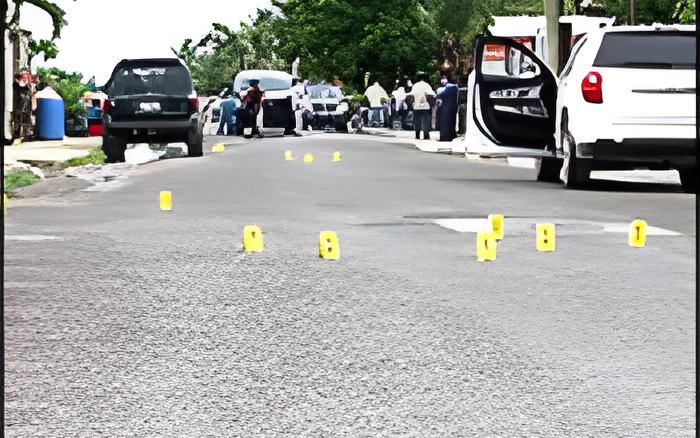


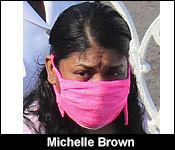

A week ago, we brought you extensive coverage of the high-profile murder trial of Police Constable Michelle Brown. She's the cop from the department's Special Assignment Team who was charged with the December 2017 murder of Fareed Ahmad, the well-known barber from Hattieville. Well, Justice Colin Williams, who presided over this trial without a jury, has found her not guilty of Ahmad's murder.
We have a detailed account of the judge's reasoning for the acquittal, but we start first with the Ahmad family's reaction to the verdict. Daniel Ortiz has that story:
Police Constable Michelle Brown walked out of the Supreme Court this morning a free woman.
After spending almost 2 years on remand at the Belize Central Prison, Justice Colin Williams found her not guilty of the December 2017 murder of Fareed Ahmad.
This acquittal is certainly a relief for Brown, who is no longer accused of that high-profile crime. She can now reconnect with her children and her family, return to work, and collect all of her back pay that was accumulated while she was on interdiction.
But, for the loved ones of Fareed Ahmad, the man Brown was accused of fatally shooting at close-range, will have to come to terms with the fact that no one will face any legal consequences for his violent death.
Taheera Ahmad - Sister of the Deceased

"As a family, we were resolute to leave the matter up to the court, and the hands of the law. And so, there is a verdict, and we respect that verdict. As a family, we will just continue to move on, pick up the pieces, and move on from here."
Reporter
"Essentially, you aren't getting justice for the death of your brother."
Taheera Ahmad
"Well, justice for us means Fareed being here, and if Fareed is not here then, you know..."
Reporter
"What is the next step for healing for your family, given that the culprit, whoever that person is, is still out here?"
Taheera Ahmad
"You know, at the end of the day, we are also a God-fearing family. And so, that person or those persons will have to leave with what they did and have to give account to the best of judges. And so, we'll live with that. But in terms of picking up the pieces, we will continue and go on remembering Fareed as the loving brother, caring son, father, and husband as he was, and continue living with those cherished memories, as we have been doing for the past 3 to 4 years."
The judge spent almost 2 hours going through all of the evidence that emerged in this trial without a jury. He made sure to note that there were significant gaps in the case, where the authorities failed to deliver key pieces of forensic evidence that could have helped to address important doubts he had about Brown's guilt or innocence.
Taheera Ahmad - Sister of the Deceased
"Quite a bit came up during the trial, I think as well that there were certain names of officers that she also mentioned. And maybe that's an element for question in terms of the prosecution and the DPP's Office. Why were those missing pieces not presented in the trial? It's unfortunate how it ended up."
"As I said, we had every optimism and respect for the process of the law. And so, yes, we did hear some disheartening - I would say - missing pieces. But, you know, we have to respect the verdict and the process that took its course."
And while they try to move on with their lives, the Ahmad family is hoping that police no longer have any reason to be keeping tabs on them, as though they are suspects in some sort of illegal activity that is yet to be revealed.
Taheera Ahmad
"You highlight something that our family has been struggling with for a couple of years, the fact that we have been unnecessarily harassed and being targeted unjustifiably. We hope now that the fact that the process has taken its course. There were an investigation and a trial, and this is the outcome. We just hope that our family can continue to live in peace, and all harassment and ongoing surveillance over us is ceased."
"Our plea to the Government and to the police is that listen. We've continued, and proven ourselves as law-abiding, productive citizens in this country. Each of us has vested and invested positively and constructively in this country. There is absolutely no reason for us to be under that surveillance. And if there is, then let it manifest itself in terms of the evidence."
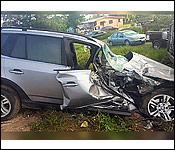
Although there were no eyewitnesses to the actual shooting, the prosecutor relied on circumstantial evidence which pointed to Brown as Ahmad's assailant. She told the court that Brown's service weapon was found in the wreckage of the vehicle Although Brown testified that another cop mysteriously ended in Ahmad's vehicle and that he shot Ahmad from the backseat, the prosecutor asserted that there was no evidence to support her sensational claim.
But, Justice Williams, in the nearly 2-hour read-out of his judgment this morning, outlined gaps in the evidence, which caused him to have reasonable doubt that Brown pulled the trigger.
Although the judge did not believe Brown's defense testimony about some other killer cop, he made it clear that in a court of law, Brown doesn't have to prove her innocence. He reminded the court that the prosecution had the burden of proving her guilt.
First, the judge pointed out that the prosecution did not adequately prove that the weapon found in the wreckage of the SUV was a murder weapon and that it was actually issued to Brown.
One officer testified in court that at the beginning of that workday, he handed over a police-issued firearm to Brown and that Brown failed to return it when her shift ended. But, he did not produce any documentary evidence to support this claim, and during his testimony, he made a critical error about the weapon's make and model.
There was also no direct evidence that the weapon found in the wreckage of Ahmad's vehicle was the weapon that was used to shoot him. The judge pointed out that one of the prosecution's witnesses testified that she took samples of what appeared to be bloodstains on the weapon and that these were tested. However, those test results, which could have conclusively determine that this was the murder weapon, were never actually produced as evidence in the trial.
Also, the judge pointed out that a key element on a murder conviction is that an accused inflicted unlawful harm and that this harm had to be intentionally done to kill. In this case, the judge was not satisfied that the prosecution proved that Brown shot Ahmad and that she did so with an intent to kill.
With that, he found Brown not guilty and ordered that she was free to leave.