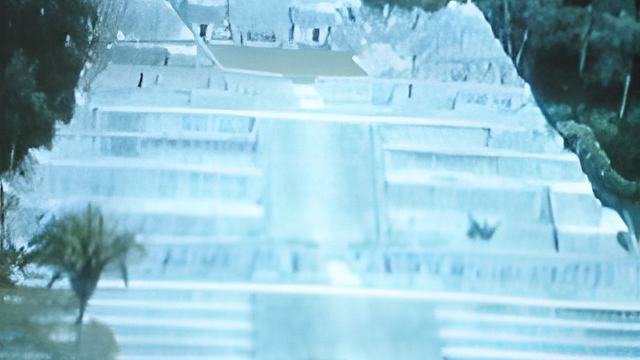
We've taken you to Caracol, a couple of times on this newscast. It is the largest Mayan city and is home to the spectacular Kanaa built more than 1500 years ago, it is still the tallest building in Belize. But tonight, in our continuing series with Director of Archaeology Dr. Jaime Awe, we'll tell you about the secret history of Caracol detailed in the inscribed monuments and markers that appear all across this site.
Dr. Jaime Awe, Dir. Institute of Archaeology
"Caracol has produced some of the greatest quantity, if you want, of inscribed monuments. Inscribed monuments are monuments that are carved with and have hieroglyphic writings."
And the numerous appearances of inscribed monuments at this sprawling Mayan City have provided have provided critical information about this site and the late to mid classic period of the Maya.
Dr. Jaime Awe,
"The hieroglyphics on these monuments, not just at Caracol but at most sites, inform us about political events. They tell us a bit about the history of the people that lived there, especially the rulers that lived at Caracol."
This ball court marker is one of those important documents. As you see it here, it looks like a cluster of crumbled stone - but archeologists have been able to decipher it. And today the information they have from it reads like a newspaper form the Mayan late Classic Period
Dr. Jaime Awe,
"We know that for quite a number of years, especially in the early years of Caracol, there was a lot of enmity between Caracol and Tikal. There was a
series of wars and initially Caracol was defeated in a lot of the battles with Tikal. But we know in 562 AD, Caracol finally comes to its own and defeats Tikal. This was a very important event because what followed was that for many years after, Tikal goes into sort of a dark age and they don't erect any more monuments or claim that this person is their ruler whereas the opposite happens at Caracol. Following the defeat of Tikal, Caracol starts to develop lots of the big pyramids and temples and palaces. They started being constructed and it's a time of boom, so much so that some archaeologists, like the Chases who worked there, say that it is possible that the Caracol residents brought back with them a lot of the captives and used them as forced labor to help construct public buildings etc. etc."
And while the Caracolenos vanquished Tikal and rose to a new dominance in the Maya kingdom - it was not a position of pre-eminence that would go unchallenged. And this other ball court marker tells us that - as is the case in present day Belize - to find the enemy - Caracol only had to look west.
Dr. Jaime Awe,
"There is a another marker that tells us that shortly after Kinich Hoi becomes ruler, he attacks two cities in the Peten and captures either important people there or their rulers, brings them back to Caracol, and subsequently sacrifices these people. So we often make fun about this, that this so called enmity between Belize and Guatemala has a very very long history."
A history dating back to the fifth century AD which is also where we find this: what is known as Stela 27 - the oldest inscribed monument ever found in Belize, dating back to 40 AD. This piece of it was found hidden away.
Dr. Jaime Awe,
"At some time in Caracol's history, somebody broke this off the rest of the Stela and chose to take this piece and bury it underneath the stairway. We feel the reason they did that was because the individual that is represented in here, or on this monument, was a third ruler in the Caracol lineage. You will see the individual right here. There is his eye, his nose and mouth. He is wearing this fancy headdress, that's his earring right there. The headdress has a bird. His arms comes right up his chest."
And while those are inscribed objects - there are also telling inscriptions on the temples themselves. This panel tells of a very special and exact day, September 2nd, 640 AD.
Dr. Jaime Awe,
"That date marked two important occasions. One is it was the end of a Catun. A Catun is a 20-year period. You know how you and I and Belizeans love to celebrate January 1st, it's the completion of a year and we call it new year's day and as we celebrate it. Well the Mayans used to celebrate this important 20-year period, so at the end of every 20 years there is a big celebration. They would call it completion of a Catun and during this ceremony there would be all kinds of rituals etc, but it happened that on that Catun it was also the day of the autumnal equinox. You know that there are two equinoxes. There is the vernal equinox and the autumnal equinox because as the earth tilts, the sun moves to the north or to the south...but the sun doesn't really move it's the earth that's tilting that causes these events to happen. So Lord Kaan ii had two reason to celebrate and its recorded on top of the Kanaa."
Of course, if you see these inscriptions as the newspapers of the day - then they would be like the Belize Times or The Guardian of the day - they only tell the good news about the ruling party.
Dr. Jaime Awe,
"Like today these people used writing as a major form of propaganda and they also stretched the truth. A lot of times they say they may have won the battle but they would tell everybody they won the war and they would blow it out of proportion. And just like how today we tend to sometimes use writing to make things look better or worse, so did the ancient Mayas and they were masters of it."
Next week we'll have the second part of that story when we'll tell you how Caracol rose to position of supremacy in the Mayan World.
7NEWS produced for broadcast by News Director Jules Vasquez
Edited and Prepared for the internet by Keith Swift