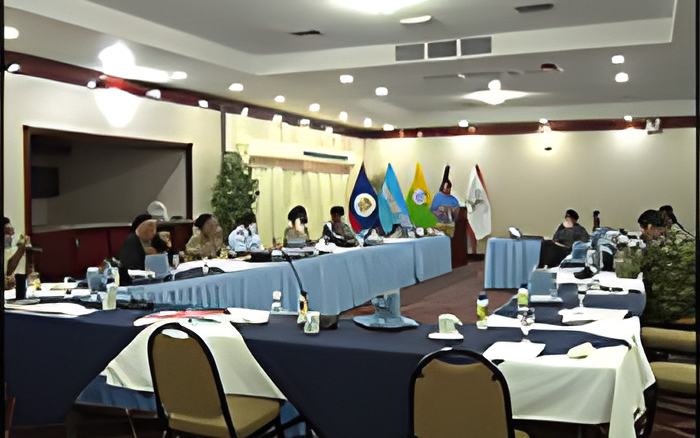

At the beginning of this week's news cycle, we told you about the weekend press engagement that the Toledo Alcaldes Association, the Maya Leaders Alliance, and the Julian Cho Society hosted.
The complex issues of Maya Customary Land Rights are back in national focus. That's because the Government and advocates of the 41 Maya Communities are disagreeing on the next stage of the implementation of the 2015 Judgement from the Caribbean Court of Justice, which affirms that the Maya Villages have rights to their community lands.
As all the world knows, the rollout of a government system to recognize and protect those rights has been slow. Almost 7 years has passed, and there is still much work left before parliament will even receive draft legislation on a final implementation.
But, the Maya communities continue to push on undeterred. Today, representatives of 4 of those villages gathered in Santa Teresa, Toledo to sign boundary treaties, and our news team was there to witness it. Daniel Ortiz has that story:
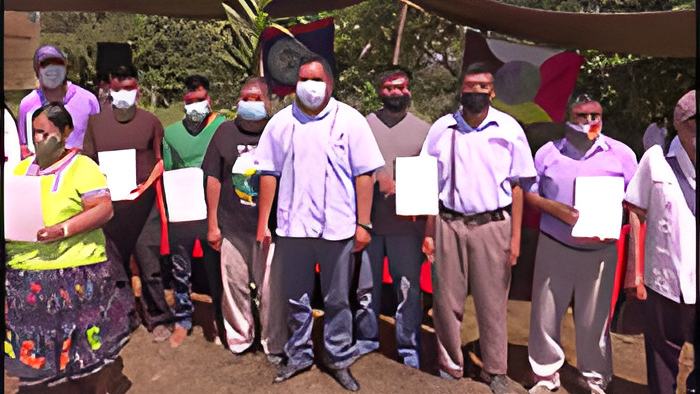
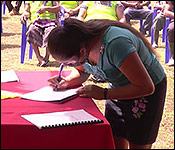
Leaders representing the Maya communities of Santa Teresa, Laguna, Jordan, and Aguacate have signed what they hope are long-lasting treaties that define their borders as neighbors.
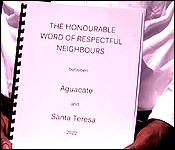
The document is titled "The Honorable Word of Respectful Neighbors". It memorializes the hard-earned agreements they arrived at through negotiations on where one community's territorial lands end, and where the other community's lands begin.
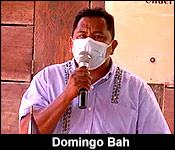
Domingo Bah - President, TAA
"We are here to witness an important occasion, which is the signing of agreements between 4 communities."

Donicio Shol - Mapping Coordinator, Land Tenure Facility Project, Julian Cho Society
"So, we are at this point now where the villages have all, after countless meetings and being out in the bush, actually, they are now harmoniously demarcating their boundary, and now, they're all in agreement to go go to the other step in the process where the villages are here to sign the inter-boundary agreement."
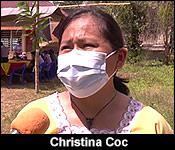
Christina Coc - Spokesperson, MLA/TAA
"In the present day, you are witnessing the implementation of the Caribbean Court of Justice's order. You will recall that the court ordered the Government of Belize to clearly define/delimit the territories of the Maya people and to do so in accordance with the Maya people."
For the avoidance of any kind of doubt, the leaders of these 4 communities are making clear that they went through a democratic process to obtain consent by majority from villagers of all 4 communities. It's part of a lengthy 8-step process called the Delimiting Principles and Methodology.
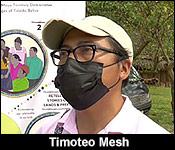
Timoteo Mesh - Manager, Tenure Project, Julian Cho Society
"It's a long word for a simple protocol. It is the mapping procedure for the Maya Communities so that the Government can actually issue titles to their lands."
Christina Coc
"The entire membership of any given village has to direct their leaders to accept - whether or not they accept these procedures, and whether or not they are interested in clearly defining/limiting their territory."
Domingo Bah - President, TAA
"We go to the communities, and they arrange the meeting for us. We have the person, the coordinator for the auto-delimitation. Then, we take them along, organize a meeting with the communities, explain to them the process of how you go about starting the first step. The first step is to meet with the people. You meet with the people and give them an understanding, of how you go about doing the auto-delimitation. Then, from there, we take on the next step, which is to get consent."
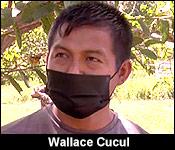
Wallace Cucul - Chairman, Laguna Village Council
"It was decided amongst us, the leaders, that we go from house to house to hear from the people, what is their view. And if the majority approves that, then we fix our community boundary lines. It will take the majority. That is what happened. We wouldn't be here signing this agreement had our villagers not approved it."
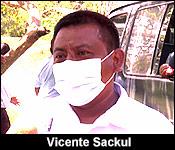
Vicente Sackul - 1st Alcalde, Laguna Village
"We hold meetings in the villages. We educate our own villagers to understand the borderline with our neighboring village, so in a future life, our kids don't have problems. Then, we settle all the borders."
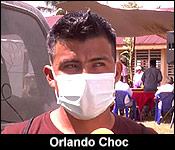
Orlando Choc - Chairman, Jordan Village Council
"We have a public meeting, whereby the community gives consent to go through, have the boundary line, to demarcate."
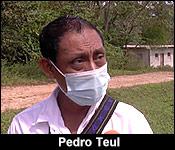
Pedro Teul - 1st Alcalde, Santa Teresa Village
"We very much appreciate what has been done between the two communities, and we are willing to sign it now, to make it official."
After the residents of neighboring villages have given their signed consent to the border delimitation, the Toledo Alcaldes Association then organizes a reconciliation process in which information about where those borders stand, is collected through community guides and field visits.
Timoteo Mesh
"What was central to the Delimitation Principle and Methodologies is that it is only the Maya communities that know where their lands are, and they should be the ones who identify - lead the process where those lands and submit those maps to the government for verification."
Christina Coc
"They did this by talking, first of all, among themselves, talking to their knowledge-holders, their elders, the people who know where the boundaries run, setting aside a group of 10 community field guides, and these are the knowledge-holders who guide the community mappers to know where the boundaries. The guides began to sketch the maps of Santa Teresa and began to look at whether or not there are conflicting areas with their neighbors."
Orlando Choc
"We have a public meeting again, where we draw a sketch map showing where. Our elders are very important in each of our communities. They are the ones telling us where our boundary line is. So, after we draw a sketch map, everything, we present it to the community again, as well. From there on, we start to inform our neighboring communities, such as Santa Teresa."
There is even a robust process for addressing disputes between neighboring communities that are claiming the same land or territory.
Cristina Coc
"Whenever there is a disputed area, an area of conflict, then the support that we provide from the Julian Cho Society, the TAA, and the MLA, is to provide what is called the Boundary Harmonization Council. This is a council of elders, knowledge-holders, mediators, who come to try to bring the two parties together to resolve and harmonize these boundaries. This takes a lot of time, a lot of negotiation. There are some intense negotiations that happen in the community meetings, but also in the field, on the boundaries themselves. But at the end of the day, our goal is to make sure that as we define our boundaries, as we draw lines, as we recognize natural boundaries, what is important for us is that our communities remain united, that they remain friends. We will have to live with each other, and so, we don't want to create unnecessary conflicts among our communities. These boundaries are to be harmonized. It is not to divide us. It is to harmonize us."
After all that discussion and work, the delimitation process then results in these boundary treaties being signed. It's a moment of pride for these Villages because of the progressive thinking involved.
Donicio Shol
"We have 22 villages that have consented to auto-delimit, to demarcate their boundaries. So, those are the ones that I - not to say that others are not in the process, but there are different steps. As a coordinator, the 22 are the ones that I'm currently working with."
Orlando Choc "It takes time. So, it's a process that takes about 6 to 7 months."
Jacinto Ical - Resident, Santa Teresa Village
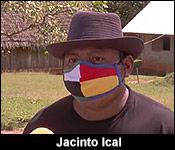
"It is a milestone for us."
As you surely know by now, most actions connected to Maya Customary Land Tenure have complex twists and turns. That's why we'll have more from this Toledo trip next week.