
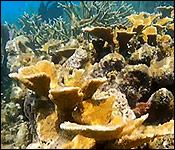
On Friday we took a closer look at work being done by The Belize Audubon Society and the fisherfolk in Belizean waters. While the Organization continues to provide boat to boat interactions as a way of maintaining the relationship between the NGO and the fishers, Fragments of Hope in Placencia is working to restore the coral reef structures through reef skinning and sheathing methods. In a feature sponsored by the Earth Journalism Network Jose Sanchez reports on the techniques used to increase shoreline protection through reef restoration.
Jose Sanchez
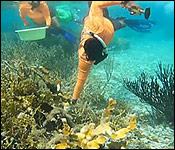
The Barrier Reef Jose Sanchez The barrier reef and the diving experiences draw thousands of tourists to popular dive sites every year and provide income to many. But coral reef structures are affected by disease and climate change. Fragments of Hope has been innovative by replanting corals to replenish areas that need new growth. The organization's founder, Lisa Carne, says they have been growing Elkhorn corals that are not affected by Stony Coral Tissue Loss Disease. And these should help with shoreline protection. In South Silk Cayes, the organization collected corals from a nursery site and then cuts them with a wet tile saw. After cutting with the saw, the coral micro fragments are replanted with cement.
Lisa Carne, Founder, Fragments of Hope
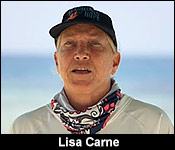
"Previously, we would take small pieces of the Elkhorn coral from wild colonies and place them in a coral nursery for one to two years to grow big enough to then put them out on the reef. And in 2017, we adapted and changed that with Dr. David Vaughn, who really came up with or coined the micro fragmenting technique. And he and others, most others use it for land-based nurseries. And the principle behind it for any coral species is that when you make a cut or a lesion, the analogy is like if you make a cut on your skin, it forces the skin cells to grow back faster. So, by cutting the coral quite small, it actually forces it to grow faster than it would if you didn't touch it at all, if that makes sense. And so Dr. David Vaughn and most others are using it in controlled land-based nurseries in what they call raceways or tanks or aquarium, and they cut the corals very, very small. So, the value of that is, if you don't have much of a coral to start with, you can make lots of little pieces that will then grow up into more. We're not in that situation here in Belize."
"We prefer to use the sea as our laboratory. We have so much corals and reefs still living here. And so, all of our nurseries are based in the ocean. And so, what we did is modified this method to use it for directly in water purposes. So, with the Elkhorn coral now, we have bypassed the nursery time completely. So, we can take either from a nursery where we've grown it already, or from the wild, where we never take more than 10% of the coral. We bring it to shore or on a boat where wean set up the saw, and we cut them into about five-centimetre pieces, and then we outplant them on the reef. And we often plant, like, two or three little pieces together, and then they grow up into a colony, and they make a nice little colony, and they're doing really well. So, our oldest ones are at South Water Caye coral reef, and they turned five this year. I think they turned five in April."
"And the other exciting news about this innovation, it is an innovation because we adapted someone else's methods for our work in Belize. And it's innovative because we're cutting out some of the middle parts so we can restore more areas quicker. And what's important to realize is that we focused always on the shallow reefs in Belize with our work. Fragments of Hope has always focused on the shallow reef. Why? That's where the shoreline protection comes from. So, it's that top meter of reef that breaks up over 80% of the wave energy. So, if you're talking about shoreline protection, you have to have a living reef in order to withstand the incoming waves and the sea and everything. If you put rocks and just cement that will break over time, I don't care how strong you build it, the ocean will win, right? So, it really needs to be a living reef to breakup that wave energy and protect the shoreline for the future."
"So, what we've been doing is reskinning what we call reskinning, or reheating the shallow reefs with this species. And the exciting news for us was last year at Laughing Bird Caye, some four year-old micro fragments that were little tiny pieces when we put them out turned into these little coral colonies now, and they spawned last year, which means they're sexually reproductive. This is exciting news for us because it means that within just four years, we can create a self-replicating, self-reproducing, living, functional reef. So, we're really thrilled with that, and we hope to expand our efforts. We've done this technique everywhere now. We've done it in Caye Caulker, we've done it in Turneffe Atoll, we've done it in South Water, Tobacco, out here at Silks, at Moho Caye, Laughing Bird, and everywhere we've done it for reef, back reef, fringing reef. It's working really well."
This story was made possible with funding from "Internews' Earth Journalism Network"