
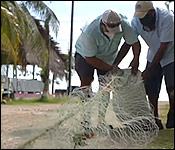
Tonight we take a look at the closing segment of the Blue economy innovations story, where Journalist Jose Sanchez explores the use of underwater drones being used within the Blue economy sector to monitor enforcement activities within the Port Honduras Marine Reserve. Sanchez reported on how this technology helps fishers within the area to prevent illegal fishing and the use of gillnets along the coast line.
Jose Sanchez
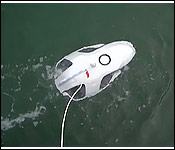
In the Toledo District, Punta Gorda, the Toledo Institute for Development and Environment (TIDE) has been innovative with the use of technology by utilizing aerial and aquatic drones that dive to depths of 100 feet. They have been used as part of its patrols, monitoring and enforcement activities within the Port Honduras Marine Reserve. Ryan Moore, TIDE's Marine Protected Area Manager believes the technology will continue to be essential to conservation organizations.
Ryan Moore, Marine Protected Area Manager, TIDE
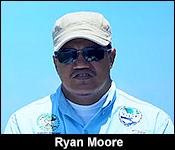
"It had to be able to maneuverer more freely while underwater, in the sense of like a scuba diver being able to hold in place, rotate 360 and likewise being able to look up and down for it to be useful. And so, in 2022, courtesy of Belize Marine Fund Project, we were able to acquire our second underwater drone which had those features that we were looking for. And so, this drone now is primarily used as a part of that project to modernize or increase the use of technology in enforcement. And so that also has a secondary component, which is the enforcement strategy. We tend to refer to it as a hybrid enforcement strategy because it has aspects of the old methodology of using enforcement, which is standard within all the other enforcement strategies. But this one now will include the aspects of the new technologies such as the aerial drones and the underwater drones."
"We would launch the use of our drones, which started with the drone that could land on water, and now we have the access to drones which have increased range. And so, we would launch from the while we take off at the Caye to give a first look at where potential vessels are located. But we would still go on patrol and we would have the drone up in the air as well because these drones now have increased range of like up to 40 minutes of flying time. And so, we would be on patrol and the drone would be flying as well. So, we don't have to deploy all the time. It's already launched in the air. And it just increases our understanding. And so, we could use less fuel."
Edwin Cabrera, Head Ranger, TIDE
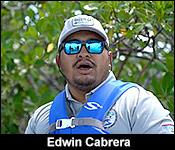
"Everybody has to adapt and at the end of the day, the technology is very beneficial for us because the drone, the aerial drone, helps to go up and then you see a bigger area where you want to cover. It avoids going to different areas, just to check if a vessel is there."
Female Fisher, Port Honduras Marine Reserve
"A lot of people are coming in from the neighboring countries (Guatemala), to take our fish. Well actually taking our product we are making, you know. And if you notice, the weather is kind of bad. So it is not a lot of fish again, like back in the day. They use a lot of nets too and a lot of different things too. So it is kind of hard too, to keep up with them. If you notice a lot of trap too."
Male Fisher, Port Honduras Marine Reserve
"Too much trap."
Fisher, Port Honduras Marine Reserve
"Yup. A lot of trap. Like, extremely too much. If you notice over that side, if you go fishing over that side, no fish. Because too much trap in there. Even when I throw my line sometimes, I catch it, 2 or 3 times I haul up my trap with my line. So I believe they have a lot of trap. Over this side, a little is caught on this side but the weather is kind of..."
Fisher, Port Honduras Marine Reserve
"One person, one person has too much trap. One person. They need to regulate it but in this area, there are about 5 persons with fish traps. I am not lying."
Edwin Cabrera, Head Ranger, TIDE
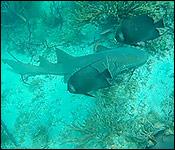
"They have different type of activities that we try or we want to explore. We can do habitat mapping; we can do fish ID, we can do coral as well. We know that they are using the gill nets more in the deep now. We have seen that even along the coastline these guys are using, they are sinking the entire net. So, it is a possibility of using the drone near the coastline to search for gill nets as well."
Ryan Moore, Marine Protected Area Manager, TIDE
"We will be documenting with the underwater drone how many of those types of fishing equipment are present within the reserve. Of course, we will be actively seeking gill nets because in the past couple of years we started to see the use of gillnets being submerged and when they submerge it, they would bring up like lobsters within the gill nets. Overall, the use of all of these technologies is all to reduce the gaps within our standard efforts."
Jose Sanchez
Conservation work in the blue economy is not only responsibility of organizations such as TIDE, Fragments of Hope, or the Belize Audubon Society. It is also your responsibility at home to learn more about our regulations, Jose Sanchez reporting.
This story was made possible with funding from "Internews' Earth Journalism Network"