
Over the years, the Karl Heusner Memorial Hospital has steadily been trying to upgrade the services that it provides. But while the will may have been strong, the expertise, equipment and financing has not always been there. That's what happened with the hospital's Orthopedic Wing which has been trying failingly to offer knee and hip replacement procedures. But now, thanks to the involvement of orthopedic surgeon Fawcett Jeffrey, Belizeans now have affordable access to the life changing surgeries. _7NEWS w_ent into the operating theatre to see the magic of a knee replacement procedure. We warn you that what we show you might be a little graphic for some.
Alfonso Noble Reporting,
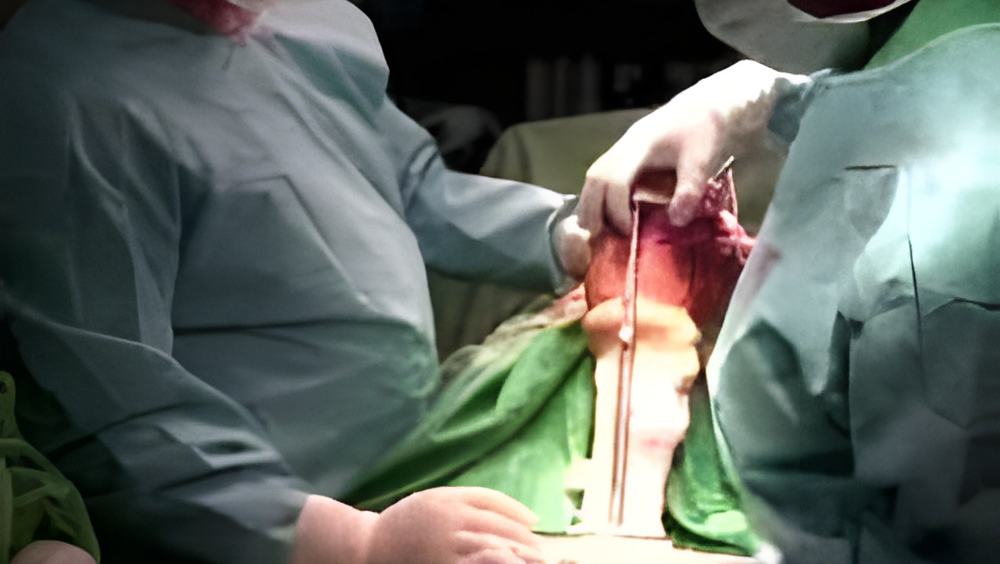
What you are seeing is actual video footage of a knee replacement surgery. Here surgeons completely remove the damaged cartilage in the knee and replace it. With the use of specialized instrument the ends of the of the thigh bone (femur) and the shin bone (tibia) are cut off and shaped to be fitted with a new metal tray that is placed on top of the remaining bone. This tray holds a special hard plastic spacer that will become the new "shock absorber" between the smooth metal coverings. The new joints are then cemented on to the leg bones.
This procedure is now available here in Belize and it's done by local physicians. The Karl Heusner Memorial Hospital is now offering the service of complete hip and knee replacement. Orthopedic Surgeon Dr. Fawcett Jeffrey visits Belize on a regular basis and this time around he's brought back both the expertise and the material to perform the procedures.
Dr. Fawcett Jeffrey,
"You are taking the entire cartilage that is damaged in the joint and you are going to replace it with material that will be reproduced to a design
of a normal human knee. So in general, you have, in the case of the knee, you'll take off the damaged cartilage of the condole, the femoral condole, you replace that with a stainless steel metal femoral condole and the tiboral plateau, which is below the condole, you replace that with a metal back and a polyetelene insert that allows the two to articulate with one another. Basically the principle is removing all the damaged cartilage in the knee and replacing it with an implant that facilitates the patient adequate movement and normal anatomic function and bio-mechanics."
And Dr. Jeffrey says that most if not all patients who choose to take the surgery are pleased with the outcome.
Dr. Fawcett Jeffrey,
"Most of the patients, or all the patients who get knee replacements are generally very grateful to the surgery because it gives them another lease on life. So knee replacement surgery tends to be well appreciated by patients. Hip surgery or so gives them very good function but it seems to be from the literature that the knee replacement surgery is even more appreciated by patients than the hip surgery.
After a total knee replacement, or a total hip replacement, patients should get an improvement in their lifestyle, the quality of life, and because the purpose for doing total joint surgery really is to reduce or eliminate the pain problem that the patient has, then that is what the surgery accomplishes.
The bone does not hurt. What hurts is the covering of the bone which is highly innovated as well as in the joint you have a cap and that is also innovated and that can hurt. But once we remove those coverings that are painful and we replace them with something that has no nerve endings, the tendon sees that you will not get any pain from the implants we put in the patient because they have no nerve connections. You would say in layman's term they overdo with a replacement. Sometimes they can come and say they are having a little bit of irritation in the knee, mild pain, but it tends to go away with treatment."
And while the procedure is fairly common in other parts of the world, it's new to Belize. But this isn't for lack of trying. Doctor Francis Smith is also an orthopedic surgeon at the KHMH. He's been trying to offer hip and knee replacements in Belize for years, but up to now, it's been too expensive.
Dr. Francis Smith, KHMH
"It is a most welcomed endeavor. We are extremely grateful to Dr. Jeffrey for introducing this procedure to Belize. It has made us shift focus a bit because we have been understudying surgeons from the US and we have been looking at implants from the US but they are beyond the reach of the ordinary Belizeans. The cost is accessible. With some help and determination, people who really have these conditions and who really want to improve the quality of life, for what they are paying, comparing costs from Central American hospitals, or even the US especially, it is insignificant. So I think the procedure as it is being done in Belize has made accessible to the general population. We have been wanting to see this realized in Belize for a long time, ever since I came back and it was out of reach because of the cost and that is because of the US prices but Dr. Jeffrey has found a way of bringing very reliable technology, the implants, to Belize at a more economically feasible cost."
And because the costs are now cut, those common problems associated with deteriorated hips and knees can now be alleviated with an inexpensive surgery.
Dr. Francis Smith,
"Conditions known as bowleggedness or 'K knees' or knuck knees - what the procedure does is it replaces the entire joint. It resurfaces the joints and it restores basically the orientation and alignment of the limbs. If you can restore mobility to these patients, it actually prolongs their life. So it is a very important procedure."
An important procedure that because of it's ready availability now in Belize is expected to be accessed by many who are bothered with worn and weary knees and hips.
So how do you get a procedure performed? After evaluation, patients who are deemed to have absolute need for the surgery are then considered.