
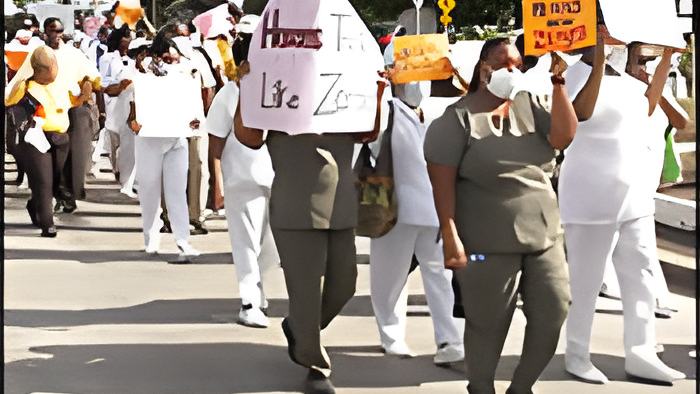
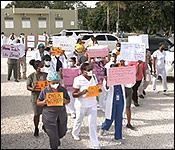
Yesterday, the healthcare sector saw a turbulent day with protests across the country at every regional and community hospital. Today though, it was business as usual as the healthcare workers await the administrative Adjustments and refunds that will restore their rightful pay.
And while the issue with their pay may be an easy fix, the protests also highlighted a huge gap in the sector - a severe lack of basic supplies. Doctors and nurses have had to do their jobs without tape, gloves, tissues, water, and even basic meds.
Courtney Menzies has a recap of the cry of the medical workers. Here is that story.
Nurses and doctors from across the country stood up strong and in solidarity yesterday to shed light on the healthcare horrors that they have had to deal with.
Not having access to food and water during their shift is just the opening page of a deep catalogue of complaints about a failing health system. Gloves, medical tape, even vital, life saving medication is missing from the major hospitals all around the country.
And yesterday, these healthcare professionals aired it all out:
Nurse
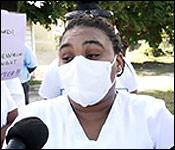
"We don't have basic things like tape, we don't have tape if we were to put an IV on someone, we had masking tape the other day to put IV's on patient. Some staff had to go and buy tape from Brodies and all over the place where we could find medical tape because there was no tape here in the hospital, there was no pampers, staff took to Facebook to beg the public to donate."
Doctor
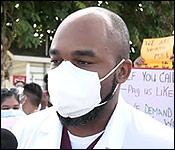
"To use an example, I had a patient with hypertension and I am unable to treat him with my resources, I can tell him what he needs but now he has to go out and figure out how he's going to get it. So what are we doing here? Are we just dispensing prescriptions? Is this healthcare?"
Caretaker
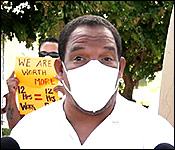
"We cannot do magic with little or no resources, the resources is terrible, when it comes to gloves for us to work with, some of us don't even have the right size to put on our hands. When it come to medication, we have to send our patient to the different stores or to the different pharmacies to buy medication."
Their cries weren't in vain - by early afternoon, the Ministers of Health and Labour and the Fin Sec. had urgently met with the Nurses Association to hammer out their differences.
But while the administrative issue of shift calculations and short hour deductions were rectified, it exposed an underbelly of a system stretched beyond its limit - but one that the Minister of Health says they're working on.
Kevin Bernard, Minister of Health and Wellness

"There's many other issues that have been raised by the Nursing Association of Belize and one of them having to do with the main problem as well, lack of medications, lack of medical supplies and in some instances, they have mentioned that some areas they did not have gauze. By the end of September, we should stabilize those issues and the regions and all the various facilities should be getting their medications and medical supplies on a timely manner. We are also looking at the internal procedures in terms of how people make request from the regions to the central medical store and how timely that delivery is done back to the regions."
Jules Vasquez
"We don't have Tylenol available at CMS, minister. That's real. When a central medical store does not have acetaminophen to supply, that is a critical fail. That is on the verge of being a fail state. Who's responsible?"
Kevin Bernard, Minister of Health and Wellness
"Thats what we are working on and that's exactly what I said, we must hold people accountable and that inventory audit that I requested will reveal that and that's where we then in the administrative decision to make the changes necessary."
But while the healthcare workers wait for relief - the fact is it has reached a crisis point - and they feel they have already waited too long - that's why so many health workers were ready to demonstrate their deep dissatisfaction yesterday - because the healers are sick of the shortcomings.
And while there are basic shortages - there are also critical shortages of medicines use in the ICU that can mean the difference between life and death. Sources tell us that many important medicines used in intensive care are "basically non existent."