

body,td,th { font-family: Arial; font-style: normal; font-weight: normal; }
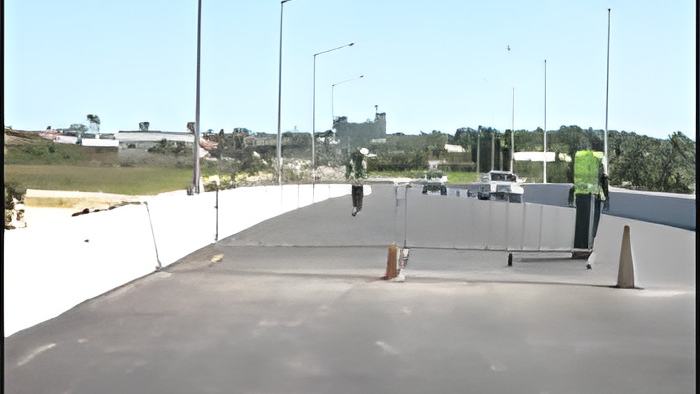
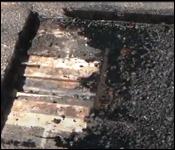
21 days after the soft opening for the new Haulover bridge, Belizeans swarmed Facebook to let the world know that the 30 million dollar structure was already showing signs of wear and tear, claiming that the split in the road, on the right hand side of the bridge looked pretty much like a pothole.
No one moved faster than Chief Engineer Evondale Moody to clear up these claims and confusion that what you think you saw, isn't what you saw.
And so this afternoon he went out on the bridge himself, while repairs were already underway to explain what happened and what went wrong.
Jomarie Lanza was there and here's what he told her.
Is it possible that the premature opening of the bridge may have contributed to its early wear and tear?
The Chief engineer says that it's all part of a process, and today he went in depth as to what that process is, and how exactly these damages showed up on the bridge.
Evondale Moody Chief Engineer, MIDH

"Basically we saw some posts that were done yesterday with respect to some popping out of the hot mix on the bridge. We were kind of surprised about the kind of comments being made from a ministry's standpoint because they basically everyone might not know what we are doing on top of the bridge itself during the construction I'm so I think it was best for us to do an interview to present what exactly is occurring."
More than an interview, he gave us a crash course in advanced engineering - also known as "what had happened is…."
Moody says that the main cause of all this fuss has to do with the bridges' expansion joints:
Evondale Moody, Chief Engineer, MIDH "What you are seeing on top of the bridge is the hot mix asphalt which is basically just a wearing course for the movement of traffic to even move smoother across the bridge it carries no load it bears no load and so it's just what we call a wearing course."
"So what has basically transpire Is that when we were placing the hot mix on top of the bridge we had to cover the expansion joints. The expansion joints basically has an elastomeric bearing pad, which is this rubber material here and that is between the joints, so that when the bridge expands and contracts it bucks against this rubber. So you don't have the two concrete hitting together because if that happens, then the bridge will crack. And so engineering wise you would have to put in expansion joints so this entire bridge structure has six expansion joints so when we were replacing the hot mix we had to protect this rubber because the hot mix is a superheated material that is over 400°F and so we did not want to damage this material because it is very important for the bridge so we did we protected that rubber with a piece of plywood, so that that could absorb the heat when we are placing the hot mix and the idea is that we would have to come back and take it out. Before we were able to do that, there was a section of plywood that had broken and that was what the public was seeing in terms of the hot mix coming off the plywood."
So, there it is - a hot mix failure in the normal course of expansion - something the public might not have seen if the bridge was opened in March, perhaps.
But, whatever you think you saw posted, or in a drive by - this was not a pothole:
Evondale Moody, Chief Engineer, MIDH "That is not a pothole because as I mentioned before the main bridge structure is 11 inches thick of concrete there will be no potholes on the bridge. Absolutely none and so that misconception has to be corrected and I think it is important for us to explain the basic process that is being done in an effort to create these expansion joints for the bridge."
So far MIDH has completed repairs at three sections of the bridge so the plywood could be removed and a 8 inch metal plate is inserted to protect the expansion joints. Thereafter another hot mix will be poured in to seal the repairs which he anticipates will be completed by the end of today.