
The Pomp & Pageantry of the Supreme Court Opening
posted (January 16, 2006)
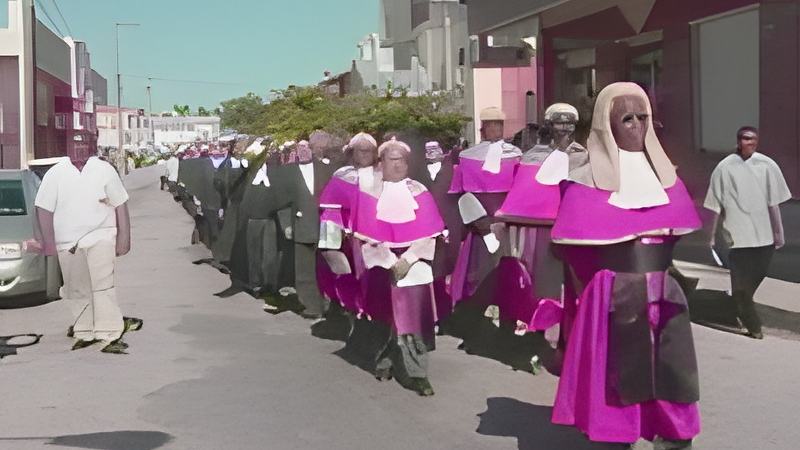
It's the one weekday workday when the combustion in the downtown area slows to an idle, and permits the legal fraternity to hold sway and have its way in the city's commercial center. It's the ceremonial opening of the Supreme Court: an occasion for pomp and pageantry, and a few wry remarks from the Chief Justice. Today's event started with an ecumenical service at the Holy Redeemer Cathedral followed by a procession from the Cathedral to the Supreme Court. That was followed by a general salute and the inspection of a guard of honor by the Chief Justice.
Jules Vasquez Reporting,
After the ceremony, the Chief Justice got straight to business by noted the unrest that transpired in the past year.
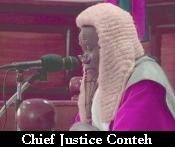
Abdulai Conteh, Chief Justice of Belize
"The year that has just ended was a trying one for the Belizean society. At nearly every level we witnessed public demonstrations, go slow, strikes, and agitation, and what could be fairly described as a riot, just a stones throw from the Supreme Court itself resulting in serious damage and loss to some commercial houses. All this fairly tested the fabric of Belizean society but we survived the test as a democratic society. To the credit of everyone, even in the midst of various protests, no one really seriously or deliberately broke the law, and where this was done, there were swift recourse to the abitrement of the law itself."
And while he commended the rule of law, he deplored to public mischaracterization of the justice system.
Abdulai Conteh,
"The view that judges and magistrates let criminals go scot free is,
I want to declare, a pernicious and unhelpful one. It is pernicious because it may, if indulged in for long, undermine confidence in the integrity of the administration of justice. I want therefore to take this opportunity to counsel against any unfounded and misguided criticism directed at the Judiciary. The administration of justice in Belize is not in closed quarters, behind closed doors, it is by law open, and open for everyone to come and see it at work. As a public institution, the judiciary is open and accountable and certainly not beyond criticism but for the welfare and integrity of the system, let the criticism be informed and be fair."
And while he's open to criticism, he also gave it out to the legislature whose tweaking of the law as it regards bail has hamstrung the judiciary.
Abdulai Conteh,
"Mr. Attorney (General) there is more than an arguable case to revisit the present provisions regarding bail with a few to enacting a clear and comprehensive bail act with appropriate provisions. Instead of a comprehensive bail act, with clear principles and guidelines, recourse has been made in Belize to ad hoc provisions. The understandable anxiety for the executive, including the police, to stem the rising incidence of crime has led to the tightening of the provisions for the grant of bail, and a widening of the range of offenses, which have become literally unbailable. The anxiety and confusion were recently highlighted by the brouhaha surrounding the grant of bail to an accused by a Magistrate even after refusal by a Judge of the Supreme Court. This was unfortunate and regrettable and I've been assured, it will not happen again."
And while the bail for accused persons was one sore point, missing witnesses, that growing phenomenon, was another.
Abdulai Conteh,
"I am constrained to mention that the of missing or unwilling witnesses in criminal trials. This is a development that is having a deleterious effect for the presentation of crime and hence an unwholesome impact on the fight against crime. I believe that more cooperation and coordination between the police and the DPP's office in providing witness monitoring and availability schemes would lessen the incidents of missing or vanishing witnesses."
And from vanishing witnesses to missing money, the Chief Justice lamented the fact that the judiciary continues to be constrained by budgetary cutbacks and is afforded less than 1% of the national budget. That's a part of the problem that has accounted for a lack of sitting judges forcing the Chief Justice into an unusual position.
Abdulai Conteh,
"I am myself going to begin to try some criminals cases as from the start of the new session of the Central District commencing tomorrow the 17th of January. The net effect of this is that I will not be doing civil cases for some time to come and there will only be one judge available in the whole country to do civil cases. This is not good enough. I need not elaborate on the frustration and inconvenience this will cause to attorneys and their clients but for now, it is unavoidable. It is therefore with a heavy heart I don on my red robes to start criminal trials tomorrow. I am the only of my colleagues available, it is a strain. The system is creaking and it will break down. This portends serious consequences for the rule of law on which so much depends."
And according to the Attorney General that rule of law will be bolstered if government's proposals for reform of the legal system are honored. It includes a provision to ban unsworn statements form the dock.
Hon. Francis Fonseca, Attorney General
"My Lord Chief Justice we also intend to abolish unsworn statements from the dock in criminal matters. It is the view of my Ministry that at present, the playing field between the prosecution and the defense is not level in so far as the defendant is allowed to make unsworn statements from the dock, the veracity of which is never tested by the prosecution in cross examination. On the other side, prosecution witnesses are subjected to rigorous cross-examination, regardless of whether they are minor or vulnerable witnesses. We are therefore of the view that allowing unsworn statements from the dock should be abolished because it defeats the very purpose and object of a criminal trial, mainly to determine the innocence or guilt of an accused person through objective which is presented in an atmosphere where an accused person does not have an unjustified upper hand over the prosecution."
The Attorney General's position on un-sworn statements from the dock is just a proposal and one that is expected to invite some debate before it could be proposed as a law.