
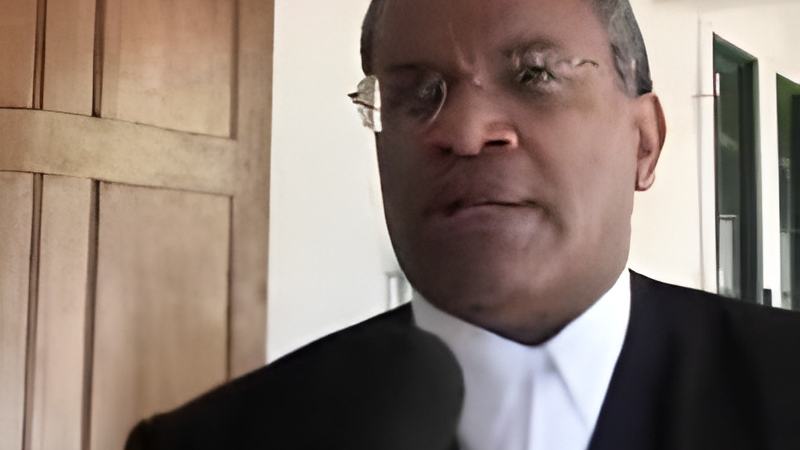
Chief Justice Dr. Abdulai Conteh today ruled that of the government’s proposed amendments to the constitution violates citizens’ constitutional rights. The case is the Belize Landowner’s Association and Barry Bowen versus the Attorney General over the proposed sixth amendment bill of the constitution. The landowners and Bowen had claimed that clause number two of the bill, which sought to vest petroleum and mineral rights in the government of Belize and simultaneously remove section 17(1), which is the right to seek redress in the courts, was unconstitutional, a violation of the doctrine of the separation of powers, a dilution of the constituent powers of the people of Belize and anti-democratic. Moreover, he explained that to pass the bill without a mandate from the people would have been a fundamental departure from the constitution.
The Attorney General, through its counsel, Lois Young, had rejected that position wholly saying that the clause as written did not take away any property or rights already held by the landowners…it simply was an attempt to elevate the government’s rights which has been declared in other legislation, to the level of the constitution. Young had also argued that as for the separation of powers, the legislature had met all the necessary requirements to change the constitution that is the three fourths majority in the House of Representatives and the ninety days waiting period.
Those positions were put forward in October and after weeks of deliberation, this morning the Chief Justice sided with the landowners. In a judgment that took more than more than two hours to deliver, the CJ found that to enact clause two as it stands “would not be in consonance with the constitution” and would offend the rights of ownership of private property, equal protection of the law and access to the courts. He also found that the clause could open the door for the arbitrary deprivation of property.
The judge did not strike down the clause as he says because it has not been assented to by the Governor General or gazetted, it is still only a bill. He did however make a declaration that the clause offends the basic structure of the constitution of Belize. Following the proceedings, 7News spoke with attorneys from both sides.
Eamon Courtenay, Claimant’s Lead Attorney
“It is a landmark decision that has just been handed down by the Chief Justice. The essence of the Chief Justice’s decision was to reaffirm the supremacy of the Constitution. To reaffirm what is a fundamental principle in the Constitution, namely that parliament cannot simply because it has a three quarters majority pass any law that it wants to pass even if it in doing so derogates from the fundamental features of the constitution. It’s a decision that resounds and redowns very much for the rights of individuals when they wish to challenge decisions or pieces of legislation by the state. It’s going to be a very important case. The case was well argued by all sides and the Attorney General through its counsel Senior Counsel Lois Young put all the arguments that they could marshall and they did not find favour with the Chief Justice and I am very happy for that as a civil libertarian.”
Janelle Chanona,
Knowing that you didn’t get the coercive relief that you sought how does this bind the government to make sure that the offending parts of clause two are removed?
Eamon Courtenay,
“Well again what the Chief Justice said is that since the government has not yet passed the Bill into law, he didn’t want to strike down the legislation as it were. But what he did was to make a declaration to the effect that if these provisions are brought into law, they would amount to a violation of the constitution. Now those declarations are binding on the government and I cannot believe that the government of Belize in light of the Chief Justice’s decision will attempt to pass into law something which he has already said if brought into law is binding. So the truth and the fact, we have achieved the objective which we set out to achieve, to have those particular provisions of the Sixth Amendment Bill declared unconstitutional.”
Lois Young, Attorney General’s Representative
“I don’t know what happens to the bill. What happens to the judgement is the thing. I don’t know what my client is going to do. I suspect we will appeal it and I suspect the other side, if the appeal is in their favour will be happy. If it’s not in their favour, they will take it to the Privy Council. Either way this is going to the very top, I think.”
Janelle Chanona,
The snap reaction of the Attorney General’s representative is that her client will appeal.
Eamon Courtenay,
“I would expect that whoever would have lost would appeal this case. This is a particularly fundamentally an important case. If we want to meet in the Court of Appeal, we will be there.”
Ivan Roberts, Belize Landowners Association
“It was a very malicious law or attempt or attempt to become a law and I am surprised at my Prime Minister for being a lawyer, to have even attempted to push something like that before the people. We have a whole department of legal minds that should have looked at this and said this is not right for our people. Why did they try and ram it down our throats. That’s what got to me.”
The Chief Justice has awarded costs to the claimants, that is the Belize Landowners and Barry Bowen. That figure will be agreed upon between the attorneys. Early estimates suggest that it could go upwards of two hundred thousand dollars. The Prime Minister today confirmed to us that it is going to appeal and until it is resolved, the amendment will not be brought into force. Government is also waiting for a Court of Appeal ruling on another one of the constitutional amendments – that one having to do with the requirement of a referendum before the constitution is amended. That should be delivered late this month or in early March.