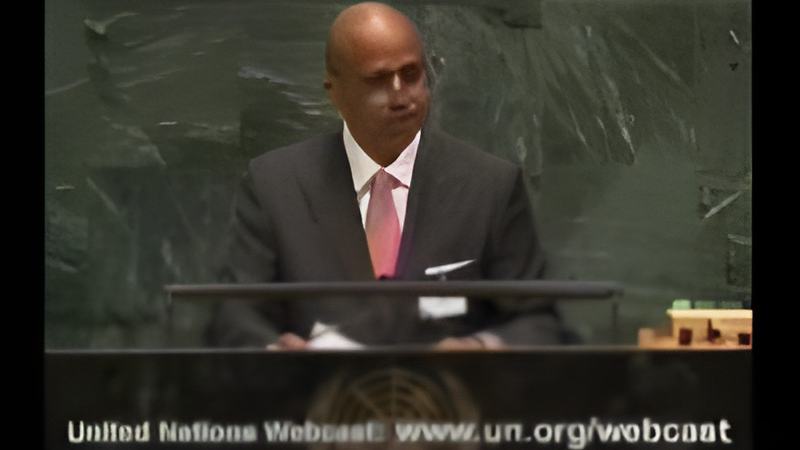
Prime Minister Dean Barrow spoke today at the United Nations in New York where he addressed an assembly considering world financial and economic crisis and its impact on the developing world. The goal is reform of the global financial system and the hope that the United Nations can play a meaningful role in reshaping it. He spoke as the Chairman of CARICOM but Barrow gave a fairly accurate snapshot of the Belize blues when he described the pressures that the global financial downturn has brought to bear on developing countries.
Hon. Dean Barrow, Prime Minister
“Commodity prices remain severely depressed accompanied by prolong decline in export earnings from agriculture. There is also a continuum in the contraction of tourism revenues with the attendant myriad job losses and business closures and foreign direct investment is in retreat resulting in biting retrenchment especially in the construction sector. I single out these three areas because of their importance for Caribbean economies not because they are the only areas of continuing difficulties. These activities employ the overwhelming majority of the workforce, particularly persons in the middle and lower income earning groups and those with low levels of formal education and skills. This in turn means that decrease level of activity in these sectors have a disproportionate negative social impact. Complicating the situation further has been a continuing decline in the flow of family remittances, converting the economic crisis into social disaster a considerable portion of our populations."
But apart from cataloguing the many effects of the downturn, Barrow also discussed the disadvantageous terms of lending agreements with distressed developing countries and the burdensome terms of tax competition arrangements.
Hon. Dean Barrow,
“The G20 agreed arrangements to increase the capacity of some international financial institutions sot lend to countries in distress as a result of the crisis. Unfortunately, the amounts agreed are not nearly enough to deal with even part of the more urgent developing country requirements. Further it seems to us none of what was agreed has yet to started to flow. Indeed part of the G20 agreement has caused additional stress for some developing countries. The opportunity was taken to reactive the harmful tax competition initiative, publicly requiring a number of countries, including many in the Caribbean to each conclude at least a dozen tax information exchange agreements. But this is a labour of Sisyphus giving us basket to back water as we say in the Caribbean. Our limited staff is already full stretched trying to deal with the economic crisis and there is more than a suspicion that the big countries with which we are required to conclude such agreements have no interest in or intention of facilitating us. We are thus to be hounded out of the successful business of providing international financial services when those diversification activities were neither the cause nor the consequences of developed country problems.
Click here for the Prime Minister’s full remarks.