
Last Friday, we showed you the website innovation competition that the Public Utilities Commission hosted for several high schools around the country.
The utilities regulator's mission is to encourage young Belizeans to pursue careers in coding and technological innovation. But their primary purpose is to maintain that delicate balance between you, the customers who pay for electricity, water, and telecommunications, and the utility companies that provide those services. The PUC is aware that the public doesn't hear enough from them about how they seek to protect consumers from high utility bills while trying to ensure that those companies make a fair return on heir investment.
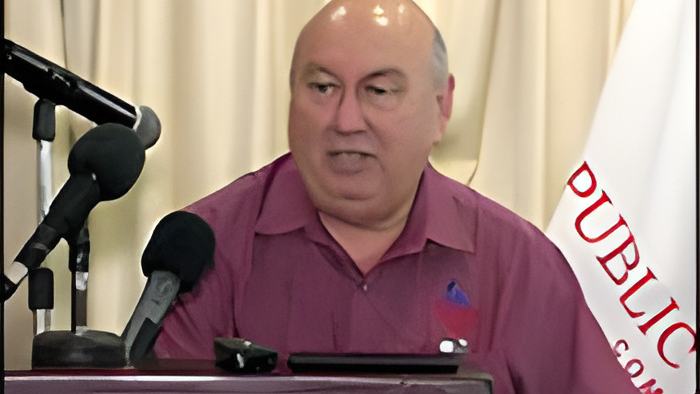
So, last week, in an extended, sit-down conversation with the press, Chairman Dean Molina and his team sought to begin the long journey of changing public perceptions about their role and function. Our Daniel Ortiz has been reviewing their main arguments, and tonight, he examines how the PUC works. Here's that story
Here's that story:
The Public Utilities Commission exists to balance the relationship between consumers, who pay for utility services on one hand, and the utility companies and their shareholders on the other.
Ernesto Gomez, Director, Tariff Compliance and Standards, PUC
"The PUC, or the regulator, has to be autonomous and independent. We do not report to any ministry, no minister at all. We are hired by the Governor-General, just like the Supreme Court judges and the rest of the people, and our commitment is to make annual reports to the National Assembly. We always have to be alert that we're not captured by anyone to make sure that we stay autonomous as the law asks us to be."
They must ensure that the country's utilities providers, who they refer to as licensees, don't extract unreasonably high profits out of consumers. They do that by obliging the companies to justify each and every cent you pay.
Ernesto Gomez, Director, Tariff Compliance and Standards, PUC
"Our job is not just to accept. For example, we don't just accept what we get from electricity or what we get from water. We're supposed to design and develop the product we want. We want electricity that is 24 hours of service. We want to make sure that people do not get more than 20 hours of blackout a year. We want the frequencies and the voltages to be stable. So, we define the product. Whenever you see the rate, it is because we have checked all their components."
Simultaneously, they must ensure that consumer protection efforts don't injure a utility's financial viability by implementing rates that force the licensee to absorb production or distribution costs in an unsustainable way.
Ernesto Gomez, Director, Tariff Compliance and Standards, PUC
"We have to be careful in trying to balance. We're asking for quality, but if you ask for too much quality, it might be unaffordable."
Daniel Ortiz
"Okay, so you have to be reasonable with cost-benefit."
Ernesto Gomez, Director, Tariff Compliance and Standards, PUC
"Yes."
The regulators are aware that the public will associate their public appearances with the heralding of a light or water bill increase or occasionally with the occasional announcement that your pockets are getting a slight ease.
Ernesto Gomez, Director, Tariff Compliance and Standards, PUC
"You never hear the works of the PUC. It only comes around when there is negative news. When the rates are going down - or going up - and everyone is making noise about it. A lot of times, when the rates are going down, nobody cares. It's good."
But, they're hoping that if and when unwelcome news of an increase in rates has to be delivered, consumers will be more receptive if they understand the "why" behind a rate increase.
That then led to the VERY dense and technical explanation of the many variables they track on whether to refuse or sign off on a rate increase.
So, after listening to the main presenter, these are our biggest takeaways. The overall business performance of each utility company is assessed in cycles which the PUC refers to as the Full Tariff Review Periods or FTRP for Short. Electricity is monitored on four-year cycles, while water is monitored on five-year cycles.
Ernesto Gomez, Director, Tariff Compliance and Standards, PUC
"The water now is a five-year plan. It's expected that water is less volatile than electricity. So the plans can be more stable. The Full Tariff Review Period that is running right now is from 2020 to 2025."
Within each four or five-year Full Tariff Review Period, the PUC and the utility companies compare numbers every 12 months. That's known as the Annual Review Period - or the ARP. During that assessment, if the cost of providing the utility was less than initially estimated, the rates are decreased for a little relief to customers. However, if the utility provision cost was higher than the two sides anticipated it would be, then accordingly, your monthly bill has to be increased sooner or later.
Ernesto Gomez, Director, Tariff Compliance and Standards, PUC
"Especially in the cost of power, which is the one that's volatile a little, if that is going well or badly, we have an opportunity to make an adjustment because of the cost of power in the six-month period. That is what we call the ARP amendment."
There have also been instances where the PUC has had to dig its heels in to rebuff rate increase proposals that they don't think are fair to ratepayers. Fourteen years ago, the regulator refused a rate increase to BEL during the final years of the Fortis Ownership.
It led to the former owners suing to challenge the PUC in an extended legal battle.
Ernesto Gomez, Director, Tariff Compliance and Standards, PUC
"The disagreement got so big in 2008 that it ended up all in courts that in 2011, the Supreme Court ruled in favor of PUC, and the government had to take over the utility because they disagreed on multiple issues, and one of the big ones was - what - a 30+ million dollars, the Mollejon line."
John Avery, Former Chairman, Public Utilities Commission
"BEL's or FORTIS' thing is that - they believe that they deserve this 36 million… The request they made of the government was, we want you to legislate a rate increase above the PUC's head, or we want you to continue to put money into the company."
In recent times - at the beginning of this year, to be exact - that very same super-strict oversight caused BEL to basically demand that the regulator ease up a little.

E. Andrew Marshalleck, Chairman, BEL
"It must also be recognized that you are making decisions based on expectations, and we can only be rational and prudent in making those decisions. We're not Nostradamus."

Dean Molina, Chairman, Public Utilities Commission
"If you take away nothing from today, what I ask you is to understand that the PUC cannot arbitrarily set rates. This is a very strictly prescribed method."
Of course, this message is timely because this is the time of the year when the PUC BEL and BWSL may have to engage in talks about the Annual Review Period. They spend their Christmas Holiday poring over numbers on whether or not they should implement a change in utility rates.
Chairman Molina tells the press that he intends to engage the public more frequently on continued education about their role.