Right now in Cayo at the Cahal Pech Mayan site - the foremost archaeological experts on Belize are gathering for the opening ceremony of the third Archaeological Symposium. From Wednesday to Friday at the San Ignacio Hotel, local and international archaeologists will make 30 presentations on Belize's pre-history.
And while Belizeans are welcome to participate in the symposium for a nominal fee, here on 7NEWS we've been having our own symposium of sorts over the past two months. We've been showing you glimpses into the Mayan past with Dr. Jaime Awe, Director of the Institute of Archaeology. Tonight we continue with part two of our look at the spectacular city of Caracol. Last week Thursday, we told you about the inscribed monuments on the temples at Caracol. Well, tonight we look to the majesty and grandeur of those temples and find out about the political alliances that made them possible.
Alfonso Noble Reporting,
Rising to a position of dominance at the end of the 6th Century, Caracol flourished.
Dr. Jaime Awe,
"Caracol and its ally Calac Mul, their period of greatest dominance tends to go from about 600 AD or towards the end of the 6th century, right up to about maybe 700 to 800 AD. We know this from several different sources. It is at this time that Caracol starts to construct all these causeways going all over the Chiquibul Forest. Some of these causeways go over for more than 10 kilometers linking important other communities with the downtown area of Caracol. It's like Belmopan today---all roads lead to Belmopan; it is at the heart or the crossroads of the Belizean polity, if you want to call it. Caracol was the same type of way back then."
And form that position of regional dominance, Caracol built great temples, led by the towering and majestic Canaa.
Dr. Jaime Awe,
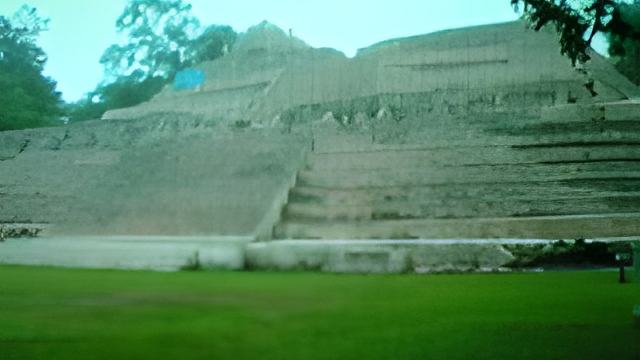
"When you go to Caracol you cannot fail to be impacted, or overwhelmed, by the monumental architecture, especially when you look at the big structure we call Canaa. Canaa is over 140 feet tall; it is still one of the most dominant architectural features in the country today even though it was built more than 1,000 years ago. The structure also has some very interesting features. At the top of it, there are three temples and we think that's why the site got its name, the huge temples on top of this huge pyramid, or mountain, which in this is case a human made mountain. It also has a lot of symbolism in Canaa but it certainly dominated the landscape of this ancient city. Across from Canaa there's also this temple, we call it temple B5, and temple B5 has beautiful monumental masks that we have preserved. Some of the masks show what we call the water lily jaguar and then on top of it also has these Rain Gods known as Talcos on top of the water lily jaguar. So the visitor gets to see these monuments which are not found at many sites."
And while the Canaa temple is unmatched, it is not the only structures that make Caracol singular - it is the size this city was said to have at least 200,000 people living there. That's a number that Awe disputes.
Dr. Jaime Awe,
"Some of us archeologists disagree with the large number, some of us say it's more accurate to say it had around 100,000 people. Despite that, it still makes Caracol a very highly populated, or densely populated, city. How do we come to these numbers? Well we often do what we call settlement surveys. You do transects and you walk out in the bush and we number every mound and survey and tie it into a map that we see. I've been all over the country of Belize and there are more ancient Mayan buildings, of different sizes---not just the big temples even small ones, than they are modern houses in this country. What does this tell us? Let's assume that there are four people that lived in each of these houses at the same time. That alone will give us a million people. So we think that the population of Belize was far greater than it is today."
And what were these houses like? The foundations for many of them are preserved at Caracol.
Dr. Jaime Awe,
"We call this the Raleigh Group and this is actually one of those middle class compound or home. You can see the buildings are very small, at one time they had thatch houses on top of them, back when the Mayas were living there. So it gives you an idea of how, not the elite, but the people towards the lower social scale built their homes."
"This is a group of mounds that we call the south acropolis. We know that an important branch of the rural elite may have lived here. Excavations were done there by the chases and before them by this archeologist from Pennsylvania and found several early classic tombs in one of the buildings here."
And the pattern of excavation at Caracol is designed to ensure that the visitor sees how the cross section of this once thriving society lived.
Though it was once viewed as impossibly remote - a large part of the road to Caracol has been paved as part of the tourism development project.
7NEWS produced for broadcast by News Director Jules Vasquez
Edited and Prepared for the internet by Keith Swift