
In terms of Maya sites, it's not as popular as Xunantunich, not as imperious as Caracol, and not as iconic as Altun Ha, but Cahal Pech, "the place of the ticks" was once a major ceremonial center and still holds its own amongst those Mayan temples. Now Dr. Jaime Awe, the Director of the Institute of Archaeology is leading a dig to expand Cahal Pech's renown. 7NEWS news was there on friday to see what new has been found.
Jules VasquezReporting,
This artist's rendering depicts how archaeologists believe Cahal Pech looked at the height of its civilization in about 800 A.D. Dr. Jaime Awe was here throughout and says Cahal Pech had a long run.
Dr. Jaime Awe,Dir - Institute of Archaeology
"At Cahal Pech we know that the first people settled here around 1200 BC and that it continued to be occupied, none stop, until about 800 AD. That's two thousand years of habitation. How long have we, modern period in Belize. Well near, just like two or three hundred years."
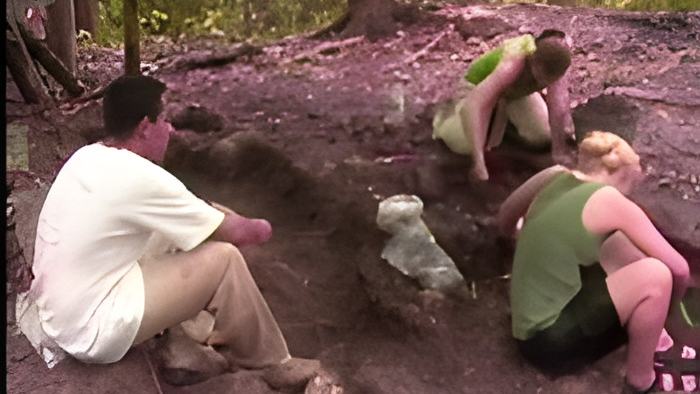
Between 1988 and right up to 2001, archaeologists excavated the temples and the palaces used by the elite, but now Awe and these students from Galen University are looking elsewhere for other clues about Cahal Pech. They're here in Plaza C, on this rendering, that area would be here, a small mound at the northeastern corner of the site.
Dr. Jaime Awe,
"The purpose of this excavation is to try to find out how the other segments of Maya society lived. When you do these types of excavations, you won't find the Jade Head. You won't find fabulous tombs, rare imported ceramics, or beautifully carved objects. No. You are going to find pieces of the common people, of the middle class of the backbone, if you want, of Mayan society."
And judging by what they've found, that backbone was mostly made of flint. This area was a dwelling; Awe believes it looked much like this one. The dwelling was over here, and adjoining it was a work area.
Dr. Jaime Awe,
"Excavations in the area that would have been inside the house, we have only found pottery. But outside the house all along the sides we have been finding a lot of flint chips or what we call chirp flakes and I mean thousands of these flakes and I will show you some of these.
It tells us that perhaps the people who are living here are producing tools, tools that were used by everybody. A lot of times we forget that the Mayas did not have steel. The Mayas were also a stone tool technology, they only used stone tools, and so these chips are from the production of these tools."
Awe believes artisans and craft people lived in the area, the Mayan middle class, those who assisted the elite. And there are more clues to be gathered
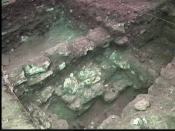
about that middle class over here in structure C-2. There was a long thatch structure on top but awe says what lies beneath is what's interesting.
Dr. Jaime Awe,
"It is sort of like looking at an onion skin. You know that the onion, if you peel off the top layer, you have another layer underneath. You peel off that layer and you have another underneath and the same is true with a lot of Maya buildings. They would build a small building, use it for a certain period of time, then cover it up and build something on top of it again, and this goes like I said for over two thousand years and by excavating down below the floor
level we see the remains of these earlier structures.
The first people who settled on top of Cahal Pech Hill, they started to build small houses. They weren't building temples, they were not building palaces. In fact you are looking at a village type of society, very much like some of the small villages we have in southern Belize. Then with time the population grows. They want to expand but if they are on the top of a hill, the only way to expand is you have to start to build walls, fill it in to make the land level and you build on top of that."
And over time, Awe says you can see the drop in construction standards.
Dr. Jaime Awe,
"The architecture in the pre-Classic Period, whenever they would go to fill in their platforms or their floors, they used to mix white mall with white lime and stone to make like concrete and so it was solid, a robust type of building. Then in the late Classic it is like high-rise, 'we have to move this job fast.' They would just take dry fill, loose stones."
And it's not only the loose stones that tell of a society that's increasingly populated; these snail shells taken from different layers and different eras show how the passage of time and growth of Cahal Pech affected eating habits.
Dr. Jaime Awe,
"It is not just a shell. If you look carefully at the shell, the lower point is broken off. We know that even the Maya today, all around in San Antonio, even down in Southern Belize, they call these jute or totu. They boil these,
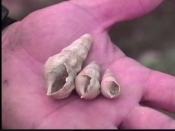
they break off the little point, and they suck out or they pull out the meat and they make a stew or a soup out of jute. It is like escargot, just like how we eat crab or people eat clams. It was the same sort of thing. In the pre-Classic level, we know that it is a small village at Cahal Pech around 1000 A.D. so they go down to the river and they select only the big ones. You find these big ones that they bring out.
As time goes on population grows and people are still eating jute but it is like when we over fish the reef, you don't find the big groupers anymore or the big lobsters. So what did the people in Classic period start to take out, they were less selective. They looked at the little ones. If you compare them, they are very very different.
You can see this one comes from the pre-Classic levels, the early early village down below. This is from the building above that dates to around 800 AD. So you can see how people, because of over-population were starting the to harvest the immature shells."
And those types of clues that detail resource usage, embody the true spirit of archeological inquiry.
Dr. Jaime Awe,
"I also say too that archeology it is like doing a puzzle but you don't get the cover, the picture of what the puzzle should look like. So that all the pieces of the puzzle are there, you only find some of the pieces. And so you put those pieces of the puzzle together and it is up to you, the archaeologist, to paint the picture."
And taking that task very seriously are students, Belizean and American - from Galen University.
Miriam-Abdul Qaiyy, Student
"Seriously I'm honored to be a part of it because this is like a big archaeology find or site and I could say I was involved, I helped dig into it so…"
Student #2,
"I've always wanted to participate in something like this because as a tour guide for example you just go and you are always referring to the archaeologist and you yourself don't even know to probably explain how they come about certain things that that say noh.
Potteries are everywhere right now. We were digging and digging and digging and were just seeing the same stuff over and over and then we saw red and it is an exciting feeling. So the idea that you can go into somebody's house or you're breaking into a wall and you see a bone, it starts making you aware; you're like 'wow.' Your mind starts going then that that this could be the house. The anthropology comes into it as you start wondering how they died and you start asking questions as to why they were buried here."
And these students say that so much of what they learn here has surpassing personal value.
Miriam-Abdul Qaiyy,
"There is not a lot of awareness, especially with the youths in Belize City. You're trapped in the city, you're working hard, you're trying to go to school, you're trying to survive-you don't even know what you have in your country. What you see on TV, the message is basically to go out to get better because what you have here isn't good enough. So you don't know what you have in your won backyard."
Jules Vasquez,
You've gotten easily ten thousand fly bites in your brief time here. Why would I want to do this?
Miriam-Abdul Qaiyy,
"Why would you want to do this? I think mainly it is education and I think because the Belizean culture and history is not included in the Belizean education and therefore if you're not aware of what you have, you won't care and you won't want to know about it and therefore you won't feel that you have to sacrifice something or sacrifice your own self, fly bites, cuts and all, to try to learn more about it and see how this affects you and how it affects your entire environment."
And perhaps that's the best lesson of this dig, among these rocks, in this soil, it's more than just archaeological, it's national.
The dig has been going for three weeks, and will go for five more.