Right now lobster is the priciest product in the sea, retailing for upwards of $15 a pound locally. And for decades, the best way to catch them has been using wooden traps. The traps work, and they work well; for proof of that you don't need to look beyond the fact that the product they capture has earned Belize tens of millions of dollars in foreign exchange. But what if trapping isn't the best way? What if all that trapping was really unnecessary, wasteful and involved needless risk?
If that sounds controversial it is, but that didn't stop a group of fishermen from the village of Monkey River to travel to Punta Allen, a small village on the south eastern tip of the Yucatan Peninsula to find out how to catch lobsters without a trap. Their trip was sponsored by the Community Management of Protected Areas Conservation Program, known as COMPACT. The idea was to have the fishermen visit the village to learn about improving the lobster industry while making it more sustainable. It's worked in Punta Allen for 20 years, but can it work in Belize? Our Alfonso Noble traveled up Mexico way to find out.
Alfonso Noble Reporting, [alfnoble@yahoo.com]
After a four hour ride by road through the Sian Ka'an Reserve in Mexico we arrive at Punta Allen, we load up to a skiff and head to the fishing island. Once there we meet a group of 10 fishermen from the village of Monkey River who have been here for this week involved in a series of training seminars. Omar Gale is the local coordinator for COMPACT, the Community Management of Protected Areas Conservation Program and is the one who brought the fishermen to Punta Allen.
Omar Gale,
"The purpose of this exchange visit is for fishermen to gain practical experience on the construction of lobster shades and also to see the system of management that the Punta Allen fishermen use."
The workshops take the fishermen from seminars to tours of the facilities where they see how the fishermen from Punta Allen operate. The tour is complete with the way they collect information about their lobster industry and how they use that information for improved harvesting. We then move to hands on training of the fishermen. They are thought how to build lobster shades. These are set in the bottom of the ocean, the lobster gathers under it and harvest is done there.
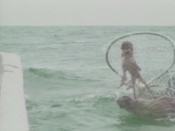
The ultimate goal is this: to harvest lobster in a sustainable fashion, minimizing the impact that the industry has on the resource while at the same time ensuring that whenever fishing boats go out to sea, there will always be a healthy population of lobster available.
Omar Gale,
"Traditionally fishermen have used lobster traps and different types of shades. These concrete shades are more durable and the way how they use it is conjunction with a net which allows the fishermen to catch the lobster live and see whether or not they are female or they are of legal size and by so doing they can put the female lobsters back into the sea. The fishermen have realized that the type of fishing, the fishing net that they are using is not sustainable. While it is effective it is not sustainable because once they hook that lobster, that lobster is going to die so they have decided that they need to come and learn new fishermen techniques that is going in the long term benefit them."
Derwin Garbutt, Fisherman - Monkey River Village
"For us the production of lobster has declined for us. The way they harvest is much different from us because we use a hook to harvest and they use a net. I think that is why the fishing here is much more sustainable the way they do it. In Belize if we hook a small lobster, that lobster is probably going to die. But they don't hook here so if a lobster is small then they would select it and put it back, release it back. We don't harvest females in Belize, females with eggs, as well as they do here. For us its more difficult to the way we fish for lobster to select the female with eggs because you can't really tell if a female eggs when its really hiding until you already hook it. But the way they do it here, you could always release it, as long as it has eggs."
That process of selective collection of lobsters has put the fishermen at Punta Allen leagues ahead of everyone else in the industry. Because they are considerate of the impact the fishing industry is having on the resource, they are careful to maintain the industry in a sustainable manner. Julio Moure is the COMPACT Coordinator in Mexico and has been offering capacity building to these fishermen.
Julio Moure, Coordinator COMPACT
"The way they organized themselves respects the different laws and regulations is very good and the way they fish lobster is very sustainable. They share quite happily their experience, even their mistakes, and that is the spirit: to go a little bit ahead but to share your experience to help the others to improve their activity. What we try to do is to put together, to think and to share experience, those who are ahead and those who are behind. It's marvelous to have the different experiences exchanged between those countries. We are neighbors; the sea is the same, and many parts of the culture, Mayan culture and influence, is similar."
Daniel Castellanos, Fisherman - Monkey River Village
"We are thinking now how to protect it, how to manage it, and by coming to Punta Allen we asked the people to give us ideas on how to do such things. I think that when I reach back home, I and my colleagues that have come, we want to inject into our village how the system works here, how we are supposed to address the government on what we need."
Omar Gale,
"Its not something that's going to happen overnight, its going to come with time. These guys at Punta Allen have been going at it for over twenty years. However by these guys coming and seeing it first hand, its going to come but its going to take some time."
And because of the success that the fishermen here in Punta Allen have had over the years, COMPACT believes that the fishermen in Belize, and in particular Monkey River, will be able to apply it for our sustainable fishing industry.
Punta Allen forms a part of the Sian Ka'an Reserve which is a World Heritage Site. COMPACT will continue the support of the fishermen in Monkey River. The next phase will be funding the construction of shades for the fishermen.