body,td,th { font-family: Arial; font-style: normal; font-weight: normal; }
If you frequent the George Price Highway, you may have seen a jaguar, a puma, or a tapir crossing from time to time. And, like any good driver, you probably remain vigilant when you see animal crossing signs.
But animals aren't like people, looking both ways before they cross, and with roads that cut through their habitat, sometimes they meander across but are hit by vehicles before they could make it to the other side.
With the John Smith and Coastal Highways, those were upgraded without a safe corridor for animals to pass. But the same mistake won't be made with the upgrading of the George Price Highway.
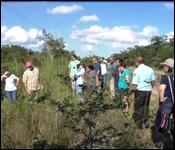
Today, the Tropical Education Center hosted a workshop with stakeholders such as biologists, ecologists, and engineers to initiate plans for a wildlife crossing.
Courtney Menzies joined them today and has this story.
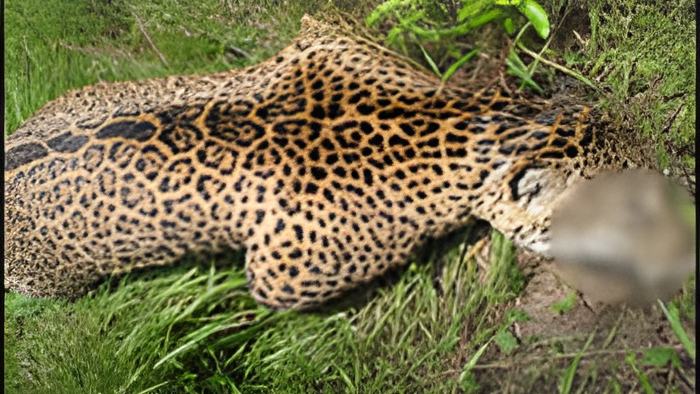
This jaguar was hit while trying to cross the George Price Highway. As was this puma. It's a fate many of our large mammals face when traversing through the country.
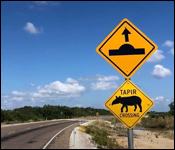
Some roads - like the John Smith - display these signs, warning drivers that animals frequently cross the road. But these signs were only erected after several tapirs were already killed.
So with the upgrading of the George Price Highway, rather than wait until another jaguar or tapir is hit, the government has reached out to the Tropical Education Center to find a solution for animals to safely cross the road.
Celso Poot, Director, TBZ & TEC
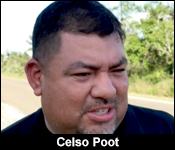
"It's no secret that the government of Belize has announced that they're going to upgrade the George Price Highway between Belmopan and Belize City and what we know is that there is only a small swath of land that connects the northern and southern forests of Belize which is called the Maya Forest Corridor, 2 and a half to 3 miles of forest max, and so what we want to do is we want to plan and we want to recommend to the government to incorporate wildlife crossing structures for safe passage for the wildlife that are moving across the Belizean landscape."
"This site where we are right now, we have confirmed crossings of jaguars, tapir, puma, and other small mammals, so we're looking at the larger animals, those require more space, those require large area to move so those are the ones more likely to cross the road."
"We tend to forget the animals when we're doing these designs, these plans, but more and more as the conservation movement in Belize advances, we are now sitting at the table, talking with the government, talking with the engineers, making sure that it's not an afterthought, it is planned, it is included, and it's budgeted for."
"If we don't plan for this with the upgrade of the George Price Highway, you isolate populations of wildlife, you'll have one population of wildlife in the north, and another population in the south and they won't be able to connect so that's what we're ensuring here, that there's connectivity, functional connectivity."
And to help with that, they've called in a consultant, wildlife scientist Tony Clevenger. He's built crossings in North America, Latin America and Asia, and he explained that the move would be transformative for Belize.
Tony Clevenger, Wildlife Scientist, Montana State University

"This is going to be an important project for Belize, this is an extremely important wildlife corridor, probably one of the most important in Mesoamerica and we're out here looking at the different locations, we have the background data on where important movements are for jaguars, for peccary, for tapirs, etcetera, and we're basically working with the transportation agencies and other stakeholders to see what locations make the best sense for a wildlife underpass or wildlife overpass, so we're sort of going through the different options."
"Terrain is important, the quality of habitat is especially important like we see here with tropical forests and mature forests on both sides is important, and to some extent the amount of water and flooding, because we don't want to build underpasses and then they get flooded and then wildlife don't use them so we need to take that into consideration in the design and the location."
And that's why engineers were also a part of today's workshop and the field visit. The president of the Association of Professional Engineers of Belize told us that while it is necessary, it won't be an easy project.
Rami Chia, President, APEB

"What we've seen is that there is the need for the crossing and the how now is the hard part because as we've seen by the walkthrough today, there is water on both sides, we have the fact that the road design has already been done and so we have to incorporate whatever it is the solution might be to this design that already exists which means that they will have to tweak the design but it seems that without this crossing, we may have some of our wildlife at risk."
"It's always a challenge worth taking on from an engineering standpoint, every challenge is good, especially if it's going to improve something in our country and I believe that according to what we learnt today, having the animals being able to cross to reproduce is worth it. Saving our jaguars."
"There are two main possibilities, they're speaking about an overpass, I really and truly don't see an overpass really happening here especially because we have the high tension but I mostly see either a large box structure, or a small bridge to help cross the animals from one side to the other."
The planned area for the crossing is between miles 26 and 29, which, as Poot explained, is where they normally see animals crossing, since they reuse the same trails.
The workshop continues tomorrow.