For several days now, we've been telling you about the media's frustration with the Briceno government's change at the Belize Companies And Corporate Affairs Registry.
The keepers of the companies registry have made a significant upgrade to their system, which has now gone from paper to digital. Also, Belize became more compliant with the strict requirements of international financial regulators by merging the local companies registry with the international business companies registry.
But those upgrades came at a significant cost. The previously free and open registry access that the press and general public enjoyed is now cut off.
As you heard last week, the press isn't pleased about the change, but the government insists that they are picking the wrong fight. Our Daniel Ortiz has been closely examining their main arguments, and tonight, he looks closely at the issues at play. Here's that story:
One of the reasons why Cabinet Minister Chris Coye insists that the independent media is picking the wrong fight over company privacy is because, since 2019, Belizeans figured out that under the old system, it was best to register their enterprise as an off-shore company, instead of as a local business. Their company data would then become private as part of the IBC regime.
For example, as an off-shore company owner, a political insider who is being unjustly enriched is immediately shielded with a cloak of confidentiality that not even the sharpest of investigators could easily penetrate.
Chris Coye, Minister of State, Ministry of Finance
"Some of what I have heard being referred to is full access, and open disclosure of director and shareholder information under the old companies act for the local companies, but there wasn't under the old IBC Act. Well, Belizeans did take advantage of that as well; if they want to keep their information private, they would form an IBC. So, even before this new companies act, that option was available and was, in fact, utilized. I think the Brads Gaming scenario or situation is actually very useful from different perspectives. That operated under the old law, and under the old law, as much the discussion has been on transparency, nobody - certainly then, I don't know about now - and certainly, the media, as far as I understood - was able to find [out] who the ultimate beneficial owners of that company were."
Jules Vasquez
"Under the current regime, you wouldn't even be able to find out that Good Lee is a principal in Brads because all you would know is that it is Brads. You would have to go to the agent, the attorney, to ask, who are the shareholders of Brads? It's one more layer of concealment that they now have."
Chris Coye, Minister of State, Ministry of Finance
"But I'm not sure that there is an additional layer of concealment. That was what was the law before. So, that's the law that's effectively being integrated now.
Minister Coye also thinks that a better way to get at the transparency objectives that the press is championing is to compel any company that wants to do business with the Government to disclose their full details, such as directors, shareholders, and ultimate beneficial ownership.
Chris Coye, Minister of State, Ministry of Finance
"I could propose a very simple solution to that problem. Any person or entity that looks to conduct business or enter into any contract with the government should fully and absolutely disclose directors, shareholders, and ultimate beneficial owners. That would deal with that problem immediately, directly, and in a simple manner. That was not available. That was not done when it concerned the Boledo contract, and so you have that problem. But if that were done, you wouldn't even have to try and find anything - where is it -St. Lucia or wherever it was."
Jules Vasquez "But how do you make that real, Minister? I mean, I hear that it's your suggestion. We all would support that, but you're the Minister. Make it into law."
Chris Coye, Minister of State, Ministry of Finance
"That has to go through its processes, including Cabinet, and after Cabinet, if Cabinet so approves, then to the legislature, the National Assembly."
This discussion has just developed over the last few days, and I'd certainly be happy to work on a Cabinet paper to put that forward.
Coye must have mentioned his full disclosure proposal to Prime Minister Briceno over the weekend because on Monday evening when the press asked the PM about the now private company records under the new registry system, he proposed it as a compromise to the unrelenting press. The idea was even fleshed out a bit more.
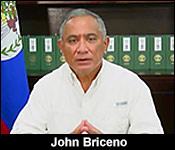
John Briceno, Prime Minister
"We are proposing right now to present to Cabinet policy and law. Immediately, we want to start with the policy until we change the law. It is to ensure that anybody that wants to do business with the government, anybody that wants to do business with the government, cannot own a company with a registered agent. We have to know who are the members of the board, who the shareholders are, and who are the ultimate beneficiaries; that is what should be your concern. When it comes to government finances, we are making sure there is going to be openness and transparency, and we're going to start with policy; tomorrow, we're going to present it to Cabinet, I've already spoken to a number of ministers, and all of them agree with it, and secondly to change the law so that cannot happen."
Briceno's Finance Minister of State says that this full disclosure by government contractors could then be bolstered by the press of other civilians who can demand public disclosure via applications under the Freedom of Information Act, FOIA.
Chris Coye, Minister of State, Ministry of Finance
"In terms suggestion I made, I would think that [that] would work complementary to that disclosure because that disclosure is made to the government. And if there is an investigation, a journalist wants to investigate that contract or anything associated with that contract, the Freedom of Information Act could be utilized to access that information."
Daniel Ortiz
"FOIA requests aren't perfect. We've seen persons who complain that you have to be very specific in what you're requesting, and when you're trying to investigate whether a specific company, its shareholders, and beneficial owners have behaved in a certain way, their interest is to conceal."
Chris Coye, Minister of State, Ministry of Finance
"That's something that I think you could look at, how the Freedom of Information Act operates and whether it can be improved."
So, since the FOIA is supposed to be the tip of the spear used to get at public disclosures from government agencies, we asked Senator Janelle Chanona, a conservationist with a strong journalism background, about her past experiences with that legal avenue.

Janelle Chanona, NGO Senator/ VP, Oceana Belize
"I would say right off, both as a journalist and as an advocate, every time I have had to resort to the Freedom of Information Act, FOIA for short; it has worked. It has really been heartening to get support from the Office of the Ombudsman, which is a party to Freedom of Information Act requests. How well it works is another question. We have had experiences where it has highlighted that requesting information and accessing the information is facilitated. However, with various government agencies and departments, we've found that their maintenance and storage of the information being requested has impacted the quality and timeliness of the response to the data requests. They'll come back, and they'll say, all of this data that you want is on one flash drive, and it's going to impact our work. They've come back and said we're short-staffed. So getting somebody to compile the information you're requesting will negatively impact our work on the ground."
But, Senator Chanona and the NGO community have had instances where the requested information was missing an important puzzle piece.
Janelle Chanona, NGO Senator/ VP, Oceana Belize
"In one case, I remember specifically the approval of causeways offshore Belize City, and we made that request in 2019. We got a set of documents as a part of the response in 2020, but then we also got a letter saying, oh, there may be a few things missing, but it's just a matter of bureaucracy. Somebody got the file somewhere else, and as soon as we get those documents, we will add them to those responses."
The Freedom of Information Act is imperfect and to introduce it now as a transparency tool in this company secrecy matter is - critics would argue, a less than optimal workaround.
We'll have part 2 of that story tomorrow when you'll hear how this new public disclosure policy introduced by the Finance Ministers can be easily defeated.