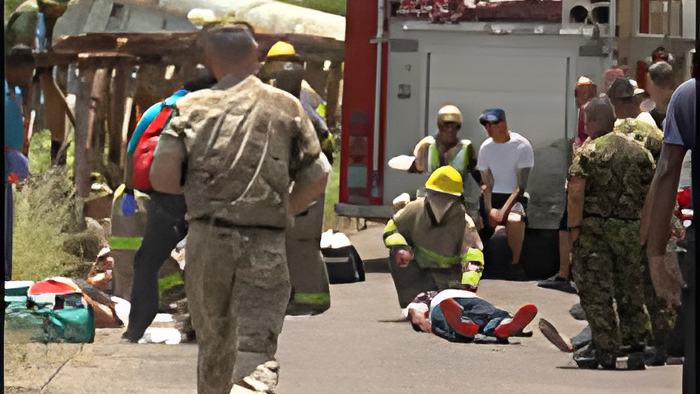
If you were on the Boom Road today, it might have looked like all hell had broken loose: all kinds of vehicles, and bodies were strewn every which way - including in the river - which also had an oil slick!
And while it looked like a major disaster - it was only a simulation - another one to test the response and readiness of Belize's first responders.
7News was there at the Burrell Boom bridge to see how emergency services responded to an environmental disaster on top of into a mass casualty event. Cherisse Halsall reports.
Cherisse Halsall reporting
A soldier cries out for help after being thrown from his vehicle.
It was an environmental disaster and mass casualty event that fortunately was just a simulation. The government led initiative spearheaded by the DOE and its partner BATSUB today completed phase 3 of an exercise that prepares first responders to help save lives and protect the environment in the event of an emergency. Anthony Mai from the Department of the Environment walked us through Exercise Tropical Alliance.
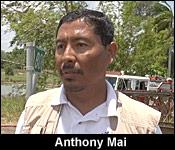
Anthony Mai, Environmental Officer, DOE
"A BNE tanker truck is coming from the direction of, well, is coming towards Boom. Before it reaches the bridge a vehicle is coming out, and the truck collides with the vehicle. The vehicle then overturns over that section of the bridge. The truck continues out of control and slams into this mini bus with tourists. The mini bus then slams into a BATSUB truck and another vehicle. The tanker truck is on the side of the river spilling oil into the river. So that's the picture. that's the scenario."
"This simulation is in planning since early April. The DOE is working along with BATSUB in terms of preparing for this simulation. We had three phases the first phase was when we had our planning meeting with all key agencies to work out the scenario. The second phase was a show and tell exercise where we had each agency coming out demonstrating the assets that they have and explaining what their roles and functions are in terms of responding. And then the third phase is actually this. This is the simulation that each agency now is responding to and the idea is that it's not a simulation where we want to see if we pass or fail but more one where we want to train and we want to identify areas that we need to improve upon."
The simulation was designed to create a scenario where multiple, simultaneous emergencies were playing out on land and water.
It's a lot of moving pieces and BATSUB helped in the design:
Major Alan Grant, Training Safety Officer, BATSUB
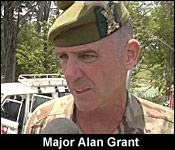
"All we are doing is we are facilitating the exercise by supplying the man power a lot of the assets the broken cars that we've borrowed to put in position and we've come up with a lot of the ideas from our own lifetime experience to help test all the different agencies that are here and put them under a bit of pressure."
And while Mai says that the exercise was not about passing or failing, participants were being evaluated for their performance.
Anthony Mai
"Each agency has an evaluator that is evaluating their response because after this we want to go back to the headquarters at BATSUB and we'll have a de-briefing where each evaluator will present activities or issues that we have identified that we need to improve upon."
And what better proving ground than a real time simulation - thankfully without real world consequences.
But, to make it as real as possible, these pretend casualties were transported to the morgue by pickup for processing.
Other participants in the exercise included: NEMO, The Belize Police Department, The National Fire Service, BERT, BNE, The BDF's special boat unit, and Astrum helicopters.