
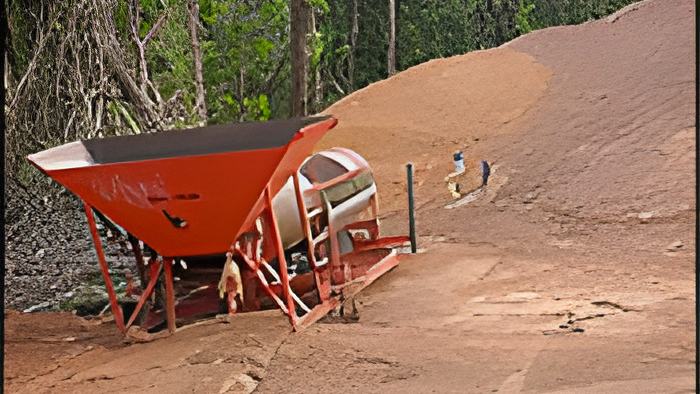

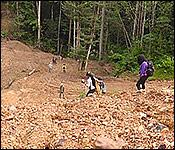
Last week we took you into Chiquibul National Park to show you the operations that Boition Minerals Ltd. has been carrying out at the top of the Maya mountains.
And in that first part of the journey we heard the questions and concerns posed by the environmentalists who went there with our team. But, tonight, as we hear even more from them, we'll also turn the tables and talk to Boiton's geologist, Jean Cornec.
He spoke via Zoom to Cherisse Halsall, and tonight she brings you the conclusion of this story.
Tonight, we're back in the Chiquibul, back to the makeshift roads, and the very bumpy ride, and that's because while we've heard the alarm bells raised against Boiton Minerals Ltd. we've yet to hear from the company itself.
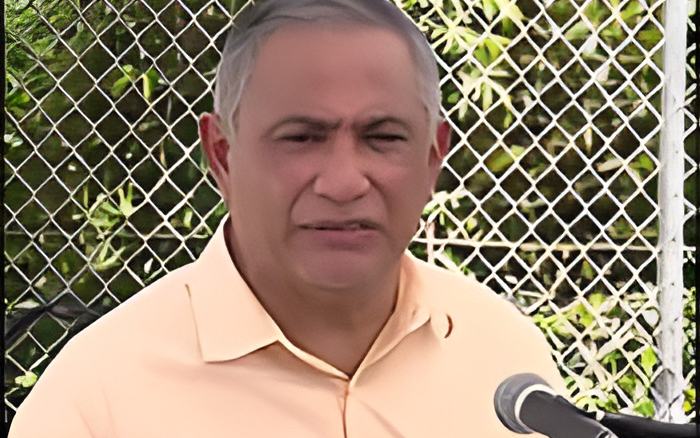
But that changed this morning when I spoke, via Zoom, with Geologist Jean Cornec, Boiton's project geologist who the company directed to address the host of environmental concerns.

Jean Cornec, Project Geologist, Boiton Minerals Ltd.
"We have a lot of gold in the creek and it had to be coming from somewhere in the watershed and we were lucky enough to locate some of the gold sources in 2016, 2017, 2018 and then we applied for a production license."
Cornec says that was a lengthy process, one that no one objected to when it was gazetted. And after the required consultation period, Boiton was granted its production license in early 2019.
But Cornec's words may do little to assuage the concerns of Senator for NGO's Osmany Salas. During the trip he stressed that a mining license granted for use in a national park was very strange indeed.
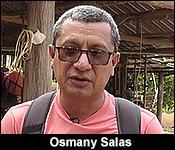
Osmany Salas
"According to the national protected area system act extraction of resources should not take place in a national park, of course, the minister has discretionary powers, and that is the opening, that's the loophole, ha's he window ha probably was used here."
"We should not be allowed, it is very bad practice to allow an operation such as this type of mining to be self-policing, or policing themselves, for obvious reasons that doesn't make any sense. So, there's a lot that needs to be improved here."
But Cornec disagrees; he says there's no law against mining in a national park.
Jean Cornec, Project Geologist,
"First of all exploration activity in the area has been taking place for probably 70 years in and out since 1955. There is no corruption involved because the legislation in Belize allows for mining, legislation in Belize allows for mining and exploration to take place including in a national park, it's like oil exploration. So there is nothing illegal for the government to provide, to give licenses in the area which is under national park status."
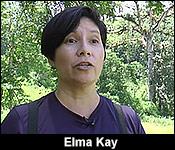
But legal or not, there are major concerns about the impact that Boiton's activities are having on the area's wildlife.
Elma Kay
"You're looking at what we call cumulative impacts, so it's not just the impacts of the mining operation but you have to look at the picture holistically and holistically our wildlife is already under assault by the trans-boundary issues that we're facing, so yes you're destroying a localized area with the mining because obviously wildlife will not be able to persist there it is destroyed."
Jean Cornec, Project geologist, Boiton Minerals Ltd.
"I must admit that there are a lot of problems with biodiversity but we are not the culprit. There are as many as maybe 300 Guatemalans roaming around, and panning for gold. As far as 12 kilometers from the border they have burned thousands of acres, demolished what by my calculations may be a combined 20 kilometers of rivers, they've stolen a lot of gold of course and killed all the wildlife, I mean those guys carry guns, they hunt. We do not carry guns, we do not hunt."
And Guatemalan activity is something that Cornec continued to harp on during our interview with the gist of his opinion being that those activities are much more widespread and more invasive than that of Boiton's, and that if nothing else Boiton's permanent presence serves as a deterrent to their illegal incursions. But NGO leaders like Oceana's Janelle Channona remain skeptical, insisting that GOB must make greater efforts at monitoring, especially in this remote wilderness.
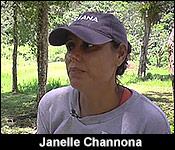
Janelle Channona, Vice President
"We can't keep doing the same thing and expect a different result it's really about looking at the system and making the changes there, whether it's marine terrestrial whatever the case is, we're seeing that they're bottlenecks and there are things that by design need to change if we want to see different outcomes for the resources, for economic development, for people and so it's really important that we just take some hard looks at what's happening and make the changes and keep making changes until we get what we want. But this kind of you know out of sight out of mind approach has never worked well and what we have back here is far too precious just to hand it over."
Elma Kay, Forest Biologist
"What is it that when we made this decision to grant this licensee and have this developme what were we thinking in terms of monitoring, how do you leave a company out here."
"In terms of the forest mining is one of the most destructive activities that there is, your literally digging up the earth to get something for it. And it's very hard to see there would have to be a lot of work to remediate that."
Osmany Salas, Senator, NGO's
"FCD staff, this is their life they do this everyday, they are used to even rougher conditions that what we went through yesterday, that is one of the reasons why FCD has been a successful co-manager of the Chiquibul national park for all these years, and I would suggest that government should consider engaging with them and see how they could assist with the monitoring operations."
Jean Cornec, Project geologist, Boiton Minerals Ltd.
"Well we are not done anything that is irreparable actually everything we have done can be taken care of and if there is any infraction, we can take care of it but we'll be very soon in the process of re-seeding the area so what looks like a good optics will be taken care of pretty soon."
Jean Cornec
"The re-seeding won't take place for a few months, but once it starts I believe that you can see the results easily within a year."
And while the trees may grow back, the other, more serious accusation is that Boiton may be diverting streams and destroying watersheds, That's aquatic ecologist Ed Boles's major concern.
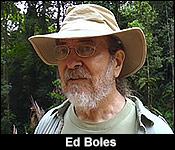
Ed Boles
"I'm always worried about any kind of disruption of the integrity of this watershed. Creates erosion when your removing material from this watershed and especially when you're digging into the terrain and you create erosion situation such as this. This erosion is an ongoing process naturally but when you get into a situation like this it greatly increases."
"We really have to take care of our Belize river, it gets a lot of sediment introduction from many other activities as well. So this is just yet one more, how large and how much is a question that we would want to ask."
Cornec has those numbers, but he agrees with Dr. Boles assessment that, erosion, something he calls a natural process, is happening with or without Boiton.
Jean Cornec
"So, maybe our activities contribute to a couple of tons of clay being washed into the creeks, but you have to keep in mind that at least according to my calculations there is probably 100,000 metric tons of mostly clay plus some sand and gravel that are washed every year out of the Maya Mountains 100,000 metric tons. So, we may have bay accidents a couple of tons of clay,clay, which are inert non-toxic, we do not use chemicals so our impact is very very minimal."
But despite Cornec's measured and straightforward style, the environmentalists certainly wouldn't agree with the assessment that Boiton's impact is minimal.
But what can they do? According to Boition all operations being conducted in the Chiquibul Park are not only legal but also very much above board. Now, it'll be up to the constant vigilance of the FCD and the NGO's to poke holes in that assessment.
But knowing the terrain and what they journey takes we can only wish them good luck and godspeed because continuous monitoring of Chiqibul operations will be almost as challenging as the journey there.
A joint inspection by officers of the Department of the Environment, Forest Department, National Biodiversity Office, the Mining Unit and the Friends for Conservation and Development concluded that several conditions of the Environmental Compliance Plan were not being met. A release says "The Government of Belize takes this non-compliance seriously and will be applying the appropriate penalties and fines for these infractions." The details of those penalties, inexplicably, remain secret.