
But the tirade didn't stop there, no Flowers was just getting started, and next up he tells us about what the P.S.U. is calling C.E.O. crises caused by vacuums of power in both the Ministry of Natural Resources and the Ministry of Sustainable development.
Flowers and Tate finished up the conversation by appealing to all their P.S.U. members to come forward with their concerns and grievances, the messaging being that they are their not to just to call out the abuses but to serve public officers.
CCJ Hearing on Implementing Maya Land Rights
For a number of years now, the Caribbean Court of Justice has been dutifully overseeing the implementation of Maya customary land rights in Belize. That's after the Government of Belize agreed in a consent order that Maya customary land rights exist and need to be recognized and fully protected in the country's traditional land system.
That was back in 2015, and over the course of persistent compliance hearings hosted by the judges of the CCJ, the Mayan communities of Southern Belize have either complained about the very slow pace of translating their land rights from a court judgment to an actual system that is recognized at the Lands Department.
Through their attorneys, they have either complained outright or implied that the former Barrow Administration was not doing enough to speed up this implementation. For several months now, a new Government has taken over the management of this very complex issue, and a ministerial portfolio of Indigenous People's Affairs was created to address matters like this.
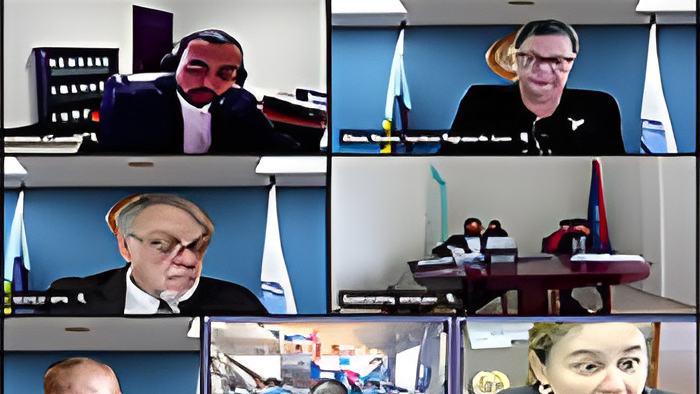
This morning the CCJ presided over another compliance hearing today to find out what - if any - progress has been made since they last convened on this case in June of this year. That session was broadcast live on their YouTube page, and it lasted for a little under 3 hours.
Here's what the presiding judge and the independent oversight authority had to say about the Government's attempts to move the needle ever so slightly in the right direction:
Hon. Jacob Wit - CCJ Judge
"My impression is that although it's slow - but progress is made. Nothing is perfect in this world, but I think we can say that we are doing - at least the system is doing better than it used to."
Professor Rosa Celorio - Dispute Resolution Authority
"There's been a number of positive steps from the state. I mean I think a few things that are important to recognize from the Government is that there is an effort. I believe, at least from my assessment, to comply with the CCJ consent order and paragraph 4. And it seems like government officials are also engaged and interested. One thing also to highlight, you see, especially for example, in the follow-up letter that I sent on the San Marcos Village is the amount of cease and desist orders, for example, that the Government has been issuing, and also the non-renewal of licenses or authorizations that could be contrary to paragraph 4 of the CCJ consent order. And the other thing I want to recognize from the Government is that every time I have requested information from the Government on any of these complaints, they do provide the information. They provide detailed information. So, I'm grateful for the collaboration of the Government In that regard."
Leslie Mendez - Attorney for Claimants
"What I did want to say very quickly is that very recently, we have noted a change in the approach from the Police Department here in PG, and we just wanted to recognize that."
But, according to Dispute Resolution Authority on this matter, there are major lingering issues that remain unaddressed in the implementation of Maya customary land rights. She told the court that some sort of intermediate dispute mechanism needs to be identified, while the government and the Maya work out a full protocol for their Free Prior and Informed Consent. Here's how she explained why:
Rosa Celorio - Authority/Expert
"I continue receiving reports of third-party activities in Maya lands without consultation and consent. This is an ongoing problem, and it does underscore the need to have an approved FPIC protocol, and I believe that this is something that probably the parties will brief you in terms of where the FPIC is. And it's very important that when this FPIC protocol is adopted that this also serves as a way of building trust between the parties. A lot of what I see is that we still need confidence-building measures. And at the end of the day, this is very important for any solution to this matter to really work and that the FPIC protocol does reflect not only the Government's interest but also what is very important for the principles of self-determination of the Maya. This is extremely important when discussing the provisions of the FPIC. The other thing that I am very concerned about - and this is - I'm thinking, for example, villages like Indian Creek, particular. We still have this very serious issue of conflicting land claims, right, between the Maya and third parties. This goes beyond my mandate as an authority, but when it comes to my mandate, my main concern is that we do need interim measures to really prevent escalating tensions to deal with threats, to deal with security issues that really could threaten the Maya and their integrity. And I'm very concerned about - especially in the Indian Creek Report, you'll see this, the presence of rangers, the presence of surveillance, but also the obstacles that the Maya are having in the Indian Creek Village to access needed resources for their survival."
Later on in the court hearing, one of the attorneys representing the Mayan Claimants explained that the communities continue to find themselves in bitter disputes with "third parties" who also have rights to lands that the communities claim as their own. She insisted that the residents of these communities are open to dialog and discussion with these "third parties" in the hopes of avoiding conflict. Here's that part of the discussion:
Leslie Mendez - Attorney for Claimants
"The third parties need to consult, need to approach, and need to work with the communities to try to get to a sort of interim measures, which we repeatedly mention, even at the meeting that we had with the representatives of the third parties is that the communities are open to considering what they want to propose. Propose to us exactly what is it that you want so that we could get to some sort of agreement. But what has been repeated, and what has been emphasized is that I have a legal title. And when the government does not clearly refer to paragraph 4 and the obligation to consult, even when there are third-party rights, which has been repeated in several of the reports from the authority that creates unnecessary confusion. And, it makes the process even more complicated because, with much sincerity and frankness, it's not that complicated. But if they had come from the beginning and accepted that what obtains right now is that if you don't negotiate an alternative with the communities to give access, and for you to be able to conduct certain activities within their lands, then you cannot conduct those activities within their lands. What is happening right now is that is being flipped. The communities, now, need to go and ask these third parties. That's what the third parties are under the impression, and quite frankly, that's what the Government is under the impression is that it is the communities that need to come to the table and negotiate a way forward. The communities are open."
5 Artists Get A Shyne-ing Moment
Last night we told you about the 5 Belizean artists who will have their music distributed by Universal Music Group - which is the largest music label in the world. But we couldn't air the story due to a technical difficulty. But here it is now - Friday morning's event from the Shisha Lounge in Belize City:
US Embassy Political Office Investigating Narda's Lawyer Letter to Arist
And our next story is also abut an artist - painter Alex Sanker.
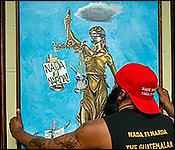
You may know as the bridge foot artist from Belize City. He's been in hot water over one of those publicly displayed paintings for months now, one that depicts CEO in the PM's Office Narda Garcia as a sort of jaundiced Lady Justice.
That painting apparently riled up the C.E.O. in the Prime Minister's office so much that she sent him a lawyer letter - from no less than CEO - slash attorney Kevin Arthurs. The question now is whether she threatened to sue for silence.
That question is being asked by no less than the U.S. embassy's political section. We stopped by Sanker's studio yesterday and in his classic style he used a painting to show us just what he's being put through.
Alex Sanker, Artist
"I'm presently working on this one, it's called modern-day lynching. As you can see, I always tell people it was in the 1800s earlier 1800's I would be lynched for something like this, trying to call out powerful people and even government officials but because we live in a more modern time, they aren't doing it to me physically but financially and even the way it, and I've been persecuted in this country for years, that's not a lie, everybody knows that but because I'm so consistent people start to say you know what this is truly who this guy is so let's respect the art. A lot of people in power cannot bring themselves to do that, but this will not stop, this is the message I need to get across."
Cherisse Halsall:
"You're claiming that at this point an international organization is looking at Human rights violations in terms of what you are being accused of, tell me about that?"

Alex Sanker, Artist
"Well, Ha Ha, and I laugh because my mom always said listen, do right and you'll end up on the right side of history. Yes, right now the U.S. embassy that does write reports of human rights violations had reached out to me and asked me, there's a lawsuit suing me for being this vocal through my art and even verbally and they reached out and said, Alex, we need to comb through those letters from the lawsuit to see if there's any violation of human rights. So, I say I'm gladly gonna do that so I want to make this clear, even if they don't find a violation of human rights, are trying to find out if people in this country are doing me wrong because they're trying to intimidate me through their man give power like I always say. So, I'm going to stand my ground and I'm going to be authentic who I am and at the end of the day, I guarantee you that I will end up victorious in this case."
We have seen Facebook Messenger messages confirming that US Embassy's Political Section did inquire into the matter for possible submission into its annual Human Right Report on Belize. That is compiled by the State Department which makes the final decision on what will be in the report which is usually released in April.