
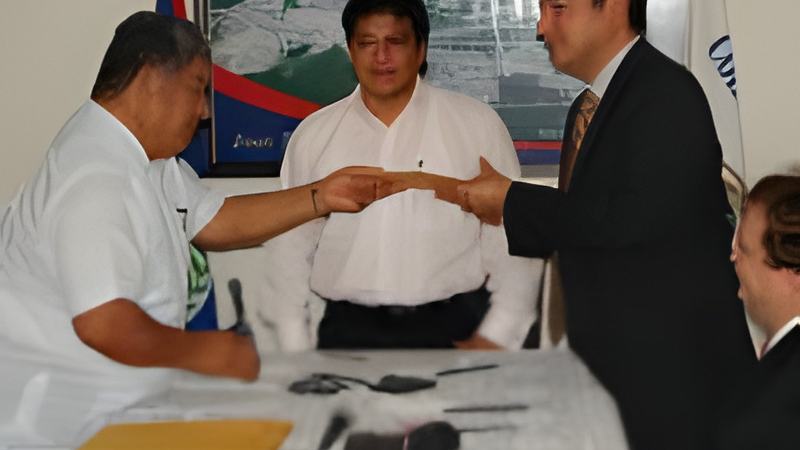
When 7 production sharing agreements were signed on Friday afternoon in the Corozal Free Zone, it seemed to us that the circumstances of the signing were deliberately evasive, and meant to exclude the independent media. Well today, government’s media masseuse Nuri Mohammed said that in terms of scheduling and location, there was no intention to exclude the independent media. It was scheduled and arranged like that, he explains, because of a shortage of suitable spaces and also because of the Prime Minister’s tour. It’s his job to stress those things, but as for us, we know what we know, and for reasons beyond those stated we’ll stick to our position.
But looking at the production sharing agreements themselves, from what we’ve been able to glean, they are indeed vastly improved over the Belize Natural Energy Agreement and do see the accrual of greater benefits to Belizeans. They are called model production sharing agreements developed with technical advice from the Commonwealth Secretariat.
But we can’t say the same model was used for production sharing agreements signed for two other local companies a few months ago. The companies are ZMT Incorporated and BCH – and our reports say that those agreements were developed with some elements of the Belize Natural Energy production sharing agreement and not the Commonwealth model.
This is seen by observers as retrograde because the Belize Natural Energy Agreement was far less favorable to the Belizean interest because it was negotiated when oil had not yet been discovered in Belize. In that case, the exploration company got more favorable terms, because it was very unlikely that they would find anything. Now that oil has been discovered, Belize’s bargaining position is better and those in the know say it should be reflected in the agreements.