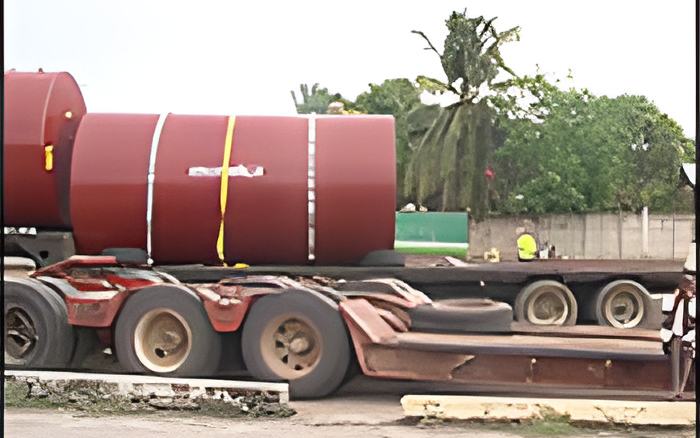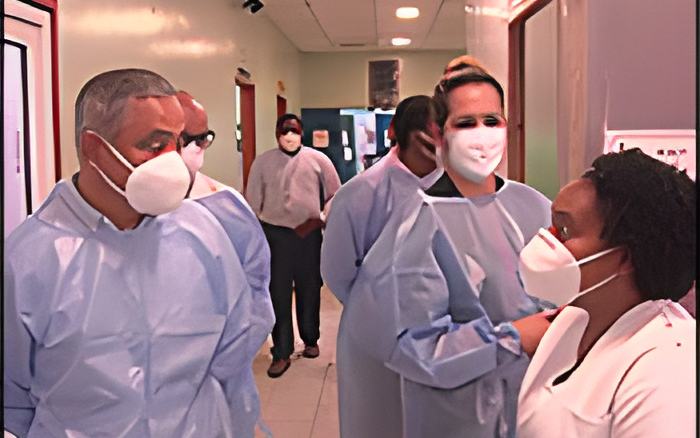
While we were in Seine Bight, we spoke with the contractor who is installing the fuel storage tanks for the gas station. As you heard, the residents are very concerned about their community's public health and public safety. They say that this populated area of the village is an unsuitable location for the gas station.
So, since the residents are convinced that a future fire hazard is currently under construction, we asked the Operations Manager of the Petroleum Equipment Services Ltd to discuss some of the safety features. The manager told us that the developers have taken on a hefty price to comply with the demands of the Department of Environment and the National Fire Service:
Armis Hernandez Jr - Ops. Manager, Petroleum Equipment Services Ltd.
"DOE and the fire department requested that if any gas station was to be built, no permit would be obtained for an above ground installation, it had to be underground, not direct burial, that it had to have an explosion proof valve underground, so based on those additional request the developer decided that he wanted to comply and so he did invest in this concrete vault that is designed to contained a 110% of the full capacity of the amount of fuel that will stored in there. As you see those tanks, we call them double wall tanks glass steel tanks, which is basically a metal tank that is covered with a jacket of fiber glass and it has a space in between whereby we can monitor the integrity of the primary which is the metal tank. In this case to this coastal environment the salt air has a lot to do with corrosion. We choose those tanks for that particular reason as well. Normally, in the mainland we have installed these tanks direct burial which is just dig a hole, we bury them and we leave them with sensors and some type of technology there, but in this case, since its coastline, the authorities said you know what you need a third protection and hence the reason this is a solid caste, 8 inch concrete vault. So whereby we are going to contain in the event we have any spill, that will be spilt first into the first jacket and if that burst as well then we have the containment whereby we are going to have manholes that we can gradually inspect in our maintenance program to see if we have any type of fuel."
"Normally at a service station we do servicing every 3 months, whereby that includes inspection of any containment that is housing something with fuel, so we have a maintenance program that we do and that's part of the maintenance program and we log it and those types of logs should be at the station when the relevant authorities need to verify those."
"In most service stations the first thing that is some form of fright is explosion. Our tanks have emergency vents that will in case of burning will evacuate that excess pressure and it won't create an explosion, so we have to be clear on that, that is has the required ventilation systems in place that won't allow any explosion. In the difference from a contain tank of maybe LPG which is pressure, they don't have vents, so whenever its burning it creates pressure and the pressure is what causes explosion. In this case, the tank in the event something like that occurs then the fuel will heat up, expand, pressure is going up, then our vents will take care of that evacuating all that excess pressure from the tank system."
"We also have emergency shut off valves for fires that can activate at the time of any fire it melts the emergency valve which by will cut off the fuel supply to the fire. The fire department also request that we have an emergency shutoff system that in case any fire happens at the service station, the train personnel should cut off that switch that will cut off all the power and cut off all the fuel supply to the dispenser, so we can try to contain that such fire. Also, the fire service actually, in this case they require additional features for this service station that is stated on the fire "no objection" letter that was obtained, so all that information can be obtained from that particular "no objection" letter that was issued by the fire department."
We'll have more on this Seine Bight issue - and another controversial dredging activity on the peninsula in tomorrow's newscast.