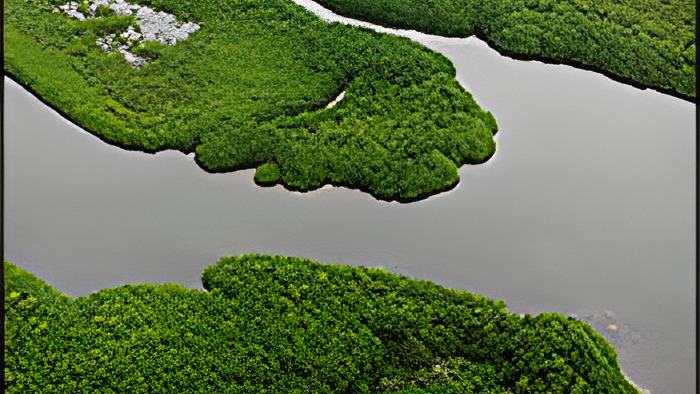
And switching now to environmental news… The plane ride from Belize City to San Pedro Town is about 15 minutes. Then, it's approximately another 40 minutes to get to the Bacalar Chico Marine Reserve. But once you're there, the golf cart clatter of the town recedes into a deep background, and you're transported to an untouched natural environment. Lush greenery ensconces a lagoon at the tip of the island, and mangroves form a natural arch over the channel that separates Belize and Mexico.
It's the type of view tourists travel miles and spend thousands in hard currency to see - and we've got it only about an hour away from the most populated part of the country.
But conservationists say that could all change if the area sees the development of a road and a bridge that will connect Ambergris Caye to Xclak, Mexico.
It's an investment plan that the PM first floated in Mexico to encourage more tourist traffic to Ambergris Caye. But, environmentalists warn that it could disrupt this fragile ecosystem.
Yesterday, we went into the marine reserve and showed you the area that's under threat. Today, we'll show you the journey to get there and the animals that call it home - wildlife that could face displacement. Courtney Menzies has this story.
A journey to the Bacalar Chico Marine Reserve usually begins within San Pedro Town, so we headed out on a flight to the island.
And once we got there, our guide, Pawny Arceo, was ready with the 25 foot lanchon to take us out to sea.
It's a trip he's made in the rain and sunshine, but yesterday, the grey clouds blotted out the sun for a skyline the color of slate, while the sea was as black as a bible.
The rain pelted us like hail, and we were forced to take cover under this tarp that the wind whipped about.
But once we arrived, though it was still raining, the tranquility of the area - populated only by wildlife - made us better appreciate the journey.
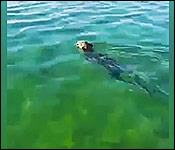
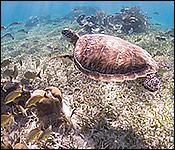
And it is here in this reserve that many types of wildlife call home - jaguars, turtles, manatees, and more.
But it is also here that the prime minister has proposed a mega-project, which could turn this pristine and preserve's greenery into a road and a bridge connecting Ambergris Caye and Mexico.
And for conversationists, it's a nightmare, since Belize's barrier reef was recently taken off the World Heritage Site endanger list.

Nadia Bood, Reef Scientist, WWF
"For one thing it's a national park, it's a marine protected area, and it's world heritage site so any kind of development will compromise the system, the health of the system. Putting a road within a national park and a marine reserve that is a world heritage site can potential impact the integrity of the area."
"There will be some level of loss of vegetation because of the clearance that that road would cause so you can have loss of mangrove eco system, another interconnected wetland areas there that are very important for many different species. You can also have potential pollutants and sedimentation that can come with the construction of a road in such a sensitive location and the sedimentation and erosion in that area, those sediments can be carried to the marine environment killing off the grass beds, impacting the reef eco system in that area."
"You'll be displacing very important species to that area, as you mentioned, manatees are using the mangrove channels are nursing area, as feeding grounds, as habitat. We have other species that come and feed in that area, they come and quench their thirst, drink in those areas. Just recently about a year ago, jaguars were found swimming in those areas. So they're very important habitat for wildlife and for people because they offer very good flood control as well."
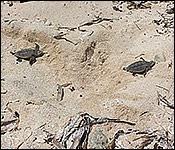
And the World Wildlife Fund was key partners in addressing the areas of concern to get the reef off the endangered list. And this point was also brought up by Miguel Alamilla, who developed the Ambergris Caye Marine Turtle Program back in 2010. He's spent years monitoring the three protected species of turtles that nest in that area - the loggerhead, the green, and the hawksbill turtles.
And before he left the program in 2018, he was seeing 90-95 nesting areas for turtles during the season at both Robles and Rocky Point, but all that will be put at risk if this project goes into development.

Miguel Alamilla, Former Member, Ambergris Caye Marine Turtle Program
"The nesting beaches within the Marine Reserve, because the turtles are nesting within that 66 foot high tide, beyond high tide line on the beach dunes, on the sand dunes and. Where are you going to put the road?"
"Are you going to place your road within the national park? Or are you going to place it within the beach dunes, which is the Marine Reserve, which is the public land, you know?"
"Right now, we're seeing a lot of problems with the little roads there because I think the road stops like about five miles before you get to Robles in within the Bacalar Marine Reserve. And we are seeing a lot of human impacts in the nesting beach of Robles and Rocky Point. People are going with golf carts, they're driving on top of the sand dunes. We have seen golf carts, You know, of beachgoers on top of Nest's, golf cart tracks, you know, just riding everywhere on the beach."
"And it's a challenge. It's a big challenge, given that we don't have major developments there. Now, let's say we build a road and we expand our tourism development to north Ambergris Caye, the human impacts would be a lot greater and would impact our nesting beach a lot more."
And this impact could be detrimental for the turtles, especially that hawksbill, which is critically endangered. Not to mention the other types of protected species in the marine reserve.
And like Bood pointed, once that is gone, it can affect our great foreign exchange earner.
Nadia Bood, Reef Scientist, WWF
"It will essentially be contrary to what we're saying because we're saying that we are a nature based country, that we want to prioritize the natural eco system, that these natural eco systems are nature based solutions for climate change. we are destroying the same thing that we are trying to map ourselves on and the same thing we are benefitting from economically."
Both Bood and Alamilla underscored that the government's Blue Bond is predicated on marine conservation
Bood also proposed that rather than a road, there can be ferries like the ones that travel from Chetumal to San Pedro - except these ferries can start somewhere closer, like Xcalak Village.