
Another group of Belizeans is gearing up for a fight with the Briceno Administration; this time it's the Mayan communities from Southern Belize. They are expressing their outrage at the latest decision by the government to move forward in the implementation of Maya Customary Land Rights, which was confirmed by the Caribbean Court of Justice in their 2015 Consent Order.
Fast forward to 2022 and it's still not implemented - and a major stumbling block has been the agreement on the FPIC - known as the Free, Prior, and Informed Consent Protocol.
A press release from the government yesterday says, quote, "Cabinet approved the Free Prior Informed Consent (FPIC) Protocol that will guide consultations with Maya communities, whether by government or private entities, in keeping with government's commitment to the implementation of the 2015 Consent Order of the Caribbean Court of Justice." End quote.
This FPIC Protocol has attracted a lot of attention because it is basically the rule book that the two sides must agree on. It will govern all future interactions between GOB and the Maya when it comes to the entry into - and exploitation of the natural resources on - what will eventually be recognized as Maya communal lands.
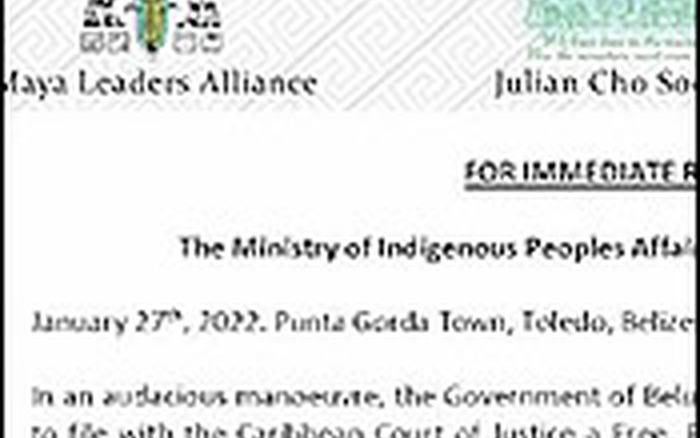
In a strongly-worded, joint press release, the Maya Leaders Alliance, the Toledo Alcaldes Association, and the Julian Cho Society accused the government of ambushing the Maya people.
Their statement says, quote, "...The Government of Belize has unilaterally finalized and proceeded to file with the Caribbean Court of Justice a Free, Prior, and Informed Consent Protocol. The Appellants (the Maya Leaders Alliance and the Toledo Alcaldes Association) make clear: that no agreement has been reached between the Parties on the FPIC Protocol as is required by the implementation process... That the Government of Belize, in particular the Office of the Commissioner in the Ministry of Indigenous Affairs, did not consult or seek agreement on its revisions to the filed Protocol,...[and] that, without any notice whatsoever to the Appellants, the Protocol purports to come into effect upon filing with the CCJ." End quote.
This morning, the MLA and the TAA hosted a virtual press conference to amplify a few of their biggest complaints against this current draft of the FPIC Protocol that the Briceno Administration has endorsed.
Here are a few excerpts from that 70-minute conversation:
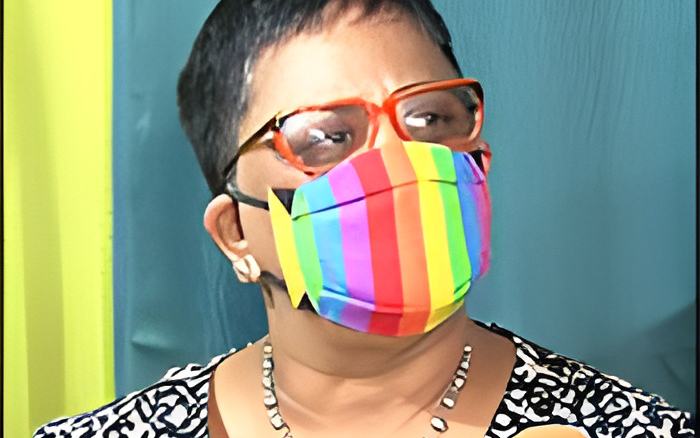
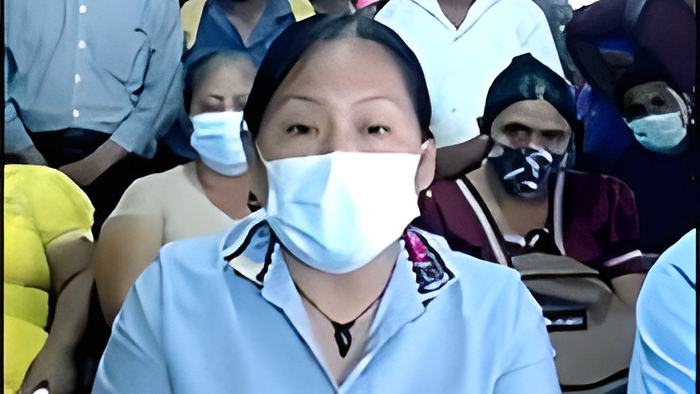
Cristina Coc
"You controlled your own life, your own wellbeing, your own property, then anyone wanting to do something on your land must seek your free prior informed consent - approval. Consent is what is being sought. That should be the end result of consultation, but the Maya people can also decide not to give consent if they decide that that is going to be something that's not right or in the best interest of their communities."
"After the CCJ consent order was passed, the government signed an agreement with our people on a way forward for the implementation of this great judgement, a road map. This included a need to develop a free prior informed consent protocol, which would later become a part of the Maya land law that will protect our rights. This protocol is to guide the government and all proponents on how to engage with the Maya and their lands. Now in the latest manoeuvre of the government, the government of Belize has unilaterally finalized and proceeded to file with the Caribbean Court of Justice a free prior informed consent protocol that was never consulted or agreed upon by the Maya people. This shows the power imbalances that exists in this country where the government behaves as if they don't have to listen to anybody, that they can deny and continue to ignore the already recognized rights of the Maya people."
As you heard, they take exception to the interchangeable use of the words "consent", which they insist the 2015 judgment mandates, and "consultation", which is a lower threshold of responsibility on the government. Here's how Cristina Coc explained the grievance with the wording the Protocol:
Cristina Coc
"Its not a very long document, but every word has a meaning and we have to carefully review each and every change that was made and already we can see that just as an example, they have emphasized the use of consultation. In fact they changed the name of the protocol to call it a consultation protocol, not a consent protocol even after the courts admonish them that word have meaning and that is has an impression and that you can't use ambiguous terms especially if it is a principle that will guide a process. Ultimately consent is what should be sought, not just consultation. You can't just come talk to us and tell us what you are going to do on our lands. You have to come with the understanding that you are coming to ask for our permission, our approval and we set the conditions for those, if we decide to give it. So, it is important for us to highlight that there are already red flags that we've seen."