
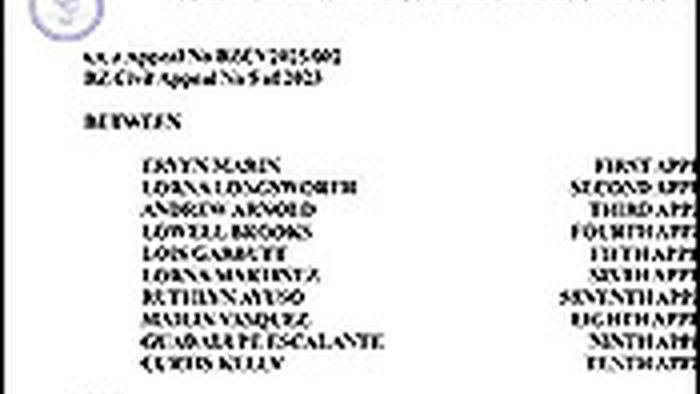
Tonight, BTL is facing a nearly half a million dollar payout to ten former employees. They left the company years ago through resignation, voluntarily retirement or agreed retirement age of 55. And they all and got the company's pension benefits. In the mid 90s, BTL was advised that because they had introduced a pension scheme, they no longer needed to pay employees severance.
But, the labour law promises employees severance - so were they entitled to that as well? They argued that they were and the case went to the Supreme Court, the Court of Appeal and finally the CCJ.
The decision was handed down today and it was emphatically in their favour - and it could have a meaningful and costly impact on companies with pension schemes. Eamon Courtenay explained via Zoom:
Eamon Courtenay, SC, Attorney - Retired BTL Employees
"And today the CCJ ruled that all the employees, those who resigned, those who retired voluntarily, and those who reached the retirement age were all entitled to severance as well as pension."
Reporter
"What precedent does this ruling set for other employers who have transitioned from severance schemes to pension plans?"

Eamon Courtenay, SC, Attorney - Retired BTL Employees
"Well, I think the first point is that a pension plan cannot displace severance."
"If you move to a pension scheme, the pension scheme must also account for the severance benefits that an employee is entitled to."
"The CCJ has said emphatically that you cannot deny an employee severance. You either have two things: severance plus pension or the pension must be designed in such a way that severance continues to accrue on a non-contributory basis as a portion of the pension benefit. And then the pension portion is or could be on a contributory basis. But both must be accruing at the same time."
"In the case of BTL, these employees have all left their employment. They will now get, BTL will have to pay them the severance portion that they did not receive."
"The more fundamental challenge that BTL faces are its existing employees who are participating in the pension scheme. But that pension scheme does not include an aspect or an element of severance. They will now have to reach back and look at all their existing employees and say, well, you are with us for ten years, 15, 20, 25 years, whatever the case may be, and calculate how much severance those people will be entitled to when they retire or resign."
"If you have a pension scheme that does not accrue severance and you have employees employed, you need to start accruing for it from the time of the employment of each employee. If employees have left, they are entitled to come to the company and say, we now see this CCJ judgment - when I left, I only got the pension benefit. I want my severance benefit to be paid to me now."
And so how much will that now cost BTL? Well, for those case, a few hundred thousand, but others are in the works:
Eamon Courtenay, SC, Attorney - Retired BTL Employees
"In this particular case, I think the figure is about 300,000 to 400,000. So it's a significant amount that they are carrying in terms of a contingent liability. And this was well, I mean, after we started the case, I can say, you know, without disclosing any details, that we also have started to represent another host of employees who, in order to preserve any question of, statute of limitations applying, we filed, but we agreed with BTL to just hold the case and await the outcome of this judgment. So those employees will have the benefit of the judgment. And I'm sure that there are other employees of BTL who have left without getting their severance. And it may apply to other companies."
Jules Vasquez
"Is it an interesting judgment from the dimension of the justices mentioned, social justice. Is it an, a pro worker interpretation of, section 15 of the labor law?"
Eamon Courtenay, SC, Attorney - Retired BTL Employees
"WellI think it's, a, first of all, I think is a correct interpretation, remember - And we made submissions on this in the case - a lot of the labor law was introduced throughout the Commonwealth over 100 years ago to try to rectify the imbalance between the employer and employee. Employers traditionally used to take advantage of employees. And so the legislation brought in by the Labor Act is remedial and it is an attempt to do some social engineering."
"And I think Justice Jamodar focuseD on that in his judgment and saying that when you're interpreting this type of legislation, you have to understand that it is seeking to achieve a social objective. It is seeking to right wrongs. It is seeking to create balance between employer and employee, and therefore the approach of a court to. It must always lean towards the employee."